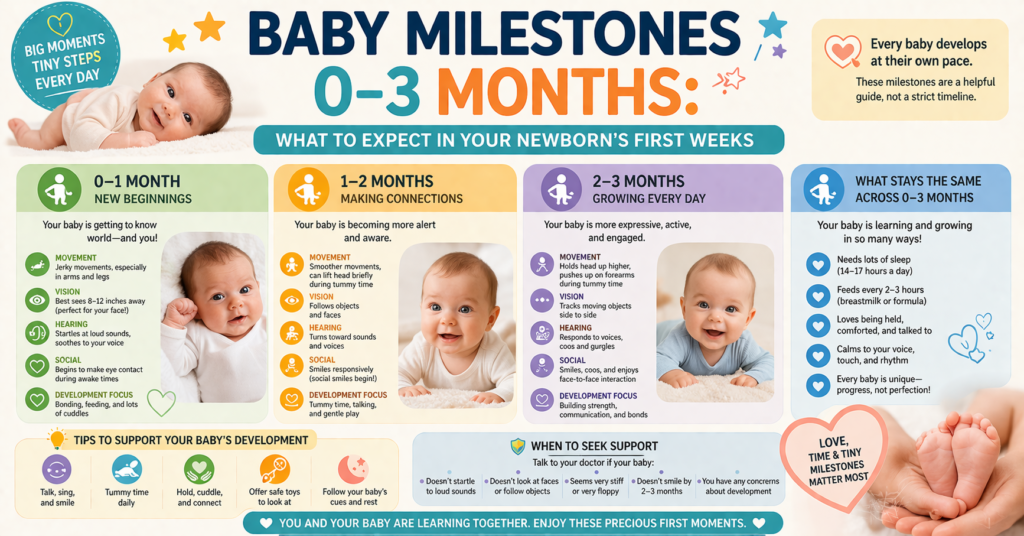
The first three months of life are extraordinary. In just twelve weeks, a newborn transforms from a creature of pure reflex and survival instinct into a social, curious little person who smiles, coos, and tracks your face across the room. Understanding 0–3 month baby milestones can help you know what to look for, what to celebrate, and when it might be worth checking in with a professional.
These early milestones are not a pass-or-fail checklist. They describe what most babies can do within a range of ages — and there is genuine variation in the pace and order of development, even in healthy, typically developing newborns. What matters is the overall picture: is your baby making progress, responding to the world around them, and connecting with the people who care for them?
This guide covers all five key areas of development in the 0–3 month window, signs that may suggest a baby would benefit from professional support, and how allied health can help in these very early weeks.
Gross motor milestones at 0–3 months
In the first weeks of life, a newborn’s movements are largely driven by primitive reflexes — automatic, involuntary responses that are present at birth and gradually integrate as the nervous system matures. Over the first three months, these reflexes begin to give way to more intentional, controlled movement as the brain develops rapidly.
At this age, most babies may:
- Turn their head from side to side when lying on their back or tummy
- Lift their head briefly during tummy time — usually a few seconds at first, gradually increasing
- Move their arms and legs in symmetrical, jerky bursts
- Show a grasp reflex — automatically closing the fingers when something touches the palm
- Show a rooting reflex — turning toward touch on the cheek, which supports feeding
- Display a stepping reflex — making stepping movements when held upright with feet touching a surface (this reflex fades around 2 months)
- Begin to bring their hands toward their face and mouth
Tummy time is important from the very first weeks. Even brief periods of supervised tummy time while awake — starting with just a minute or two on a firm surface — begin building the neck, shoulder, and core strength that underpins all future motor milestones. If your baby dislikes tummy time, try it on your chest while you recline, or use a rolled towel under their chest to make it easier.
Fine motor milestones at 0–3 months
Fine motor development in newborns is largely about the hands — how they move, open, and begin to engage with the world. In these early weeks, hand movements are mostly reflexive, but you’ll start to see the first signs of intentional use toward the end of this period.
At this age, most babies may:
- Keep their hands closed in tight fists much of the time
- Begin to open and close their hands more frequently as weeks pass
- Bring their hands to their face and mouth
- Grip a finger or object placed in their palm (grasp reflex)
- Begin to bat or swipe at objects near their face toward 2–3 months
- Briefly hold a lightweight rattle placed in their hand
You’ll notice that by around 8–10 weeks, the tight fisting gradually loosens and your baby’s hands begin to spend more time open — a sign that the grasp reflex is integrating and intentional hand use is beginning to emerge.
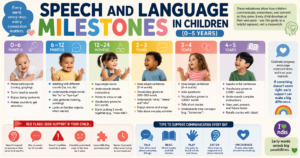
Speech and language milestones at 0–3 months
Babies are born communicators. Long before first words, they are using sound, expression, and movement to connect with caregivers — and caregivers are responding in ways that wire the developing brain for language. The “conversations” you have with your newborn in these early weeks are not just sweet moments. They are laying the neurological foundations for all future communication.
At this age, most babies may:
- Startle or still in response to sudden sounds
- Turn their head toward a familiar voice — especially a primary caregiver’s
- Calm when spoken to gently, even before being picked up
- Make small throaty sounds and begin cooing — soft, vowel-like sounds — from around 6–8 weeks
- Cry differently for different needs: hunger, discomfort, overtiredness each have a distinct quality that parents learn to distinguish over time
- Begin to pause and “respond” when a caregiver talks to them — the earliest form of conversational turn-taking
Talking to your newborn — even when it feels one-sided — is one of the most powerful things you can do for their language development. Use a warm, slightly higher-pitched tone (sometimes called “parentese”), talk about what you’re doing, and respond to their sounds as though they’ve said something meaningful. Because in their way, they have.
Concerned about your newborn’s development?
Our paediatric allied health team supports babies and families from birth. If something doesn’t feel right — or you just want peace of mind — we’re here to help you work it out early.
Social and emotional milestones at 0–3 months
From the very first days, newborns show a preference for human faces, voices, and connection. Social and emotional development begins at birth — and the quality of early attachment and interaction with caregivers shapes the developing brain in ways that last a lifetime.
At this age, most babies may:
- Show a preference for looking at faces over other objects
- Make eye contact and hold a caregiver’s gaze for increasingly long periods
- Produce their first genuine social smile, usually between 6 and 8 weeks — this is distinct from the earlier, reflexive smiles seen in sleep
- Begin to respond to smiles with smiles of their own
- Show calm and settling in response to a caregiver’s voice or touch
- Display different responses to familiar versus unfamiliar people by 2–3 months
- Begin to show early signs of emotional expression: pleasure, discomfort, and surprise
The first social smile — usually appearing around 6 weeks — is a milestone that many parents describe as a turning point. It signals that your baby recognises you and is choosing to connect. It is one of the first genuinely reciprocal social exchanges, and it matters enormously for the parent-child relationship as much as for the baby’s development.
Play, thinking and learning at 0–3 months
Newborns may seem passive to the outside observer, but their brains are working at an extraordinary pace. Every sensory experience — every face, sound, texture, and movement — is being processed and used to build the neural architecture that will support thinking and learning for the rest of their lives.
At this age, most babies may:
- Stare intently at faces, high-contrast patterns, and moving objects
- Track a slow-moving object horizontally with their eyes from early on, and vertically by around 3 months
- Show a preference for looking at faces, particularly eyes
- Respond to light and show interest in windows and light sources
- Begin to recognise familiar routines — settling differently when feeding time approaches
- Show early habituation — losing interest in a repeated stimulus and becoming alert again when something new is introduced (a sign of memory and attention)
Simple, unhurried interaction is the best “learning environment” for a newborn. Faces, voices, gentle movement, and calm exploration of the world around them are far more valuable at this age than any educational toy or screen.
Red flags to watch for at 0–3 months
The following signs don’t mean something is definitely wrong — but they do suggest your baby may benefit from a professional assessment. Raising concerns early gives the best opportunity for timely support.
Consider speaking with your GP or child health nurse if your baby:
- Doesn’t respond to loud sounds or voices by 1 month
- Doesn’t make eye contact or follow a face with their eyes by 6–8 weeks
- Hasn’t produced a social smile by 8 weeks
- Consistently holds their head to one side or has difficulty turning to one direction (this may suggest torticollis — a tightness in the neck muscles that responds well to early physiotherapy)
- Seems very floppy (low muscle tone) or very stiff (high muscle tone) in their limbs or trunk
- Moves one side of the body noticeably more than the other
- Doesn’t make any sounds or vocalisations by 2 months
- Is very difficult to settle or seems to be in persistent discomfort
- Has significant difficulty with feeding — latching, sucking, or coordinating swallowing
Trust your instincts. You are with your baby more than anyone else — if something feels off, it’s always worth raising, even if you can’t quite put your finger on what it is.
How allied health can support your baby at 0–3 months
Allied health professionals work with babies from birth. Early intervention at this stage is highly effective — the newborn brain is at its most plastic and responsive to support in these first weeks and months.
Paediatric physiotherapy is commonly sought in this period for concerns including torticollis (head tilting to one side), plagiocephaly (flat head shape), low or high muscle tone, asymmetrical movement patterns, and delayed or limited head control. A physiotherapist can assess your baby’s movement, provide hands-on treatment, and give you specific tummy time and positioning strategies to use at home.
Occupational therapy at this age often focuses on feeding, sensory regulation, and positioning. If your baby is unsettled, difficult to console, or seems overwhelmed by sensory input, an OT can help identify what’s driving this and give you practical strategies. Find out how occupational therapy supports babies and young children.
Speech pathology in the newborn period most often addresses feeding difficulties — including difficulty latching, weak sucking, gagging, or coughing during feeds. Speech pathologists are also the right professional if your baby is not making sounds or responding to voices in the expected way.
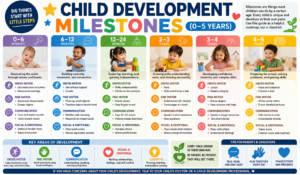
For a full picture of what to expect across the first five years, visit our complete child development milestones guide, which covers every age band from birth to school age.
Supporting your newborn’s development at home
The most important developmental environment for a newborn is a safe, warm, responsive relationship with their caregivers. There are no special programs or products needed. Here are the most evidence-supported things you can do in these early weeks:
- Respond consistently and warmly — meeting a baby’s needs promptly and sensitively builds secure attachment, which is the single most important foundation for social, emotional, and cognitive development.
- Do tummy time daily — even a few minutes several times a day from the first weeks makes a real difference to neck and shoulder strength. Always supervised, always while awake.
- Talk and sing — narrate your day, describe what they’re looking at, use a warm tone. It doesn’t matter what you say — what matters is the back-and-forth quality of the interaction.
- Make eye contact — face-to-face interaction is the most powerful social and cognitive stimulus available to a newborn. Get close, make eye contact, and let them look at your face as long as they want to.
- Follow their cues — when your baby looks away, arches, or becomes fussy, they’re telling you they need a break from stimulation. Respecting these signals helps them develop self-regulation over time.
- Skin-to-skin contact — particularly valuable in the first weeks, skin-to-skin time regulates temperature, heart rate, and stress hormones, and strengthens the attachment bond.
Not sure if your newborn needs support?
Our paediatric speech pathologists, occupational therapists, and physiotherapists work with babies and families across Australia – from the very first weeks of life. Whether you have a specific concern or just want a developmental check-in, we’re here to help.