The 4–6 month window is one of the most joyful stages of early development. Your baby is becoming more physically capable, more vocal, and more socially engaged — and they are starting to show you who they really are. Understanding 4–6 month baby milestones can help you know what to expect, what to celebrate, and when it might be worth checking in with a professional.
As always, milestones describe a range — not a single point. Some babies will reach these skills earlier, some a little later. What matters most is the overall direction of progress. This guide walks through each key area of development at this age, flags signs that may suggest extra support would help, and explains how allied health professionals can assist.
Gross motor milestones at 4–6 months
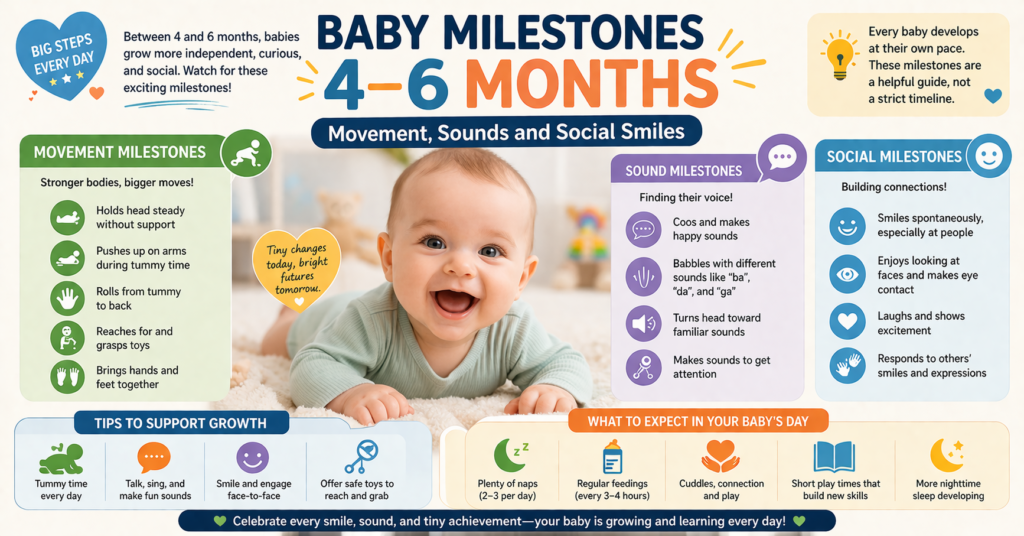
Between four and six months, babies make significant gains in head and trunk control, rolling, and the early foundations of sitting. Tummy time — which can feel like a battle in the early weeks — often becomes much more manageable now that babies have the strength to push up and look around.
At this age, most babies may:
- Hold their head steady and upright without support
- Push up onto their forearms — and sometimes their hands — during tummy time
- Roll from tummy to back (usually 4–5 months) and begin rolling back to tummy (usually 5–6 months)
- Sit with support from a caregiver or propped by cushions
- Bear some weight through their legs when held in a standing position, and bounce with enjoyment
- Bring their feet to their mouth to explore
Tummy time is the engine behind many of these gross motor gains. Aim for short, frequent sessions on a firm surface throughout the day — even 3–5 minutes several times daily adds up to meaningful strengthening. Get down on their level, use a rolled towel under their chest for support, or place an interesting object just within reach to encourage lifting and reaching.
Fine motor milestones at 4–6 months
Hands become fascinating objects of exploration at this age. Babies begin to use them with real intention — reaching, grasping, and bringing everything they can find to their mouth.
At this age, most babies may:
- Reach deliberately for objects within their range
- Grasp toys and objects with a whole-hand grip
- Transfer objects from one hand to the other (more common toward 6 months)
- Bring objects directly to their mouth to explore
- Rake objects toward themselves on a flat surface
- Hold and shake a rattle or toy with visible enjoyment
Offering a variety of objects with different textures, weights, and shapes supports this exploratory hand development. Soft toys, rings, and rattles that are easy to grip are ideal at this stage.
Speech and language milestones at 4–6 months
Communication is becoming genuinely two-way now. Babies at this age are vocal, responsive, and clearly interested in interaction — the early foundations of conversation are well underway.
At this age, most babies may:
- Babble with repeated syllable sounds — “ba-ba”, “da-da”, “ma-ma” — without specific meaning yet
- Laugh out loud and squeal with enjoyment
- Make different sounds to express pleasure, excitement, and discomfort
- Respond differently to warm, playful voices versus firm, serious ones
- Turn toward a sound or voice from across the room
- Begin to take turns in “conversations” — vocalising, pausing, and waiting for a response
Talking to your baby throughout the day is one of the most impactful things you can do for their language development. Narrate what you’re doing, describe what they’re looking at, respond to their sounds as if they’ve said something meaningful — because, in their way, they have.
Wondering if your baby’s development is on track?
Our paediatric allied health team supports babies and families from birth. Whether you have a specific concern or just want a developmental check-in, we’re here to help you feel confident about your baby’s progress.
Social and emotional milestones at 4–6 months
Four to six months is when many parents feel like their baby truly “arrives” as a social being. The smiles, laughs, and expressive faces of this stage are among the most memorable moments of early parenthood.
At this age, most babies may:
- Smile broadly and readily at familiar faces
- Laugh in response to playful interaction — tickling, funny sounds, peek-a-boo
- Show excitement through kicking, arm waving, and vocalising when they see a familiar person
- Begin to show a preference for familiar caregivers over strangers
- Enjoy extended face-to-face interaction and become distressed if it suddenly stops
- Mirror facial expressions — stick out your tongue and they may copy you
This is also the beginning of social referencing — babies looking to caregivers’ faces to gauge how to respond to something new. Your calm, curious expressions in new situations tell your baby that the world is a safe place to explore.
Play, thinking and learning at 4–6 months
Babies at this age are natural scientists — endlessly curious, experimenting with cause and effect, and beginning to understand that objects and people persist even when out of sight.
At this age, most babies may:
- Track a moving object smoothly across their field of vision
- Show interest in new objects, reaching and grasping to explore them
- Look toward a dropped toy — early understanding that things continue to exist
- Enjoy looking at themselves in a mirror
- Respond with visible excitement to familiar routines (bath time, feeding, a favourite song)
- Begin to distinguish between familiar and unfamiliar people and objects
Red flags to watch for at 4–6 months
The following signs don’t mean something is definitely wrong — but they do suggest your baby may benefit from a professional assessment. Earlier support consistently leads to better outcomes, so if you notice any of these, it’s always worth raising with your GP or child health nurse.
Consider seeking a professional opinion if your baby:
- Doesn’t hold their head steady by 4–5 months
- Doesn’t roll in either direction by 6 months
- Doesn’t reach for or grasp objects by 5–6 months
- Isn’t babbling or making varied sounds
- Doesn’t laugh or smile at familiar people
- Doesn’t respond to sounds or voices
- Seems very stiff or very floppy in their body
- Moves one side of their body noticeably more than the other
- Shows no interest in faces or interaction
Trust your instincts. You know your baby best — if something feels off, it’s always worth asking.
How allied health can support your baby at 4–6 months
Several allied health professionals work with babies at this age, depending on the area of concern.
Paediatric physiotherapy is well-suited to gross motor concerns at this stage — including limited head control, asymmetrical movement, poor tummy time tolerance, delayed rolling, or concerns about muscle tone. Physiotherapists can also provide tailored tummy time strategies and positioning advice for parents.
Occupational therapy can support babies with sensory sensitivities, feeding difficulties, or concerns about reaching, grasping, and hand exploration. OTs also work with families on positioning, play environment setup, and daily routines. If your baby seems uncomfortable or irritable in a way that’s hard to explain, an OT assessment can help identify sensory factors that may be contributing. Learn more about how occupational therapy supports early development.
Speech pathology at this age focuses on communication foundations — sound-making, responsiveness to voices, early turn-taking, and feeding. If your baby is not vocalising, not responding to sounds, or is having difficulty with bottle or breastfeeding, a speech pathology assessment is a helpful next step.
For a broader overview of what to expect across all of early childhood, visit our complete child development milestones guide.
Supporting your 4–6 month old at home
The most powerful developmental environment for your baby is everyday life with you. Here are some simple, evidence-based ways to support development across all areas during this stage:
- Keep up tummy time — short, frequent sessions on a firm, flat surface help build the strength needed for rolling, sitting, and crawling. Make it fun by getting down with your baby and using toys or mirrors to encourage lifting and reaching.
- Talk, sing, and narrate — your voice is your baby’s most important language input. Comment on what they’re looking at, respond to their babbles, sing the same songs repeatedly. Repetition is how language is learned.
- Offer a variety of safe objects to explore — different textures, shapes, and weights engage the hands and build early fine motor and sensory processing skills.
- Play face-to-face games — peek-a-boo, pulling funny faces, mirroring their expressions — these simple interactions build social-emotional development and the neural foundations for communication.
- Follow their lead — when your baby looks away or seems to switch off, they’re regulating their level of stimulation. Respecting these signals helps them develop healthy self-regulation over time.
Not sure if your baby needs support?
Our paediatric speech pathologists, occupational therapists, and physiotherapists work with babies and families across Darwin and the NT. If something doesn’t feel right — or you just want peace of mind — we’re here to help you work it out.