Reading time: 10 minutes | Updated: April 2026 | Written by: TEAH Allied Health Team
If you have an NDIS plan — or you are helping someone navigate one — understanding how the NDIS funds occupational therapy is essential. OT is one of the most widely used and most impactful supports in the scheme, but it is also one of the most misunderstood when it comes to which budget line pays for what, how to check if you have enough funding, and what to do if you need more.
This guide covers everything you need to know about NDIS OT funding in 2025–26: the relevant budget categories, the current pricing, what is and is not funded, how to access OT with different plan management types, and what to do if your current plan does not include enough to meet your needs.
In this article
- Which NDIS budget funds OT?
- Capacity Building — Improved Daily Living explained
- Capital Supports — when OT connects to equipment and home mods
- NDIS OT pricing in 2025–26
- What OT services does the NDIS fund?
- What the NDIS does not fund
- Agency, plan-managed, and self-managed — how your plan type affects OT access
- How to check if you have OT funding in your plan
- What if you don’t have enough OT funding?
- Frequently asked questions
Which NDIS Budget Funds OT?
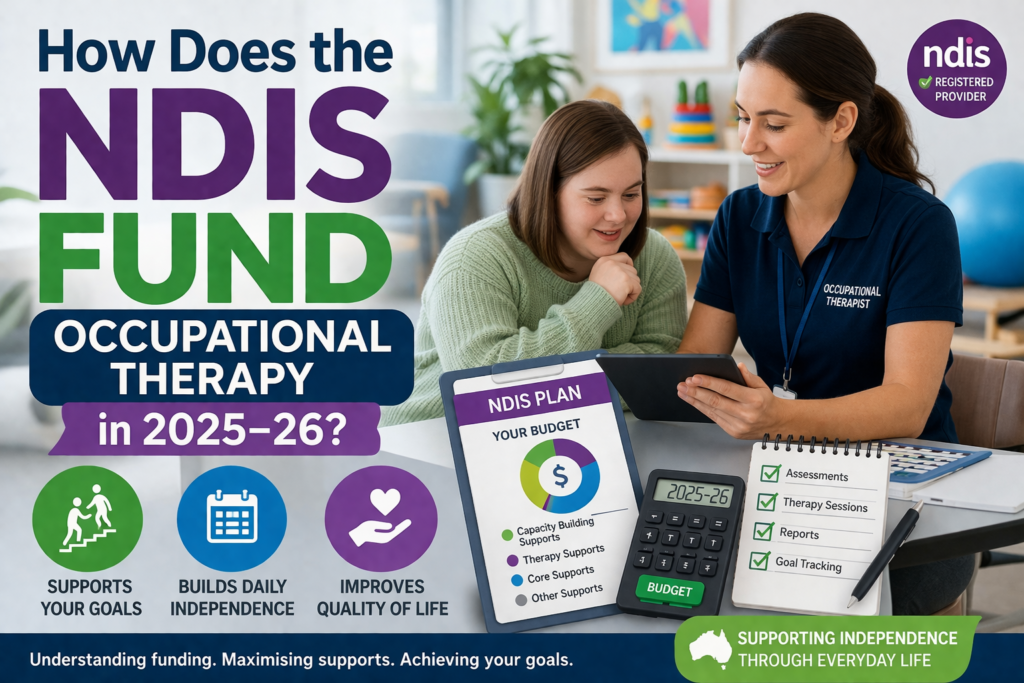
Your NDIS plan is divided into three broad budget categories: Core Supports, Capital Supports, and Capacity Building Supports. Occupational therapy sits primarily within Capacity Building — specifically the Improved Daily Living subcategory. However, OT-related activity also appears in Capital Supports when it involves assistive technology or home modifications.
Understanding which budget is which matters because the NDIS treats them differently. Core Supports are flexible and can be moved between subcategories. Capital Supports are earmarked for specific items. Capacity Building funds are allocated by subcategory — you cannot generally shift Improved Daily Living funding across to other Capacity Building subcategories.
Core Supports
Everyday support — personal care, community access, transport. OT therapy sessions are not funded here, but some OT-adjacent supports may be.
Capacity Building ★
Primary OT funding source. Improved Daily Living subcategory funds assessments, therapy sessions, reports, and training.
Capital Supports
One-off items. OT assessment costs for AT and home mods may be claimable here depending on the context.
Capacity Building — Improved Daily Living Explained
The Capacity Building — Improved Daily Living subcategory (support purpose code 15) is the primary mechanism through which the NDIS funds occupational therapy. Its stated purpose is to fund assessment, training, or therapy that helps a participant build skills, increase independence, and participate more fully in their daily life and community.
This broad mandate covers a wide range of OT activity — from a single functional assessment to an ongoing therapy program spanning many months. The NDIA’s expectation is that Capacity Building supports are an investment in the participant’s future independence, not simply an ongoing service. In practice, however, many NDIS participants receive both short-term, goal-directed therapy and ongoing maintenance support through this budget.
What Improved Daily Living funds for OT
| OT service | NDIS support item | Funded from IDL? |
|---|---|---|
| Functional Capacity Assessment (FCA) | Assessment of Capacity for Informal Support | ✓ Yes |
| Individual therapy sessions | Individual Therapy | ✓ Yes |
| Group therapy sessions | Group-Based Therapy | ✓ Yes |
| NDIS report writing | Report Writing / Non-Face-to-Face Support | ✓ Yes |
| SIL / SDA assessment & report | Assessment of Capacity | ✓ Yes |
| Home modification assessment & report | Non-Face-to-Face Support Provision | ✓ Yes |
| AT assessment, trial & prescription | Assessment Recommendation Therapy or Training | ✓ Yes |
| Support worker training by OT | Training in Self-Management & Workplace | ✓ Yes |
| Travel to participant’s home or community | Provider Travel | ✓ Yes (conditions apply)* |
*Provider travel was subject to NDIS pricing changes in 2025. Confirm current travel claim rules with your OT provider. Travel may be billed at 50% of the applicable hourly rate per kilometre beyond a threshold distance.
Capital Supports — When OT Connects to Equipment and Home Mods
While the OT’s professional time is funded through Capacity Building — Improved Daily Living, the equipment and building works the OT recommends are funded from a completely different part of the plan: Capital Supports.
Capital Supports has two subcategories relevant to OT:
- Capital — Assistive Technology: Funds the physical equipment — wheelchairs, hoists, communication devices, adjustable beds, smart home systems. The OT writes the prescription; the AT budget pays for the item.
- Capital — Home Modifications: Funds the structural building works — ramps, widened doorways, roll-in showers, ceiling hoist tracks. The OT writes the report and specifications; the home modification budget pays for the builder.
The split that confuses many participants and coordinators: The OT’s assessment and report for an AT prescription or home modification is funded from Capacity Building — Improved Daily Living. The actual equipment or building work is funded from Capital Supports. Both budgets must be present in your plan to complete the process. If your plan has Capital Supports but no Improved Daily Living funding, the OT cannot be paid for writing the report that unlocks that capital.
NDIS OT Pricing in 2025–26
The NDIA publishes a Pricing Arrangements and Price Limits (PAPL) document each financial year that sets the maximum rates providers can charge for all NDIS-funded supports. Providers may charge at or below these limits — they cannot exceed them for registered NDIS services.
For occupational therapy in 2025–26, the key rates are:
2025–26 NDIS Occupational Therapy Rate Schedule
| Service type | Weekday rate | Saturday | Sunday / Public holiday |
|---|---|---|---|
| OT individual therapy (per hour) | $193.99 | $242.49 | $290.99 |
| OT assessment & report (per hour) | $193.99 | $242.49 | $290.99 |
| Non-face-to-face (report writing, planning) | $193.99 | N/A | N/A |
| OT group therapy (per person, per hour) | $97.00 (approx.) | Varies | Varies |
| Provider travel (per km, beyond threshold) | 50% of hourly rate | Per PAPL | Per PAPL |
Rates reflect the 2025–26 NDIS Pricing Arrangements and Price Limits (PAPL). Group therapy rates are calculated per the NDIA’s group billing methodology. Always check the current PAPL at ndis.gov.au for the definitive rates.
What these rates mean in practice
To give you a sense of how quickly OT funding is used, here are typical cost estimates for common OT engagements at 2025–26 rates:
| OT engagement | Typical OT hours | Estimated cost |
|---|---|---|
| Standard FCA + report | 8–12 hrs | $1,552–$2,328 |
| Home modification assessment + report | 2–4 hrs | $388–$776 |
| AT assessment + trial + report | 6–16 hrs | $1,164–$3,104 |
| SIL/SDA assessment + report | 10–20 hrs | $1,940–$3,880 |
| Ongoing therapy program (12 weeks, weekly 1hr) | 12 hrs | ~$2,328 |
Context on 2025–26 OT pricing: The NDIS OT rate has been frozen or minimally adjusted for seven consecutive years despite rising operational costs. The 2025–26 pricing review also reduced travel claim entitlements for mobile OT providers. This has placed significant financial pressure on smaller allied health providers in regional and remote areas — which is directly relevant to participants in Darwin and regional NT, where mobile OT delivery is essential.
What OT Services Does the NDIS Fund?
The NDIS can fund a broad range of OT services — but only where they are related to your disability, represent reasonable and necessary supports, and are aligned with your NDIS goals. Here is a practical overview:
Assessments
All forms of OT assessment are fundable under Improved Daily Living, including Functional Capacity Assessments, home modification assessments, assistive technology assessments, SIL and SDA assessments, cognitive assessments, sensory processing assessments, and driving assessments (where relevant).
Therapy
Goal-directed OT therapy programs are fundable — for example, fine motor skill development for a child with cerebral palsy, daily living skill training for someone transitioning to independent living, cognitive rehabilitation following a brain injury, or sensory processing intervention for a participant with ASD. Therapy must be linked to specific NDIS goals and demonstrate capacity-building intent rather than simple maintenance.
Report writing and non-face-to-face work
The NDIA allows providers to claim for report writing, case coordination, clinical documentation, and communication with other providers — within reason. This is significant because OT reports are often substantial documents, and the time required to write them is a legitimate clinical cost. Your OT should itemise non-face-to-face time transparently on their invoices.
Training of support workers and carers
An OT can be funded to train your support workers or family members in manual handling, safe use of assistive equipment, sensory strategies, communication approaches, or other techniques relevant to your care. This is a valuable and underused part of the funding framework.
Telehealth OT
Telehealth OT — delivered via video call — is fundable under Improved Daily Living at the same rates as in-person therapy for eligible service types. Not all OT services can be delivered effectively via telehealth (in-home assessments and equipment trials, for example, require physical presence), but therapy sessions, goal-setting consultations, and some cognitive assessments can be delivered remotely.
What the NDIS Does Not Fund
Understanding the boundaries of OT funding prevents surprises and helps you plan your budget realistically. The NDIS does not fund:
- OT services unrelated to your disability. If your condition is age-related, managed through another health system (such as a chronic disease managed through Medicare), or not listed as an NDIS disability, those services are not fundable through the scheme.
- General health and wellbeing OT. Exercise programs, wellness coaching, and general fitness support are not fundable unless directly linked to a specific disability-related functional goal.
- Day-to-day activities that anyone would need to do. The NDIS does not fund support for ordinary living costs — even if your OT frames them as therapeutic. Cooking a meal is not an NDIS-fundable activity unless you are building a specific, measurable capacity that is genuinely impaired by your disability.
- Private health extras claims. You cannot double-dip — if a service is funded through your NDIS plan, it cannot also be claimed through private health insurance for the same service.
- Support beyond reasonable and necessary. The NDIA assesses every support claim against whether it is reasonable and necessary. Excessive frequency, duration, or scope of OT services relative to identified clinical need can result in claims being disallowed or funding being reduced at plan review.
Agency, Plan-Managed, and Self-Managed – How Your Plan Type Affects OT Access
Your plan management type significantly affects which OT providers you can use and how the funding flow works. Here is a clear breakdown:
| Plan type | Which OT providers can I use? | How is the OT paid? | Price limit? |
|---|---|---|---|
| Agency managed | NDIS-registered providers only. You cannot use unregistered OTs with an agency-managed plan. | OT claims directly from the NDIA via the myplace portal. No invoicing required from the participant. | Yes — provider cannot charge above PAPL rate. |
| Plan managed | Registered or unregistered OTs. You have full choice of provider. | OT invoices your plan manager, who pays the OT and tracks your budget. | Yes — plan managers must stay within PAPL limits. |
| Self managed | Any OT, registered or not, at any agreed price. | OT invoices you directly. You pay and then claim reimbursement from the NDIA via the myplace portal. | No mandatory cap — but NDIA expects reasonable value for money. |
TEAH is a fully registered NDIS provider. We work with agency-managed, plan-managed, and self-managed participants across WA, NT, QLD, and VIC. Our intake team can help you identify the right funding lines before your referral is even confirmed.
How to Check If You Have OT Funding in Your Plan
Before making a referral for OT, it is worth confirming that your NDIS plan includes funding under Capacity Building — Improved Daily Living, and that there is sufficient budget remaining for the type of OT service you need. Here is how:
If you are agency managed
- Log in to the myNDIS participant portal at my.ndis.gov.au
- Navigate to My Plan and select the current plan
- Look for Capacity Building Supports and expand the subcategories
- Find Improved Daily Living – this shows your total allocation and remaining balance
If you are plan managed
Contact your plan manager directly and ask for the current balance in your Capacity Building – Improved Daily Living budget. Your plan manager has real-time visibility of your spending and can tell you exactly how much is available for OT.
If you are self managed
Check your plan document for the total Capacity Building – Improved Daily Living allocation, then subtract any invoices you have already paid from that budget. You are responsible for tracking your own spending.
What to check before your first OT appointment
- Is Improved Daily Living funding present in your plan?
- Is the balance sufficient for the type of OT service you need? (See our cost estimates above.)
- If you need AT or home modifications – is Capital Supports funding also present?
- When does your current plan expire? OT services started close to a plan expiry may not be completeable before funding rolls over.
What If You Don’t Have Enough OT Funding?
It is common for participants to find that their current plan does not include sufficient Improved Daily Living funding – particularly if their OT needs were not comprehensively documented at their last plan review, or if their disability or circumstances have changed since then.
If this is your situation, you have several options:
Option 1: Request a plan variation
A plan variation is an amendment to your current plan without a full review. You can request a variation if there has been a significant change in your circumstances — such as a new diagnosis, a deterioration in function, a change in living situation, or a clearly identified need that was not anticipated in the current plan. Your support coordinator can help you prepare the request and the supporting evidence.
Option 2: Raise it at your next plan review
If your OT need is not urgent, the most common path is to document it clearly in preparation for your next scheduled plan review. Bring an OT referral or, ideally, a completed OT report as supporting evidence. The more specific and clinically grounded the evidence, the more likely the NDIA is to include adequate Improved Daily Living funding in your new plan.
Option 3: Seek an unregistered OT and self-fund the gap
If you are self-managed or plan-managed and your funding is insufficient, you may choose to pay for some OT services privately to supplement your NDIS funding. This is less common and generally not recommended as a primary strategy — but it is an option where urgent clinical need exists.
Option 4: Ask your support coordinator to help
A skilled support coordinator will know how to navigate the NDIS planning process to advocate effectively for OT funding. If you don’t have a support coordinator but believe you need one, this is worth raising with the NDIA at your next contact.
NDIS Registered — WA · NT · QLD · VIC
Not sure if you have enough OT funding? Ask us.
TEAH’s intake team can check your plan, identify the right budget lines, and help you make the most of your Improved Daily Living funding – before your first appointment.
Frequently Asked Questions
Do I need a GP referral to access NDIS-funded OT?
No. You do not need a GP referral to access occupational therapy through the NDIS. As long as your plan includes Capacity Building – Improved Daily Living funding, you can self-refer directly to an OT provider. Call TEAH on 1300 203 059 or complete our online referral form to get started.
How many OT sessions does the NDIS fund?
The NDIS does not set a fixed number of sessions. The total amount of OT you can access is limited by the dollar value of your Improved Daily Living allocation. At the 2025–26 rate of $193.99 per hour, a $5,000 budget covers approximately 25 hours of OT time — enough for a standard FCA plus several therapy sessions. Your OT will work with you to make the most of your available funding.
Can I use my Core Supports budget for OT?
No. Occupational therapy services are funded under Capacity Building – Improved Daily Living, not Core Supports. Core Supports funds assistance with daily activities and community participation – it does not fund therapeutic or assessment services. If your plan has Core Supports but no Capacity Building allocation, you will need to raise this at your next plan review.
Can unspent OT funding roll over to my next plan?
Capacity Building funds — including Improved Daily Living — do not automatically roll over to your next plan if unused. Unlike Core Supports (which now roll over under certain conditions), unspent Capacity Building funds generally return to the NDIA at plan expiry. This makes it important to use your OT funding within the plan year rather than leaving it to accumulate.
What is the difference between Capacity Building and Core Supports in my NDIS plan?
Core Supports fund the everyday assistance you need to live your life — personal care, community access, consumables. Capacity Building funds invest in your future independence — therapy, assessments, skill development. Occupational therapy is firmly in the Capacity Building camp because it is designed to build your functional skills and reduce your dependence on Core Supports over time.
Can the NDIS fund OT for my child?
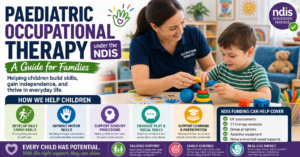
Yes. TEAH works with NDIS participants from age 7. OT for children is funded under the same Capacity Building — Improved Daily Living structure, and may also connect to the NDIS Early Childhood approach for children under 9. Common funded OT services for children include fine motor assessment and therapy, sensory processing intervention, school participation support, and daily living skills development.
How do I make the most of limited OT funding?
Prioritise assessments that unlock other funding — an FCA, AT assessment, or home modification report can each unlock significant Capital Supports funding that would otherwise be inaccessible. Work with your OT to identify which assessment is most time-sensitive given your plan review date, and schedule therapy for the highest-impact goals first. TEAH’s team can help you plan your OT program around your available budget.
Summary
NDIS OT funding is primarily accessed through Capacity Building — Improved Daily Living, at the 2025–26 rate of $193.99 per hour on weekdays. This budget covers the full range of OT services — assessments, therapy, reports, training, and non-face-to-face work. Equipment and building works recommended by the OT are funded separately through Capital Supports.
Understanding which budget pays for what, how your plan management type affects provider choice, and what to do when your current plan falls short gives you the confidence to navigate the system — and get the OT services your participant or yourself genuinely needs.
At TEAH, we make the funding conversation straightforward. Our intake team will check your plan before your first appointment, identify the right budget lines, and match you with the most appropriate OT for your needs.
Access NDIS-funded OT with TEAH
Darwin (NT) · Perth (WA) · Brisbane (QLD) · Victoria
Related articles
- What is a Functional Capacity Assessment and what does it include?
- What is an NDIS home modification assessment?
- Assistive technology assessments under the NDIS — a guide for participants
- SIL and SDA OT assessments — what support coordinators need to know
- Our Occupational Therapy Services — Darwin, Perth, Brisbane & Victoria
TEAH Allied Health Team
Top End Allied Health (TEAH) is an NDIS-registered allied health provider delivering occupational therapy, speech pathology, physiotherapy, and supported accommodation across WA, NT, QLD, and Victoria. Referrals: referrals@topendalliedhealth.com.au | 1300 203 059