Reading time: 11 minutes | Updated: April 2026 | Written by: TEAH Allied Health Team
Occupational therapy is one of the most widely used and most effective evidence-based supports for autistic people across the lifespan. From helping a four-year-old develop the sensory regulation strategies they need to manage a classroom, to supporting an autistic adult build the daily living routines that make independent living possible, OT works across the full range of ASD presentations and support needs.
Under the NDIS, autistic participants are among the largest and most actively supported groups — and OT is consistently among the most funded therapeutic supports in their plans. But navigating which OT services are available, what assessments are needed, and how to access funding can still be confusing for families, carers, and participants themselves.
This guide explains everything you need to know about occupational therapy for autism under the NDIS: what OTs actually do with autistic participants, which assessments are most useful, how NDIS funding works for ASD-related OT, and what to look for in an OT with genuine autism experience.
In this article
- What occupational therapy does for autistic people
- Key areas of OT support for ASD
- Sensory processing and OT — explained
- OT assessments for autism — what they involve
- OT for autistic children vs autistic adults
- How the NDIS funds OT for ASD
- What to look for in an OT with ASD experience
- Neurodiversity-affirming OT — why it matters
- Frequently asked questions
What Occupational Therapy Does for Autistic People
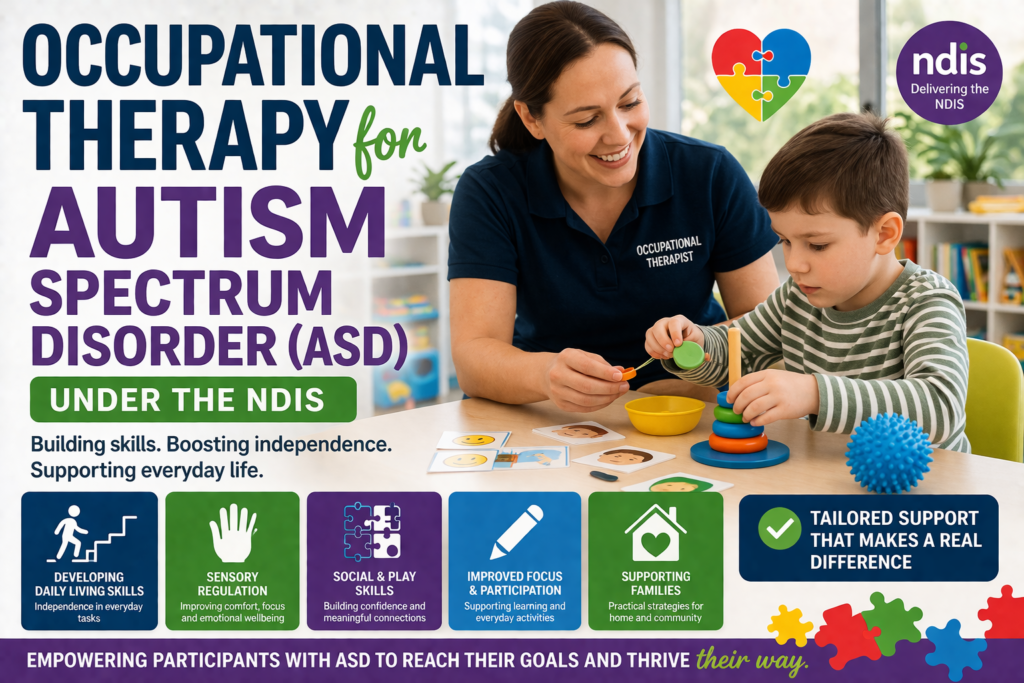
Occupational therapists work with autistic people to support participation in the everyday activities — or occupations — that matter most to them and their families. Rather than focusing on eliminating autistic traits, effective OT for autism focuses on building functional skills, developing coping and regulatory strategies, modifying environments, and providing the right tools to support independent and meaningful participation.
The scope of OT for autism is broad because autism affects people differently. For one autistic child, the priority might be developing the fine motor skills to write and use cutlery. For another, it might be building the sensory tolerance to wear school clothing and sit in a classroom. For an autistic adult, OT might focus on establishing daily routines for independent living, managing sensory aspects of the workplace, or accessing the right assistive technology to support communication and organisation.
No two autistic NDIS participants have identical OT needs. A paediatric OT working with a non-speaking seven-year-old with high support needs will use very different approaches, tools, and goals than an OT supporting an autistic adult in developing independent living skills before leaving home for the first time. Autism-experienced OTs adapt their practice to the individual — not to a diagnostic label.
Key Areas of OT Support for ASD
Occupational therapy for autistic NDIS participants typically addresses one or more of the following areas, depending on the individual’s goals, age, and support needs:
Sensory processing
Many autistic people experience differences in how they process sensory information – sounds, textures, lights, smells, taste, proprioception, and interoception. An OT can assess sensory processing differences, identify which sensory inputs are over- or under-responsive, and develop individualised strategies to support regulation and participation. Sensory diets, environmental modifications, and sensory integration therapy are common OT approaches.
Daily living skills
Getting dressed, preparing meals, managing personal hygiene, organising belongings, and managing money – these are the foundational tasks of daily life that many autistic people find challenging due to executive function differences, sensory sensitivities, or motor difficulties. OT provides structured, personalised skill-building in these areas, often using visual supports, task analysis, and graduated practice in real environments.
Fine and gross motor skills
Motor skill difficulties are common in ASD – including challenges with handwriting, using cutlery, buttoning clothing, catching and throwing, and coordinating movements. OTs assess motor development and deliver targeted intervention to build the motor capacities needed for school, work, and daily life participation.
Social participation and play
For children, play is the primary occupation – and occupational therapists work to support autistic children’s engagement in play that is meaningful, developmentally appropriate, and enjoyable. This includes developing play skills, supporting peer interaction where the child wants it, and building the sensory and motor foundations that make play more accessible.
School participation
Autistic students often face significant barriers to classroom participation – sensory challenges in the school environment, difficulties with fine motor tasks, challenges with transitions and routine changes, and sensory or regulatory needs that are not always accommodated. OTs conduct school-based assessments and work collaboratively with teachers to develop environmental modifications, sensory strategies, and skill-building programs that support learning.
Executive function and organisation
Executive function difficulties – including planning, sequencing, time management, task initiation, and flexible thinking – affect many autistic people significantly. OT addresses executive function through structured routines, visual supports, digital tools, and strategy coaching that builds practical capacity for managing daily life independently.
Transitions and life stage changes
Transitions, starting school, moving to high school, leaving home, entering the workforce, ageing – can be particularly challenging for autistic people. OT plays a critical role in transition planning by assessing current capacity, identifying skill gaps, and developing programs to build independence in preparation for the next life stage.
Assistive technology
AAC devices, organisation apps, sensory tools, adaptive equipment for daily living, and communication supports are all areas where an OT with ASD experience can conduct assessments, prescribe appropriate technology, and support the participant and their network to use it effectively.
Sensory Processing and OT – Explained
Sensory processing differences are among the most impactful and least understood aspects of autism and they are one of the areas where occupational therapy has the strongest evidence base. Understanding sensory processing in autism is essential for families, carers, and educators, not just clinicians.
What sensory processing differences look like in practice
Hypersensitivity (over-responsive)
- Distress at loud sounds, crowds, or certain music
- Avoidance of certain food textures or flavours
- Discomfort with clothing tags, seams, or fabrics
- Sensitivity to bright lights or fluorescent lighting
- Strong reactions to unexpected touch
Hyposensitivity (under-responsive)
- Seeking intense sensory input – crashing, jumping, spinning
- High pain threshold or reduced awareness of injury
- Difficulty recognising internal body signals (hunger, thirst, fatigue)
- Seeking strong tastes, smells, or textures
- Poor proprioceptive awareness – clumsiness, falling
What an OT does with sensory differences
An OT trained in sensory processing will conduct a structured sensory assessment – using tools such as the Sensory Processing Measure (SPM-2) or the Sensory Profile – to build a clear picture of how the participant processes sensory information across different contexts. The OT then develops a sensory diet – a personalised daily program of sensory activities designed to support regulation and participation – and works with the participant, their family, and school or workplace to implement environmental modifications.
For participants with significant sensory processing needs, Sensory Integration Therapy (delivered in a specialised sensory gym environment) may also be recommended – though this is a specific clinical approach that requires an OT with specific postgraduate training.
OT Assessments for Autism – What They Involve
When an OT works with an autistic NDIS participant, they will typically begin with one or more structured assessments. The specific assessments used depend on the participant’s age, presenting needs, and the purpose of the referral.
Common OT assessment tools used for ASD
| Assessment tool | What it measures | Age range |
|---|---|---|
| Sensory Processing Measure – 2nd Ed (SPM-2) | Sensory processing across home, school and community; social participation; praxis | 2 years – adult |
| Sensory Profile 2 | Sensory processing patterns; quadrant-based profiling of sensory preferences | Birth – adult |
| Bruininks-Oseretsky Test (BOT-2) | Fine and gross motor skills; coordination; balance; bilateral integration | 4–21 years |
| Peabody Developmental Motor Scales (PDMS-2) | Fine and gross motor development; reflexes; object manipulation; grasping | Birth – 5 years |
| Vineland Adaptive Behavior Scales – 3rd Ed (Vineland-3) | Adaptive behaviour across communication, daily living, socialisation, and motor domains | Birth – adult |
| Adaptive Behavior Assessment System (ABAS-3) | Adaptive skills across conceptual, social, and practical domains – widely used in NDIS FCAs | Birth – 89 years |
| WHODAS 2.0 | Functional capacity across cognition, mobility, self-care, relationships, daily activities, participation | 18+ years |
| Visual Motor Integration Assessment (VMI) | Visual-motor integration; eye-hand coordination; visual and motor skills underlying handwriting | 2–18+ years |
Functional Capacity Assessment for autistic NDIS participants
For autistic NDIS participants going through a plan review or accessing the NDIS for the first time, a Functional Capacity Assessment (FCA) is often the most important OT document in the plan. The FCA establishes the functional impact of the autism diagnosis across all areas of daily life – providing the NDIA with the evidence needed to fund personal care, community access, therapy, and other supports.
For autistic participants specifically, the FCA should address:
- Sensory processing differences and their impact on daily functioning
- Communication and social interaction capacity across different environments
- Executive function and its effects on routine, planning, and self-management
- Daily living skill capacity – what the participant can do independently, with prompting, or with hands-on assistance
- Behaviour and regulation – meltdowns, shutdowns, anxiety, and how they affect daily participation
- The variability of the participant’s functioning across different days and environments
Variability matters enormously for autistic NDIS participants. Many autistic people function very differently across contexts and days – performing well in a structured, low-demand clinical environment but struggling significantly in everyday situations. An OT who only documents what they observe during one appointment will produce a misleadingly optimistic picture. An effective ASD OT assessment explicitly addresses variability and documents both the participant’s best and most challenging days.
OT for Autistic Children vs Autistic Adults
OT for autism looks quite different across the lifespan, and it is worth understanding what to expect at different stages.
OT for autistic children (ages 0-12)
For young autistic children, OT often focuses on foundational developmental skills – sensory processing, fine and gross motor development, play, school readiness, and early daily living skills. The NDIS Early Childhood approach supports children under 9 with developmental concerns, and OT is frequently the most heavily utilised therapy within these plans. OTs work closely with families and early childhood educators to deliver intervention in natural environments – the home, childcare, and school.
Key therapy approaches for young autistic children include Sensory Integration Therapy (where indicated), DIR/Floortime, Social Stories, visual schedules, and structured fine motor programs. The OT’s goal is to build the foundations that support meaningful participation in the child’s world – not to make the child appear neurotypical.
OT for autistic adolescents (ages 12-18)
The adolescent years bring a new set of OT priorities – secondary school participation, increased independence expectations, social complexity, and the beginning of transition planning toward adult life. OT for autistic teenagers often addresses study skills and organisation, managing the sensory demands of a secondary school environment, navigating social expectations, self-advocacy, and beginning to build adult daily living skills.
Transition planning – preparing for the shift from school to work, study, or independent living – is a major OT focus for autistic adolescents, ideally beginning at age 14–15 rather than waiting until the final year of school.
OT for autistic adults
Autistic adults are a significantly underserved population in allied health services, but NDIS funding has expanded access considerably. For autistic adults, OT commonly addresses independent living skills (cooking, budgeting, managing a home), workplace access and modifications, managing sensory aspects of adult environments, executive function strategies for managing work and personal commitments, and AT prescription for communication, organisation, and daily living.
For autistic adults who are newly diagnosed – a growing cohort, particularly among women and gender-diverse people – OT can play an important role in helping them understand their sensory and functional profile, identify why certain environments or tasks have always been difficult, and develop compensatory strategies that reflect how they actually process the world.
How the NDIS Funds OT for ASD
Autism is one of the most common primary disability types in the NDIS. The scheme funds a wide range of OT services for autistic participants – but understanding which budget funds what, and how to ensure your plan includes enough, is essential for making the most of your funding.
Capacity Building – Improved Daily Living
All OT assessments and therapy sessions for autistic NDIS participants are funded from Capacity Building – Improved Daily Living (CB – IDL). This includes:
- Functional Capacity Assessments for plan reviews or initial access
- Sensory processing assessments
- Fine and gross motor assessments
- AT assessments and prescriptions
- Individual OT therapy sessions
- Group therapy programs (at lower per-person rates)
- Progress reports and non-face-to-face OT work
- Training of family members and support workers by the OT
Capital Supports – Assistive Technology
If an OT recommends assistive technology – communication devices, AAC apps and hardware, sensory equipment, adaptive daily living aids – the equipment itself is funded from the Capital Supports – Assistive Technology budget. The OT’s assessment and prescription are funded from IDL; the device is funded from Capital.
How much IDL funding should an autistic child or adult have?
IDL allocations for autistic NDIS participants vary widely based on support needs. As a general guide:
| Participant profile | Typical IDL range (annual) | What it supports |
|---|---|---|
| Child — early intervention, lower support needs | $5,000–$12,000 | Fortnightly OT + sensory assessment + FCA |
| Child — regular therapy, moderate support needs | $12,000–$25,000 | Weekly OT + speech pathology + sensory OT program |
| Adult — independent living focus | $3,000–$8,000 | FCA + targeted daily living OT program + AT assessment |
| Adult — complex needs, high support level | $10,000–$30,000+ | OT + psychology + PBS + ongoing multidisciplinary therapy |
Getting OT included in your plan
To have OT funding included in your NDIS plan, the most effective approach is to submit strong clinical evidence at your plan review — specifically, an FCA that documents how your autism affects your functional capacity across daily life, what therapy is recommended, and why it is necessary to achieve your NDIS goals. If OT is not currently in your plan, speak to your support coordinator about how to build the evidence case for your next review.
What to Look for in an OT with ASD Experience
Not all occupational therapists have equal experience with autism. Choosing the right OT for an autistic participant – particularly a child – makes a significant difference to outcomes. Here is what to look for:
Specific ASD clinical experience
Ask directly: how many autistic clients does the OT currently work with? What age range? What are the most common presentations they work with? An OT who sees autistic clients regularly will have a different depth of understanding than one for whom ASD is an occasional referral type. For children, ask specifically about experience with the ages and support levels relevant to your child.
Training in sensory integration
If sensory processing is a primary concern, ask whether the OT has completed specific training in sensory processing assessment and intervention – particularly in Ayres Sensory Integration (ASI). Sensory integration therapy as originally developed by Dr Jean Ayres requires specific postgraduate certification, and not every OT who uses sensory tools has this training.
Neurodiversity-affirming practice
A neurodiversity-affirming OT understands that autism is not a disorder to be fixed but a neurological difference to be supported. They work toward goals the autistic person values – not toward making the person appear more neurotypical. Ask how the OT includes the autistic person’s own voice and preferences in goal-setting, particularly for children who may need support to express their preferences.
Collaborative approach with family and educators
For children especially, OT is most effective when it is embedded in the child’s everyday environments – not delivered in isolation in a clinic. Ask how the OT communicates with parents, teachers, and support workers, and whether they conduct home and school visits as part of their practice.
Experience with NDIS report writing
If you need OT reports for NDIS purposes – FCAs, AT prescriptions, school participation reports – make sure the OT has experience writing reports that meet NDIA evidentiary standards. An OT who is clinically excellent but inexperienced with NDIS documentation may produce reports that are accurate but structurally inadequate for plan review purposes.
Neurodiversity-Affirming OT – Why It Matters
The neurodiversity movement has significantly changed how many allied health professionals – including occupational therapists – approach autism. Understanding what neurodiversity-affirming OT means in practice helps families make informed choices about the type of support they want for their autistic family member.
What neurodiversity-affirming OT looks like
- Goals are led by the autistic person. The OT works toward what the autistic person genuinely wants to be able to do – not toward a predetermined set of “normal” behaviours. For a child, this involves age-appropriate ways of understanding and incorporating their preferences.
- Autistic traits are understood in context. Stimming, special interests, and other autistic behaviours are understood as functional – often serving regulatory, communicative, or comfort purposes – rather than as problems to eliminate.
- Environmental and systemic barriers are addressed. A neurodiversity-affirming OT considers both the participant’s skills and the barriers in their environment – and often advocates for environmental changes rather than requiring the autistic person to adapt alone.
- Distressing experiences are avoided. Approaches that cause distress – forcing eye contact, demanding compliance in ways that trigger shutdown or meltdown – are not used. The therapeutic relationship is built on trust, predictability, and genuine respect for the autistic person’s experience.
What neurodiversity-affirming OT does not mean
Neurodiversity-affirming practice does not mean avoiding all skill-building or declining to address functional difficulties. An autistic person who wants to develop cooking skills, manage their own medication, or prepare for the workplace has every right to OT support in achieving those goals. Affirming neurodiversity means supporting the person toward the life they want – it does not mean withholding effective therapy.
NDIS Registered — WA · NT · QLD · VIC
Occupational therapy for autistic NDIS participants
TEAH’s occupational therapists work with autistic children and adults across Darwin (NT), Perth (WA), Brisbane (QLD), and Victoria — with experience in sensory processing, daily living skills, NDIS reporting, and neurodiversity-affirming practice.
Frequently Asked Questions
At what age should an autistic child start seeing an OT?
Early intervention is highly beneficial, and OT can begin as soon as a developmental concern is identified – even before a formal autism diagnosis. The NDIS Early Childhood approach supports children under 9 with developmental delays or disabilities, and OT is one of the most commonly funded early intervention supports. There is no minimum age – toddlers as young as 18 months can benefit from OT if there are motor or sensory development concerns.
Does my child need a formal autism diagnosis to access NDIS OT?
To access NDIS-funded OT as a capacity building support, your child must be an NDIS participant – which typically requires either a confirmed diagnosis of a permanent disability (including autism) or evidence of developmental delay meeting the Early Childhood approach eligibility criteria. A formal autism diagnosis strengthens the case for OT funding, but the NDIS considers functional impact – not diagnosis alone – when making plan decisions.
How often will my autistic child see an OT?
Session frequency depends on the child’s goals, their current stage of development, and the available IDL budget. Many autistic children with active therapy programs receive OT weekly or fortnightly. The OT will develop a therapy plan at the start of engagement that specifies recommended frequency – and this plan should be reviewed regularly as the child develops and goals evolve.
Can OT help autistic adults with employment?
Yes. OT can support autistic adults preparing for or managing employment in several ways – workplace assessments and reasonable adjustment recommendations, sensory audits of the work environment, AT assessments for tools that support organisation and communication, executive function coaching, and preparation for workplace social expectations. NDIS funding may support this through Capacity Building – Improved Daily Living or Improved Employment, depending on the specific support.
What is a sensory diet and how does an OT develop one?
A sensory diet is a personalised daily program of sensory activities designed to help a person maintain an optimal level of sensory regulation throughout the day. An OT develops a sensory diet after completing a sensory processing assessment – identifying whether the person is over-responsive, under-responsive, or sensory-seeking in different sensory domains – and then prescribing specific activities (such as heavy work, proprioceptive input, or calming strategies) at appropriate times and frequencies. The sensory diet is then implemented with support from parents, teachers, and carers.
How do I refer my autistic child or family member to TEAH for OT?
Submit a referral via our online form at topendalliedhealth.com.au/referral, email referrals@topendalliedhealth.com.au, or call 1300 203 059. Our intake team will check the participant’s NDIS funding, discuss the specific OT needs, and match them with an OT experienced in autism across Darwin, Perth, Brisbane, or Victoria.
Summary
Occupational therapy is one of the most evidence-supported and widely used interventions for autistic NDIS participants – from early childhood through to adulthood. It addresses sensory processing, daily living skills, fine and gross motor development, school and workplace participation, executive function, assistive technology, and transition planning – all funded under Capacity Building – Improved Daily Living in an NDIS plan.
The most important factors in accessing effective OT for autism are: a comprehensive FCA that documents the functional impact of the diagnosis, a neurodiversity-affirming OT with genuine ASD experience, and a plan that includes sufficient IDL funding to support meaningful therapy engagement. TEAH’s occupational therapists bring all three to participants across Darwin (NT), Perth (WA), Brisbane (QLD), and Victoria.
Refer for autism OT with TEAH
Darwin (NT) · Perth (WA) · Brisbane (QLD) · Victoria
Related articles
- What is a Functional Capacity Assessment and what does it include?
- Assistive technology assessments under the NDIS – a guide for participants
- What is Capacity Building – Improved Daily Living in the NDIS?
- NDIS plan review – why an OT report matters
- Our Occupational Therapy Services – Darwin, Perth, Brisbane & Victoria
TEAH Allied Health Team
Top End Allied Health (TEAH) is an NDIS-registered allied health provider delivering occupational therapy, speech pathology, physiotherapy, and supported accommodation across WA, NT, QLD, and Victoria. Referrals: referrals@topendalliedhealth.com.au | 1300 203 059