
Reading time: 9 minutes | Audience: Support Coordinators & Specialist Support Coordinators | Updated: April 2026
One of the most consistent findings across NDIS support coordination is that OT referrals happen too late. The plan review is six weeks away when the FCA is finally commissioned. The participant has fallen in the bathroom twice before anyone requests a home modification assessment. The SIL placement has been waiting for a roster for three months because the OT assessment was not started early enough.
The cause is almost never negligence – it is more often uncertainty. Support coordinators are not clinicians, and working out when an occupational therapy referral is clinically indicated, as opposed to when it is optional or premature – requires a framework that most SC training does not provide.
This guide gives you that framework. It covers the specific situations, participant presentations, and NDIS milestones that should reliably trigger an OT referral and helps you develop the pattern recognition to spot them early, before they become urgent.
In this article
- NDIS plan milestone triggers
- Functional and safety triggers
- Housing and living situation triggers
- Equipment and home modification triggers
- Condition-specific and clinical triggers
- Life stage and transition triggers
- Early warning signs from support workers and family
- When OT may not be the right first step
- Quick reference – OT trigger checklist
- Frequently asked questions
NDIS Plan Milestone Triggers
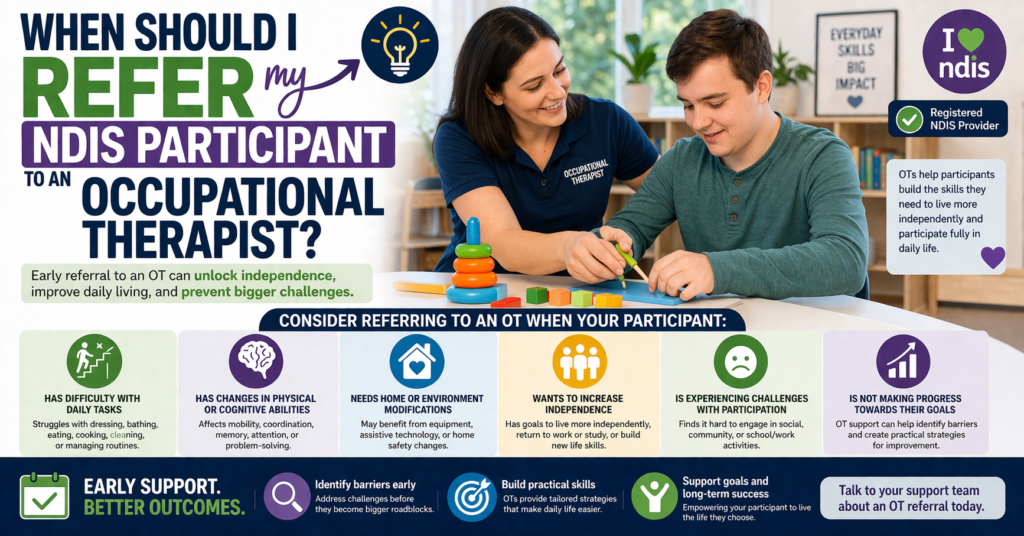
The most reliably foreseeable OT triggers are tied to the NDIS planning cycle. These are events you can see coming on the calendar — which means there is no excuse for missing them.
Plan review approaching – regardless of whether anything has changed
A plan review is always an OT trigger for participants whose functional capacity has not been comprehensively assessed in the past 12–24 months. The NDIA bases its funding decisions on clinical evidence. If the most recent evidence is old or thin, the review risks producing a plan that underestimates what the participant needs. Commission an updated OT assessment at least three to four months before the review date, even if the participant seems stable.
Plan review where previous funding was inadequate or contested
If Core Supports hours were cut at the last review, if the participant’s support workers consistently report that allocated hours are insufficient, or if the participant or their family are expressing that the plan is not meeting their needs, these are signals that the clinical evidence base needs strengthening. An updated, more rigorous FCA is the most effective response. The more specifically the FCA documents task-level support needs and time-quantified assistance, the harder it is for the NDIA to reduce hours below what is clinically justified.
New plan – no recent OT assessment on file
When you take over coordination of a participant who has an active NDIS plan but no recent functional capacity assessment, an FCA should be one of your first actions, regardless of the plan review timeline. You cannot effectively advocate for a participant’s NDIS needs without clinical evidence of their functional capacity, and you cannot know whether the current plan is adequate without that foundation.
Change of circumstances requiring a plan variation
When a participant experiences a significant change, a new diagnosis, a deterioration in function, a major health event, or the loss of a key informal carer – a plan variation is often appropriate. An OT assessment is the most effective supporting evidence for a variation request. Without clinical evidence of changed functional needs, the NDIA has limited grounds to add new funding between review cycles.
Functional and Safety Triggers
Some of the most important OT triggers come not from the NDIS calendar but from the participant’s actual daily life and they are often reported to you not directly, but through support workers, family members, or incident reports. Developing the habit of reading these signals correctly is one of the most valuable pattern-recognition skills a support coordinator can build.
Falls – first occurrence, increase in frequency, or near misses
A fall in the home is one of the clearest OT triggers there is. Falls are associated with home environment hazards, mobility aids that are no longer appropriate, cognitive changes affecting judgment and self-monitoring, and medication effects on balance all of which OT assessment can identify and address. Do not wait for a serious injury. A first fall, an increase in fall frequency, or reported near misses are all sufficient triggers for a home safety OT assessment.
Support workers consistently unable to complete the allocated care plan
If support workers are regularly running over time, skipping tasks because there is not enough time, or reporting that the participant needs more help than the care plan anticipates, this is a signal that the current plan underestimates support needs. An updated FCA, conducted by an experienced OT who documents task-level time requirements, is the appropriate response before the next plan review.
Participant declining or refusing support
A participant who is refusing meals, declining personal care, or withdrawing from community activities may be experiencing a decline in functional capacity, a mental health change, a medication issue, or an environmental barrier making daily life harder than it should be. An OT can assess the underlying functional picture and distinguish between genuine refusal (which requires a different response) and functional inability (which requires more support). This assessment is often critical for safeguarding.
Medication management concerns
Where a support worker or family member reports concerns about a participant’s ability to manage their medication, missed doses, confusion about schedules, inappropriate self-medication, an OT assessment of medication management capacity is indicated. The OT can assess what level of support is required (reminder, supervision, or full administration), recommend AT and organisational systems, and produce the clinical documentation that justifies medication administration support in the Core Supports plan.
Emerging safety concerns at home
Repeated incidents involving cooking (burns, leaving the stove on), leaving the home unsafely, or failure to respond appropriately to hazards, all indicate either a cognitive change or an environmental risk that an OT home safety assessment can identify and address. These incidents often precede a crisis and are best responded to before that crisis occurs.
Unexplained behavioural change
When a participant who has been functioning well begins displaying challenging behaviour, agitation, increased anxiety, or social withdrawal and there is no obvious explanation, an OT functional assessment can identify whether an unmet daily living need, an environmental trigger, or a sensory processing issue is contributing. OT’s contribution here is particularly valuable when working alongside a Positive Behaviour Support practitioner.
Housing and Living Situation Triggers
Participant transitioning from family home to supported living
When a participant, particularly a young adult is preparing to leave the family home for the first time, an OT assessment is essential. The FCA documents current functional capacity and identifies what daily living skills need further development. A SIL assessment and 28-day roster provides the clinical foundation for the SIL funding application. Both should be commissioned well ahead of the intended move date.
Ageing parent or carer no longer able to provide support
When an ageing parent who has been the participant’s primary informal carer begins to show their own decline or when a carer dies, becomes ill, or can no longer continue, the participant’s informal support network has fundamentally changed. The NDIA considers informal support in every funding decision. An updated FCA that documents the withdrawal of informal support and the resulting increase in formal support need is critical for securing adequate replacement funding.
Participant requesting a move to a different living arrangement
When a participant wants to move from a group home to a more independent arrangement, from SIL to a tenancy with lighter support, or into SDA housing, an OT assessment is required to establish what level of support is appropriate for the proposed arrangement and whether the participant has the functional capacity to manage additional independence safely.
Current SIL arrangement no longer meeting the participant’s needs
If a participant in an existing SIL arrangement has had a significant change in function, either improvement through therapy, or deterioration through illness or ageing, the current roster may no longer reflect actual support needs. An updated SIL OT assessment ensures the roster is appropriately calibrated in either direction.
Participant living in inadequate or inaccessible housing
Where a participant is living in housing that creates barriers to independence or safety, and where modifications could address those barriers, a home modification OT assessment is indicated. This is particularly important in the Northern Territory, where cyclone-rated construction creates specific access challenges that standard housing modification approaches may not anticipate.
Equipment and Home Modification Triggers
Participant needs new or replacement assistive technology
Whenever a participant is identified as needing mid- or high-cost AT, a new wheelchair, communication device, ceiling hoist, hospital bed, or powered mobility, an OT AT assessment is required before Capital Supports can be approved. Refer early: complex AT assessments involving multiple product trials can take several months from referral to equipment delivery.
Existing AT is no longer appropriate or has broken down
When a participant’s existing equipment is no longer appropriate, because their functional needs have changed, because the equipment has reached end of life, or because it was never quite right in the first place, an updated AT assessment is needed to establish what replacement or modified equipment is clinically indicated. This is also the time to consider whether the participant’s AT prescription needs reviewing more broadly.
Participant has fallen or is at risk due to inadequate bathroom access
Bathroom fall risk is one of the most common home modification triggers, and one of the most urgently requiring action. The time between a fall in the bathroom and the availability of NDIS-funded modifications can be months. An OT assessment should be commissioned immediately, submitted with two builder quotes, and a plan variation sought urgently if Capital Supports are not already in the plan.
Participant using a mobility aid that no longer fits the home
When a participant begins using a walking frame, rollator, or wheelchair that cannot safely navigate the current home layout, narrow doorways, step-overs, limited turning radius, a home modification assessment is indicated. The OT assesses what structural changes are needed to make the home safely navigable with the mobility aid.
Condition-Specific and Clinical Triggers
Different disability types have predictable OT trigger points that experienced support coordinators learn to anticipate. Here are the most important condition-specific signals:
| Condition | Key OT trigger events |
|---|---|
| MS | New relapse with residual symptoms; transition from RRMS to SPMS; significant fatigue increase; new mobility aid; first fall; heat sensitivity worsening; cognitive changes emerging |
| Parkinson’s disease | First fall or freezing episode; introduction of levodopa (on/off fluctuations begin); significant micrographia affecting written tasks; new hallucinations suggesting cognitive change; carer fatigue increasing |
| Stroke / ABI | Discharge from hospital or rehabilitation; 3-month and 12-month post-stroke review (significant recovery windows); returning to work or community; AT needs changing with recovery; cognitive fatigue becoming apparent in daily life |
| MND / ALS | Diagnosis (begin anticipatory AT and home modification planning immediately); upper limb function declining; speech declining (AAC referral); respiratory support becoming necessary; transition to full-time care needed |
| ASD | School starting or changing; significant sensory meltdowns escalating; transitioning to secondary school; leaving school for adult life; significant change in daily routine; first independent living attempt |
| Intellectual disability | School-to-adult transition (age 14–18); ageing parent no longer providing care; move to independent or semi-independent living; new daily living skill goals emerging; suspected early cognitive decline (particularly Down syndrome) |
| Psychosocial disability | Significant psychiatric relapse with functional decline; housing instability or tenancy at risk; first independent tenancy attempt; changes to medication affecting daily functioning; re-engagement with community after long withdrawal |
| Spinal cord injury | Discharge from spinal unit; returning home to a potentially non-accessible dwelling; first pressure injury; equipment review (manual vs powered wheelchair); vocational rehabilitation goals emerging; ageing with SCI |
Life Stage and Transition Triggers
Major life transitions create predictable shifts in what a participant needs from OT. Anticipating these transitions and commissioning OT assessments before they occur, rather than in response to them, is one of the most effective contributions a support coordinator can make.
School to adult life (ages 16–22)
The transition from school to adult life is one of the most significant and most under-supported periods in a disabled person’s life. An OT assessment during this transition should assess: daily living skills readiness for increased independence, employment capacity and workplace accommodations, community access skills, and AT needs in an adult environment. This assessment should ideally begin at age 16–17, not at school leaving.
Entering employment or education
When a participant is preparing to enter or return to paid employment or tertiary education, an OT vocational assessment can identify workplace or campus accommodations, AT needs, and strategies for managing the cognitive and sensory demands of the work or study environment. This assessment often directly enables employment participation that would not otherwise be possible.
Ageing – physical and cognitive decline emerging
People with disability age, and in some conditions, they age earlier and faster than the general population. When a participant in their 40s or 50s with Down syndrome, cerebral palsy, or long-standing physical disability begins showing signs of age-related functional decline, a fresh OT assessment captures the changed baseline and informs what additional supports and AT are now needed.
Carer becoming an NDIS participant themselves
When the person who has been providing informal care to a participant is themselves identified as having a disability and begins accessing the NDIS, or when they become unavailable due to their own health, this triggers both a change-of-circumstances OT assessment for the original participant and often a complete plan review.
Moving from one state to another
When a participant moves across state borders, their NDIS plan remains active, but the available providers, wait times, and in some cases relevant state-specific funding contexts change. An OT assessment in the new location, conducted by a provider who knows the local environment, housing stock, and service landscape, is often advisable, particularly where home access needs or SIL arrangements are involved.
Early Warning Signs from Support Workers and Family
Support coordinators often hear about emerging OT triggers not in formal reports, but informally, in conversations with support workers, family members, or the participant themselves. The following are the phrases and descriptions that should prompt a referral conversation:
Phrases that should trigger an OT referral conversation
Each of these statements describes a functional change or unmet need that an OT assessment can clarify, document, and address. When you hear them, treat them as clinical signals, not just expressions of carer stress.
When OT May Not Be the Right First Step
Knowing when not to refer is as important as knowing when to refer. OT is not the appropriate first response to every participant concern, and an unnecessary referral wastes IDL funding that could be better used elsewhere.
When the primary issue is a clinical mental health crisis
If a participant is in acute mental health distress, experiencing psychosis, suicidal ideation, or a psychiatric emergency, the appropriate first response is the mental health system, not an OT referral. OT is valuable for building functional capacity in the context of psychosocial disability, but it is not crisis intervention. Stabilise first, then refer.
When the primary issue is a medical condition requiring treatment
If a participant’s functional decline is clearly attributable to an untreated or poorly managed medical condition, an undiagnosed UTI in an older person with dementia, uncontrolled pain, a medication that needs adjustment, address the medical issue first. An OT assessment conducted while the medical issue is active may not reflect the participant’s true baseline.
When the real issue is insufficient support hours, not functional assessment
If a participant’s plan is inadequate simply because the previous OT assessment was strong and the NDIA did not fund what was recommended, the solution may be a plan review submission with better advocacy and supporting letters, not another OT assessment. Commissioning a new FCA when a good one already exists wastes IDL budget and does not address the actual problem.
When Positive Behaviour Support is the more appropriate lead discipline
For participants whose primary presenting need is behaviour support, where challenging behaviour is the central concern and daily living participation is relatively intact, a PBS practitioner, not an OT, may be the appropriate lead referral. OT and PBS are complementary and often need to work together, but PBS is the primary discipline for functional behaviour assessment and behaviour support planning.
Quick Reference – OT Trigger Checklist
Use this checklist at every participant review, case conference, or plan meeting to identify whether an OT referral is indicated:
✅ OT Referral Trigger Checklist
NDIS plan
- Plan review approaching and last FCA is more than 18 months old
- Previous plan had funding cut or support needs contested
- New participant without a current OT assessment on file
- Significant change in circumstances requiring plan variation
Safety and function
- Any fall, near-miss, or significant safety incident at home
- Participant refusing personal care or meals
- Medication management concerns raised by support workers or family
- Support workers consistently unable to complete the care plan in allocated time
- Home environment incidents, stove left on, wandering, locking out
- Unexplained behavioural change without obvious cause
Housing and living situation
- Participant transitioning from family home to any form of supported living
- Primary informal carer no longer available or significantly reduced capacity
- SIL or SDA application in progress or being considered
- Participant’s current housing has significant access barriers
- SIL roster does not appear to reflect current support needs
Equipment and home modifications
- Participant needs new or replacement mid/high-cost AT
- Existing AT is inadequate, broken, or no longer appropriate
- Home access barriers identified (doorways, bathroom, steps)
- Mobility aid cannot safely navigate the current home layout
Life stage and transition
- Approaching school leaving age (14+ for intellectual disability and ASD)
- Entering or returning to employment or tertiary education
- Ageing participant showing signs of functional decline
- Major condition-specific milestone reached (see condition table above)
NDIS Registered — WA · NT · QLD · VIC
Identified an OT trigger? Refer to TEAH today.
Our intake team responds quickly, checks funding, and matches your participant with the right OT across Darwin (NT), Perth (WA), Brisbane (QLD), and Victoria — with below-average wait times and NDIA-quality reports.
Frequently Asked Questions
If a participant seems stable, do they still need an OT assessment before a plan review?
Yes – if their last OT assessment is more than 18 months old. Stability in a participant’s presentation does not mean their clinical evidence is current. NDIA planners will not take the current plan as evidence of ongoing need; they make decisions based on submitted documentation. An OT who sees the participant and confirms stability still produces a current, credible clinical document, which is what the NDIA needs.
A participant has had multiple OT assessments. Do they need another one?
It depends on how recent they are and whether circumstances have changed. Multiple assessments over many years are not redundant if they reflect meaningfully different functional states. An OT assessment from three years ago during a period of good health is not adequate clinical evidence for a participant whose condition has progressed significantly since then. Ask the OT who conducted the most recent assessment whether an update is warranted, they can often advise without needing to conduct a full new assessment.
Can I refer before the participant has confirmed IDL funding available?
You can make an enquiry before confirming funding, most OT providers will discuss the situation before confirming a formal referral. However, you should confirm IDL balance with the plan manager before a formal service agreement is signed. Proceeding to assessment without confirmed funding creates a dispute risk that is not in the participant’s or the provider’s interest.
My participant is resistant to seeing an OT. What should I do?
First, understand the resistance, is it a previous bad experience with OT, anxiety about being assessed, a lack of understanding of what OT involves, or genuine opposition to any professional involvement? Each requires a different approach. Providing clear information about what OT entails (ideally using our participant-facing guides), discussing the referral as a participant-led choice rather than a coordinator-led requirement, and requesting that the OT is specifically chosen for their approach with resistant participants can all help. Ultimately, OT requires participant consent, forced assessment is not appropriate.
A participant has just been discharged from hospital. How urgent is the OT referral?
Very urgent. Hospital discharge is one of the highest-risk transition points for NDIS participants, the home environment may not be safe for the participant’s changed functional state, AT may need updating, and the care plan may no longer be appropriate. Ideally, the OT referral should be made while the participant is still in hospital so that an assessment can be scheduled within the first week of discharge. Contact TEAH directly for urgent discharge referrals.
How do I make a referral to TEAH for my participant?
Submit a referral via our online form at topendalliedhealth.com.au/referral, email referrals@topendalliedhealth.com.au, or call 1300 203 059. For urgent referrals, call directly. Our intake team will confirm funding, match the participant with the right OT, and provide a clear timeframe before any commitment is made.
Summary
Recognising the right moment to refer a participant for occupational therapy, before a crisis, not in response to one, is one of the most valuable skills a support coordinator develops. The triggers span NDIS plan milestones, functional and safety signals, housing transitions, equipment needs, condition-specific inflection points, and life stage changes.
The quick-reference checklist in this article can be used at every case review or plan meeting to systematically screen for OT triggers across your entire caseload. Combined with an understanding of which type of OT service each situation requires, and a referral process that gets participants to the right clinician at the right time, it puts you in the strongest position to achieve the best NDIS outcomes for the people you support.
When you identify a trigger, TEAH’s team is ready, across Darwin (NT), Perth (WA), Brisbane (QLD), and Victoria, with low wait times and OT clinicians experienced across every major disability type.
Refer a participant to TEAH today
Darwin (NT) · Perth (WA) · Brisbane (QLD) · Victoria
Related articles for support coordinators
- How to refer a participant for an OT assessment, a support coordinator’s guide
- SIL and SDA OT assessments, what support coordinators need to know
- NDIS plan review, why an OT report matters
- How much does an NDIS OT assessment cost in Australia?
- Our Occupational Therapy Services, Darwin, Perth, Brisbane & Victoria
TEAH Allied Health Team
Top End Allied Health (TEAH) is an NDIS-registered allied health provider delivering occupational therapy, speech pathology, physiotherapy, and supported accommodation across WA, NT, QLD, and Victoria. Referrals: referrals@topendalliedhealth.com.au | 1300 203 059