Every parent has done it, watched another child at the playground and quietly wondered, “Should mine be doing that by now?” Child development milestones exist to help you answer that question with confidence, not anxiety. They are not a rigid checklist of pass or fail. They are a general map of what most children can do across a range of ages, and understanding them can help you spot when your child might benefit from a little extra support.
This guide covers everything parents and caregivers need to know about child development milestones from birth to five years. You’ll find age-by-age breakdowns across all key areas of development, a clear explanation of what milestones actually mean, signs that may suggest support would help, and practical information about how allied health professionals support children and families in Australia.
One thing to hold onto as you read: every child develops differently. Milestones describe ranges, not deadlines. An eight-month-old who isn’t crawling isn’t automatically delayed; some babies never crawl at all and go straight to walking. What matters is the overall picture of your child’s growth and whether they are continuing to progress, even in their own time and their own way.
That said, early support, when it is needed has consistently lead to better outcomes. So this guide is also about helping you feel confident enough to ask for help if something doesn’t feel right. Your instincts as a parent matter.
What are child development milestones?
Child development milestones are skills or behaviours that most children can do by a certain age. They are based on decades of research into how children typically grow and develop, and they cover five main areas:
- Gross motor skills – large movements like rolling, sitting, walking and running
- Fine motor skills – smaller, more precise movements involving the hands and fingers
- Speech and language – both understanding language (receptive) and using it (expressive)
- Social and emotional development – connecting with others, managing feelings, and building relationships
- Play, thinking and learning – problem-solving, attention, curiosity and cognitive growth
Milestones are not diagnostic tools. They cannot tell you whether your child has a developmental delay or condition, only a qualified health professional can do that. What they can do is give you a starting point for conversations with your GP, child health nurse, or allied health team.
It’s also worth knowing that milestones are built on population averages. They reflect what the majority of children do, not all children. Children who were born prematurely, children who are bilingual, and children with certain medical histories may follow slightly different developmental paths, and that’s often entirely expected.
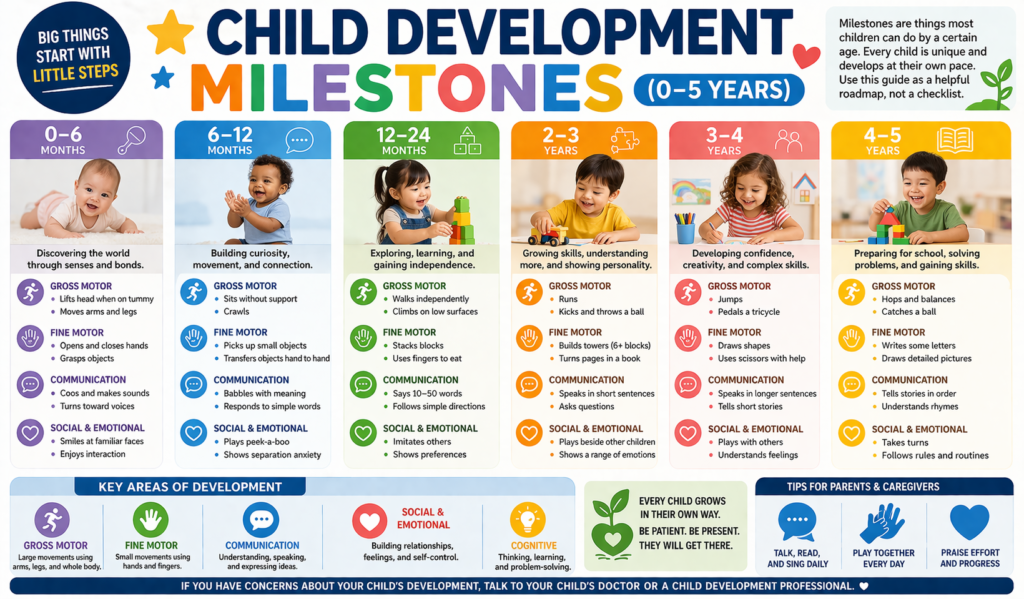
Child development milestones by age (0 – 5 years)
The following sections walk through each major age band from birth to five years. Each section covers the five key developmental areas, red flags that may suggest a child would benefit from professional support, and a brief note on how allied health can help.
Child development milestones: 0 – 3 months
The newborn stage is remarkable. In just the first three months, babies go from helpless newborns to social, curious little people who are already laying the foundations for every skill they will develop later.
At this age, most children may…
Gross motor:
- Turn their head from side to side when lying on their tummy
- Begin to lift their head briefly during tummy time
- Move arms and legs in a symmetrical, jerky way
- Show a grasp reflex when something touches their palm
Fine motor:
- Keep hands in tight fists most of the time
- Begin to open and close hands
- Bring hands toward their face
Speech and language:
- Startle or turn toward sounds and voices
- Recognise a primary caregiver’s voice and settle in response
- Make small cooing and gurgling sounds
- Cry differently for different needs – hunger, discomfort, tiredness
Social and emotional:
- Make eye contact and begin to follow a face with their gaze
- Produce their first social smile, usually around 6 – 8 weeks
- Show a preference for familiar caregivers
- Begin to calm when picked up or spoken to gently
Play, thinking and learning:
- Stare at faces, high-contrast patterns, and moving objects
- Show interest in light sources and colourful objects
- Begin tracking slow-moving objects with their eyes
Red flags to watch for at 0 – 3 months
Consider speaking with your GP or child health nurse if your baby:
- Doesn’t respond to loud sounds
- Doesn’t make eye contact or follow movement with their eyes by 2 months
- Doesn’t smile socially by 8 weeks
- Holds their head to one side consistently (this may suggest a condition called torticollis)
- Seems very floppy or very stiff in their limbs
How allied health can help at 0 – 3 months
Paediatric physiotherapy can support very early motor concerns, including low muscle tone, restricted neck movement, or asymmetrical movement patterns. Early intervention at this stage is highly effective.
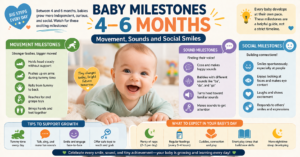
Child development milestones: 4 – 6 months
By four months, babies have settled into the world and are becoming more interactive, stronger, and increasingly social. This is a stage full of big smiles, first laughs, and purposeful reaching.
At this age, most children may…
Gross motor:
- Hold their head steady without support
- Push up onto their forearms during tummy time
- Begin to roll from tummy to back (usually 4 – 5 months) and back to tummy (usually 5 – 6 months)
- Bear some weight through their legs when held in a standing position
- Sit with support
Fine motor:
- Reach for and grasp objects deliberately
- Bring objects to their mouth to explore
- Transfer objects from one hand to the other (more common toward 6 months)
- Rake objects toward themselves
Speech and language:
- Babble with repeated syllables like “ba-ba” or “da-da” (without meaning yet)
- Laugh and squeal with enjoyment
- Respond differently to happy and stern voices
- Turn toward sounds and voices across the room
Social and emotional:
- Smile broadly at familiar people
- Enjoy face-to-face interaction and games like peek-a-boo
- Show excitement by kicking and waving arms
- May begin to show stranger wariness
Play, thinking and learning:
- Show curiosity about new objects and reach to explore them
- Look for dropped objects (early object permanence)
- Recognise familiar faces and objects
- Enjoy mirrors and looking at their own reflection
Red flags to watch for at 4 – 6 months
Consider speaking with a health professional if your baby:
- Doesn’t reach for or grasp objects by 5 – 6 months
- Doesn’t roll in either direction by 6 months
- Doesn’t babble or make varied sounds
- Doesn’t smile at familiar people
- Seems very stiff, very floppy, or moves asymmetrically (one side much more than the other)
How allied health can help at 4 – 6 months
Physiotherapy supports rolling, tummy time tolerance, and early movement concerns. Occupational therapy can assist with reaching, grasping, and sensory exploration. Both can work with families to build activities into daily routines.
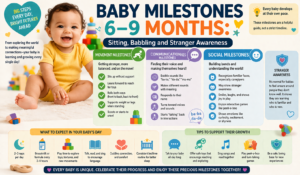
Child development milestones: 6 – 9 months
Six to nine months is often described as one of the most exciting developmental windows. Babies become mobile, communication becomes more intentional, and their personalities really start to shine.
At this age, most children may…
Gross motor:
- Sit independently without support (usually around 7 – 8 months)
- Begin to crawl, commando crawl, or find their own way of moving across the floor
- Pull to a standing position holding onto furniture
- Bounce when held in standing
Fine motor:
- Pick up small objects using a raking motion, moving toward a pincer grasp
- Bang objects together and against surfaces
- Pass objects back and forth between hands with ease
- Begin to use both hands together in play
Speech and language:
- Babble with more varied sounds and intonation patterns that sound like conversation
- Respond to their own name by turning or looking
- Begin to understand a few frequently used words like “no” and “bye-bye”
- Use gestures like reaching, pointing, and raising arms to be picked up
Social and emotional:
- Show clear preferences for familiar caregivers
- Display stranger anxiety – may cry or cling when approached by unfamiliar people
- Watch caregivers closely and copy facial expressions
- Begin to show a range of emotions: joy, frustration, fear, curiosity
Play, thinking and learning:
- Show understanding that objects continue to exist when hidden (object permanence)
- Enjoy cause-and-effect toys – anything that makes noise, lights up, or responds to their actions
- Drop objects repeatedly to watch what happens
- Begin to imitate simple actions they observe in others
Red flags to watch for at 6 – 9 months
Consider speaking with a health professional if your baby:
- Isn’t sitting independently by 9 months
- Isn’t showing any interest in moving toward objects
- Doesn’t respond to their name
- Isn’t babbling with varied sounds
- Doesn’t reach for nearby objects
- Shows no interest in or awareness of strangers
How allied health can help at 6 – 9 months
Physiotherapy supports sitting, crawling, and pulling to stand. Occupational therapy can help with hand skills, sensory processing concerns, and feeding. Early childhood intervention teams can provide holistic support if multiple areas are a concern.
Not sure if your child’s development is on track?
Our paediatric allied health team supports children from birth through to school age across speech, movement, and everyday skills. You don’t need to have all the answers – just reach out and we’ll help you work out the next step.
Child development milestones: 9 – 12 months
The lead-up to the first birthday is a period of rapid change. Most babies are moving confidently, communicating intentionally, and beginning to show the first glimmers of their unique character.
At this age, most children may…
Gross motor:
- Crawl confidently on hands and knees (though some babies use alternative methods like bottom-shuffling)
- Pull to standing and cruise along furniture
- Stand briefly without support, and may take first independent steps
- Climb over low obstacles and onto low furniture
Fine motor:
- Use a neat pincer grasp (thumb and index finger) to pick up small objects
- Put objects in and take them out of containers
- Poke at things with their index finger
- Begin to attempt to use a spoon, though with limited accuracy
Speech and language:
- Say one or two words with meaning – commonly “mama”, “dada”, or a consistent word for a familiar object
- Understand simple instructions paired with gestures (“give me”, “come here”)
- Wave bye-bye and shake their head for “no”
- Imitate sounds, words, and actions they observe frequently
- Point to draw attention to things they find interesting
Social and emotional:
- Show clear attachment to primary caregivers and may become distressed when separated
- Use “social referencing” – looking to a caregiver’s face to decide how to react to something new
- Enjoy simple interactive games like peek-a-boo and clapping
- Begin to test limits and show early signs of willfulness
Play, thinking and learning:
- Explore objects in many ways – shaking, banging, throwing, dropping
- Find hidden objects under a cloth
- Enjoy simple picture books and pat or point at images
- Begin simple pretend play – “feeding” a toy or talking into a toy phone
Red flags to watch for at 9 – 12 months
Consider speaking with a health professional if your baby:
- Isn’t pulling to stand by 12 months
- Isn’t using at least one word with meaning by 12 months
- Doesn’t point to share interest in things with others
- Doesn’t wave bye-bye or shake their head
- Doesn’t look when their name is called
- Has lost skills they previously had
How allied health can help at 9 – 12 months
If walking is delayed, physiotherapy can assess muscle tone, balance, and movement patterns. Speech pathology can support early communication, including pointing, gesture use, and first words. Occupational therapy can assist with fine motor development and self-care skills like feeding.
Child development milestones: 12 – 18 months
The toddler stage begins, and with it comes a dramatic expansion in independence, communication, and personality. This is also often the stage where developmental differences first become visible to parents.
At this age, most children may…
Gross motor:
- Walk independently, though with a wide-based, slightly unsteady gait at first
- Squat down to pick up objects and return to standing
- Climb onto low furniture
- Carry objects while walking
- Begin to run (though stopping and turning are still challenging)
Fine motor:
- Stack two to four blocks
- Turn pages in a board book (several at a time)
- Scribble with a crayon using a whole-hand grasp
- Drink from a cup with some spillage
- Begin to use a spoon more purposefully
Speech and language:
- Use between 5 and 20 words meaningfully by 18 months
- Point to familiar objects, body parts, and pictures when named
- Follow simple two-step instructions (“Get your shoes and bring them here”)
- Use words more often than gestures to communicate wants
- Use their name for themselves
Social and emotional:
- Show strong attachment and distress at separation from primary caregivers
- Begin to show empathy and comfort a distressed person or toy
- Display a range of emotions and begin to have tantrums when frustrated
- Enjoy playing alongside other children (parallel play) though not yet with them
Play, thinking and learning:
- Engage in more extended and varied pretend play
- Show interest in cause-and-effect play (pushing buttons, turning knobs)
- Enjoy simple puzzles with large pieces
- Point to pictures in books and name familiar objects
Red flags to watch for at 12 – 18 months
Consider speaking with a health professional if your toddler:
- Isn’t walking independently by 15 – 18 months
- Has fewer than 5 – 10 words by 18 months
- Doesn’t point to share interest with others
- Doesn’t follow simple instructions
- Frequently falls or seems unusually clumsy
- Shows no interest in other children
- Has lost skills they previously had
How allied health can help at 12 – 18 months
Speech pathology is often sought during this period for late talking or limited gesture use. Physiotherapy can help if walking is delayed, unsteady, or asymmetrical. Occupational therapy supports feeding difficulties, sensory sensitivities, and fine motor development. This is also a common time for early childhood intervention referrals.
Child development milestones: 18 – 24 months
The period between 18 months and 2 years is often described as the “language explosion”, a time when many children’s vocabulary suddenly multiplies and two-word phrases begin to emerge. It’s also a time of big emotions, growing independence, and the beginnings of imaginative play.
At this age, most children may…
Gross motor:
- Walk confidently and begin to run, though falling is still common
- Walk up stairs holding a railing or hand (both feet on each step)
- Kick a large ball
- Jump with both feet (toward 24 months)
- Push and pull large toys while walking
Fine motor:
- Stack five or more blocks
- Turn single pages of a board book
- Hold a crayon with fingers rather than a full-hand grasp
- Begin to show a hand preference (though this may not be established until age 3–4)
- Manage a spoon with reasonable accuracy
- Attempt to remove shoes and socks
Speech and language:
- Have a vocabulary of 50 or more words by age 2
- Begin combining two words: “more milk”, “daddy go”, “big dog”
- Ask simple questions: “What’s that?”, “Where go?”
- Name familiar people, body parts, and everyday objects
- Be understood by familiar caregivers most of the time
- Follow instructions with two steps
Social and emotional:
- Show strong, sometimes overwhelming emotions, tantrums are common and normal
- Begin to show more awareness of other children and engage briefly in interactive play
- Display clear preferences and the beginnings of defiance (“No!”)
- Show affection openly – hugs, kisses, bringing objects to share
Play, thinking and learning:
- Engage in more elaborate pretend play – feeding dolls, pretending to cook
- Begin simple sorting by shape or colour
- Complete simple shape puzzles
- Show growing memory – remember where objects are kept, recall recent events
Red flags to watch for at 18 – 24 months
Consider speaking with a health professional if your toddler:
- Has fewer than 20 words by 18 months or fewer than 50 words by 24 months
- Isn’t combining two words by 24 months
- Is very difficult to understand by familiar caregivers
- Isn’t walking confidently by 18 months
- Shows little interest in pretend play
- Doesn’t point to share interest in things with others
- Shows no interest in other children
How allied health can help at 18 – 24 months
This is one of the most common periods for speech pathology referrals, particularly for late talking. Research strongly supports early intervention for language delays – acting now rather than waiting and seeing almost always leads to better outcomes. Occupational therapy can help with self-care skills, emotional regulation, and sensory concerns. Early childhood intervention is well-suited to this age group.
Child development milestones: 2 – 3 years
Between two and three, children transform from toddlers into little people with opinions, imagination, and a growing ability to connect with others. Language becomes a powerful tool, and play becomes increasingly creative.
At this age, most children may…
Gross motor:
- Run with more control and coordination
- Jump with both feet off the ground
- Kick and throw a ball with some direction
- Climb playground equipment with growing confidence
- Walk up and down stairs alternating feet (toward age 3)
- Ride a tricycle or balance bike
Fine motor:
- Draw simple lines, circles, and early attempts at faces
- String large beads
- Use scissors with two hands (toward age 3)
- Turn pages of a regular book one at a time
- Manage buttons and zips with some help
- Use a fork and spoon independently at mealtimes
Speech and language:
- Use three- to four-word sentences regularly by age 2.5 – 3
- Be understood by familiar caregivers most of the time, and strangers about 50 – 75% of the time
- Ask frequent “why”, “who”, and “what” questions
- Begin using pronouns: I, me, you, he, she (mix-ups are common and normal)
- Refer to themselves by name and begin using “I” instead
- Enjoy simple songs, rhymes, and stories
Social and emotional:
- Begin to play interactively with other children, not just alongside them
- Show empathy and concern for others who are upset
- Navigate early turn-taking, though conflict over toys is still very common
- Show affection for familiar friends
- Continue to have tantrums, though these may begin to reduce as language improves
Play, thinking and learning:
- Engage in complex, sustained pretend play scenarios
- Sort objects by colour, shape, and size
- Complete puzzles of 4 – 12 pieces
- Begin to understand the concept of “two” and count a small number of objects
- Draw recognisable shapes and early attempts at people
Red flags to watch for at 2 – 3 years
Consider speaking with a health professional if your child:
- Isn’t using three-word sentences by age 3
- Is very difficult to understand even by familiar caregivers
- Has difficulty running, climbing, or managing stairs
- Shows little interest in other children or interactive play
- Has significant and persistent tantrums that are difficult to manage
- Shows no interest in pretend play
- Has lost previously acquired skills
How allied health can help at 2 – 3 years
Speech pathology remains highly relevant during this period, both for language development and speech clarity. Occupational therapy supports emotional regulation, fine motor development, and self-care. If your child’s behaviour is significantly challenging, a referral through your GP or paediatrician can help identify whether additional support is needed.
Early support makes a real difference
If you’re concerned about any area of your child’s development, the best time to seek support is now. Our team of paediatric therapists can assess your child and give you a clear picture of where things are at – and what, if anything, would help.
Child development milestones: 3 – 4 years
The preschool years are a time of expanding social worlds, increasing independence, and rapid growth in language and thinking. Three- to four-year-olds are curious, creative, and often exhaustingly energetic.
At this age, most children may…
Gross motor:
- Run smoothly and change direction easily
- Hop on one foot
- Catch a large ball with arms extended
- Pedal a tricycle confidently
- Walk up and down stairs alternating feet without holding a rail
- Begin to balance on one foot for a second or two
Fine motor:
- Draw a person with two or more body parts
- Copy simple shapes: circle, cross, square
- Use scissors to cut along a straight line
- Manage clothing with large buttons and zips independently
- Hold a pencil or crayon with a more mature grip
Speech and language:
- Speak in sentences of four to six words
- Be understood by most people outside the family, most of the time
- Tell simple stories and recount recent events with some sequencing
- Use past and future tense (with some errors – “I runned” or “we goed”)
- Ask and answer “when”, “where”, and “why” questions
- Know their first and last name, age, and gender
Social and emotional:
- Play cooperatively with other children in longer, more complex games
- Begin to understand and follow rules in simple games
- Show interest in having friends and may talk about specific children
- Separate more easily from caregivers in familiar settings
- Begin to understand others’ perspectives and feelings
- Show a sense of humour – loves silly words and jokes
Play, thinking and learning:
- Engage in elaborate imaginative play with storylines and roles
- Complete puzzles of 12 – 20 pieces
- Name several colours and understand basic concepts (big/small, in/out, up/down)
- Count up to ten objects and understand the concept of “more” and “less”
- Begin to understand the difference between real and pretend
Red flags to watch for at 3 – 4 years
Consider speaking with a health professional if your child:
- Is difficult to understand most of the time, even by familiar people
- Doesn’t use sentences of at least three words
- Struggles significantly with balance, coordination, or using stairs
- Has difficulty using both hands together in activities
- Shows little interest in other children or prefers to play alone consistently
- Has significant difficulties with change or transitions
- Frequently loses their train of thought mid-sentence (beyond normal developmental disfluency)
How allied health can help at 3 – 4 years
This is a key age for speech pathology assessment of speech clarity, language complexity, and early literacy skills. Occupational therapy can assist with handwriting readiness, emotional regulation, and self-care. Physiotherapy can support coordination, balance, and gross motor confidence for children who need it.
Child development milestones: 4 – 5 years
By four to five years, most children are preparing for – or already in – the first year of formal schooling. This stage is about consolidating the skills they’ve built and developing the independence, communication, and self-regulation needed for a classroom environment.
At this age, most children may…
Gross motor:
- Skip, hop, and jump with coordination
- Catch a smaller ball reliably
- Balance on one foot for 5 – 10 seconds
- Ride a bicycle with training wheels
- Climb, swing, and navigate playground equipment confidently
- Begin to show more refined coordination in sport and physical play
Fine motor:
- Draw recognisable people, houses, and animals
- Write their first name (or some letters of it)
- Cut along curved lines with scissors
- Use a fork, knife, and spoon at mealtimes
- Manage most clothing independently including buttons, zips, and velcro
- Show a consistent hand preference
Speech and language:
- Be understood by everyone, nearly all of the time
- Use sentences of five or more words with mostly correct grammar
- Tell stories with a clear beginning, middle, and end
- Understand and follow multi-step instructions
- Show early phonological awareness recognise rhymes, identify the first sound in a word
- Ask complex questions and engage in extended back-and-forth conversation
Social and emotional:
- Form genuine friendships and show preference for particular friends
- Negotiate and compromise in play (with some adult support)
- Show awareness of and sensitivity to others’ feelings
- Follow rules and understand why they exist
- Manage separations from caregivers in school or care settings
- Show growing ability to regulate emotions, though still needs adult support
Play, thinking and learning:
- Engage in complex, multi-day imaginative play scenarios
- Show strong curiosity and ask many “how” and “why” questions
- Understand the concept of time: yesterday, today, tomorrow
- Count reliably to 20 or more and understand simple addition
- Recognise and write some letters and numbers
- Sit and attend to a structured activity for 10–15 minutes
Red flags to watch for at 4 – 5 years
Consider speaking with a health professional if your child:
- Is still difficult to understand by unfamiliar people
- Has significant difficulty with balance, coordination, or physical play
- Shows very limited interest in peers or friendship
- Has difficulty sitting still or attending to tasks for more than a few minutes
- Struggles significantly with transitions or changes to routine
- Shows no interest in letters, numbers, or books
- Has persistent difficulty managing emotions or behaviour
How allied health can help at 4 – 5 years
School readiness is a key focus at this age. Speech pathology can address speech clarity, language skills, and phonological awareness the foundations of reading and writing. Occupational therapy supports handwriting readiness, attention, self-regulation, and independence with daily tasks. Physiotherapy assists children who need support with coordination, motor planning, or physical confidence before starting school.
Developmental milestones by skill area
As well as understanding milestones by age, it can help to understand development through the lens of each skill area. Here’s what each domain covers, common parent questions, and which therapy professional best supports each area.
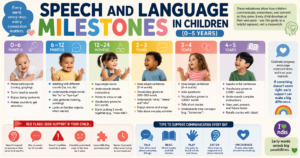
Speech and language development
Speech and language development covers both what a child understands (receptive language) and what they can say (expressive language), as well as how clearly they speak (articulation and phonology). Common parent concerns include late talking, unclear speech, stuttering, and difficulty following instructions. A speech pathologist is the right professional for all of these concerns.
Gross motor development
Gross motor development covers large body movements: rolling, sitting, crawling, walking, running, jumping, climbing, and sports skills. Common concerns include delayed walking, poor balance, frequent falls, and difficulty keeping up with peers in physical play. Paediatric physiotherapists specialise in supporting gross motor development.
Fine motor development
Fine motor development covers hand and finger skills: grasping, stacking, drawing, cutting, writing, and self-care tasks like dressing and using cutlery. Common concerns include weak grip, difficulty with handwriting or scissors, and avoidance of fine motor tasks. Occupational therapists are the specialists for fine motor development.
Social and emotional development
Social and emotional development covers how children connect with others, regulate their emotions, and develop a sense of self. Common concerns include difficulty with emotional regulation, limited interest in peers, persistent anxiety, or significant behavioural difficulties. Occupational therapists, speech pathologists, and psychologists can all play a role depending on the nature of the concern.
Play, thinking and learning
Cognitive milestones cover how children think, problem-solve, remember, and learn through play. Concerns in this area often overlap with other developmental domains, a child who isn’t engaging in pretend play may also have language or social communication concerns. Occupational therapists and speech pathologists often support this area together.
Signs of developmental delay in children
Developmental delay refers to when a child’s skills in one or more areas are significantly behind what is expected for their age. It’s important to understand that a delay is not a diagnosis, it is an observation that a child may benefit from support in a particular area.
Some delays are isolated, for example a child may have strong social skills and cognition but need support with speech. Others are more widespread and may involve multiple areas of development. Neither situation is uncommon, and both respond well to early intervention.
Signs that may suggest a child would benefit from a developmental assessment include:
In the first year:
- Not smiling socially by 2 months
- Not babbling by 6 – 9 months
- Not responding to their name by 9 months
- Not sitting independently by 9 months
- Not pulling to stand by 12 months
- Not using at least one meaningful word by 12 months
In the toddler years (1 – 3):
- Not walking independently by 18 months
- Fewer than 20 words by 18 months
- Not combining two words by 24 months
- Not using three-word sentences by age 3
- Speech that is very difficult to understand by familiar people at age 2 – 3
- Limited interest in other children or interactive play
- Significant and persistent difficulty with emotional regulation
In the preschool years (3 – 5):
- Speech that is difficult to understand by unfamiliar people
- Significant difficulty with balance, coordination, or physical play
- Very limited interest in peers or friendships
- Difficulty attending to tasks for more than a few minutes
- Persistent difficulty with transitions or sensory input
- No interest in letters, numbers, or early literacy concepts approaching school age
Any loss of skills a child previously had at any age is worth bringing to a health professional promptly.
If you’re unsure, that’s reason enough to ask. A brief conversation with your GP, child health nurse, or allied health team can quickly clarify whether a concern warrants further assessment and provide genuine peace of mind if everything is on track.
When should I be concerned about my child’s development?
This is one of the most common questions parents ask and one of the hardest to answer with a simple rule. Here is a practical framework that many families find helpful.
Trust your instincts. You know your child better than anyone. If something feels different or concerning, it’s always worth raising even if you can’t articulate exactly what it is. Parents’ concerns are taken seriously by allied health professionals and GPs, and they’re often right.
Compare against ranges, not other children. Every child has a different developmental pace. Comparing your child to a neighbour’s child or a cousin isn’t particularly useful. What matters is whether your child’s development fits within the expected range for their age and whether they are making ongoing progress.
Consider the whole picture. A single skill being slightly delayed is different from multiple areas of development being significantly behind. If you’re noticing several things at once, or if a concern has been going on for a while, it’s more important to seek a professional opinion.
“Wait and see” has a time limit. For minor concerns in very young children, a short period of monitoring is sometimes appropriate. But “wait and see” should never go on indefinitely. If a concern is still present three to six months after you first noticed it, seeking a professional assessment is the right step, not a sign of overreacting.
Earlier is almost always better. The research on early intervention is very clear: children who receive support earlier in life achieve better outcomes than those who wait. This is true across almost every area of developmental delay or difficulty. Acting on a concern promptly is one of the most important things a parent can do.
How allied health supports child development
Allied health professionals are the specialists who assess and support children’s developmental needs. In Australia, the most common allied health professionals involved in child development are speech pathologists, occupational therapists, and physiotherapists.
What does a speech pathologist do?
Speech pathologists (sometimes called speech therapists) support communication including talking, understanding language, social communication, and early literacy. For children, they help with late talking, unclear speech, language delays, stuttering, and the communication skills needed for school and social life. Sessions are play-based and appropriate for children from birth.
What does an occupational therapist do?
Occupational therapists (OTs) support children to participate fully in the everyday “occupations” of childhood play, learning, self-care, and social interaction. In practice, this means helping with fine motor skills, handwriting, emotional regulation, sensory processing, and daily living skills like dressing, eating, and toileting.
What does a physiotherapist do?
Paediatric physiotherapists support gross motor development, this is how children move their bodies. They work with children who have delays or difficulties with rolling, sitting, crawling, walking, balance, coordination, and participation in physical play and sport. Physiotherapy may also support children with low muscle tone, cerebral palsy, or other conditions affecting movement.
What is early childhood intervention?
Early childhood intervention (ECI) refers to a coordinated approach to supporting children under the age of 6 (and up to age 9 for NDIS-funded support) who have or are at risk of developmental delays or disabilities. ECI teams typically include a combination of the above professionals, working together and in partnership with families. The goal is to build children’s skills and participation across all areas of daily life, at home, in care, and in the community.
Child development support in Australia
Families in Australia can access child development support through several pathways. Understanding your options can help you move quickly when concerns arise.
Your GP and child health nurse
Your first point of contact for developmental concerns is usually your GP or child health nurse. They can conduct a brief developmental screen, discuss your concerns, and refer you to the appropriate allied health services. In some cases, your GP can provide a referral that allows you to access Medicare-subsidised therapy through a Chronic Disease Management (CDM) plan, usually up to five sessions per calendar year.
Private allied health services
You can self-refer to a private speech pathologist, occupational therapist, or physiotherapist without a GP referral in most cases. Private services typically offer shorter waiting times and greater flexibility in terms of scheduling and location. Costs vary, but Medicare rebates, private health insurance, and NDIS funding can all reduce out-of-pocket expenses depending on your situation.
The NDIS
The National Disability Insurance Scheme (NDIS) funds supports for Australians with permanent and significant disability, including children. Children under 9 years of age are supported through the Early Childhood Approach, which does not require a formal diagnosis to access. If you believe your child may have a developmental delay or disability, contacting an NDIS Early Childhood partner in your area is a good starting point. They can connect you with support even if your child doesn’t end up being NDIS-eligible.
Early Childhood Early Intervention (ECEI)
The ECEI approach is specifically designed for children under 9 who have developmental concerns. It provides access to early support and can connect families with a range of services. You don’t need a formal diagnosis to access ECEI, a developmental concern is sufficient. Your GP, child health nurse, or an NDIS Early Childhood partner can help you navigate this pathway.
Community health and public services
Many states and territories in Australia offer community-based child development services through the public health system, including paediatrician assessments and allied health programs. Waiting times for public services can be long, and availability varies by location particularly in regional and remote areas like the Northern Territory. Combining public referrals with private services is a common and practical approach for many families.
Support in Darwin and the Northern Territory
Families in Darwin and across the NT face unique challenges in accessing child development services including limited availability of specialists, geographic distance, and, for some families, cultural and language considerations. Top End Allied Health provides paediatric speech pathology, occupational therapy, and physiotherapy services to families across the Darwin region, with a focus on accessible, family-centred care. We work with both privately funded and NDIS-funded families.
Not sure if your child needs support? We can help you decide.
Our team of paediatric speech pathologists, occupational therapists, and physiotherapists works with children and families across Australia. Whether you have a specific concern or just want peace of mind, we’re here to help without the wait-and-see.
Frequently asked questions about child development milestones
What is the difference between a developmental delay and a developmental disorder?
A developmental delay means a child’s skills in one or more areas are behind what is expected for their age. A developmental delay may resolve with support, or it may be the first sign of a more long-term condition. A developmental disorder (such as autism, ADHD, or cerebral palsy) is a diagnosable condition that affects development. Only a qualified health professional, usually a paediatrician or psychologist, can provide a formal diagnosis. Allied health professionals can assess and support children whether or not a formal diagnosis has been made.
My child was born premature – how do I adjust the milestones?
For babies born before 37 weeks, it’s standard practice to use their “corrected age” (adjusted for prematurity) rather than their chronological age when assessing milestones, generally until age 2. For example, a 9-month-old who was born 2 months early would have a corrected age of 7 months. Your GP or child health nurse can guide you on how to apply this to your child’s situation.
My child is bilingual – will this affect their language milestones?
Bilingual children may have smaller vocabularies in each individual language compared to monolingual children, but their total vocabulary across both languages is typically comparable. Bilingualism does not cause language delay. When assessing a bilingual child’s language development, a speech pathologist should consider both languages – not just English. If you have concerns about your bilingual child’s language development, a speech pathologist with experience in bilingual assessment is the right professional to see.
Should I wait and see if my child catches up on their own?
For very young children with mild concerns, a short period of monitoring can be reasonable, but this should not go on indefinitely. If a concern has been present for more than a few months, or if multiple areas of development are involved, seeking a professional assessment is the right step. Early intervention consistently produces better outcomes than waiting, and an assessment that shows everything is on track provides genuine peace of mind. There is very little to lose from seeking help early and potentially a great deal to gain.
Does my child need a referral to see an allied health professional?
In most cases, you can self-refer to a speech pathologist, occupational therapist, or physiotherapist without a GP referral. A GP referral may be needed to access Medicare rebates through a Chronic Disease Management plan, or for NDIS access. If you’re unsure, calling the clinic directly is the quickest way to find out what you need.
How to use this guide as your child grows
Child development isn’t something that happens in a single window, it’s a continuous process that unfolds across years. The way to get the most value from a guide like this is to revisit it at different stages rather than reading it once and putting it away.
Here are some practical ways families use milestone information:
- Before a child health check – Reading through the milestones for your child’s current age before a scheduled appointment with your GP or child health nurse can help you arrive with specific observations and questions, rather than trying to recall everything on the spot.
- When something feels different – If you’ve noticed something that doesn’t quite fit with your child’s peers, comparing against the milestone ranges for their age can help you decide whether it’s worth mentioning to a professional.
- To celebrate progress – Milestones aren’t just for identifying concerns. They’re also a meaningful way to notice and celebrate how much your child has grown. The leap from babbling to first words, from crawling to walking, from parallel play to real friendships, these are remarkable achievements worth marking.
- When sharing information with educators – If your child is starting childcare or preschool, having a clear sense of where they are developmentally can help you have informed conversations with educators about how to best support your child in that environment.
Building a strong foundation: what parents can do every day
While allied health professionals play an important role in supporting children who need extra help, the most powerful developmental environment for any child is their everyday life with their family. Here are some research-backed ways parents can support development across all five domains — without any special equipment or formal training.
Talk, read, and sing – every day
Language-rich environments produce children with stronger communication skills, larger vocabularies, and better school readiness. This doesn’t require structured “lessons”, it means narrating what you’re doing (“I’m washing the vegetables now – can you see the carrots?”), reading books together daily, singing songs and nursery rhymes, and having real conversations where you wait for and respond to your child’s contributions.
Prioritise unstructured play
Play is the primary vehicle of development for young children. Unstructured, child-led play, particularly play that involves movement, imagination, and interaction with others, this builds motor skills, language, problem-solving, emotional regulation, and social competence simultaneously. A cardboard box and a backyard are often more developmentally valuable than an expensive educational toy.
Get on the floor with them
Tummy time for babies, floor play for toddlers, imaginative play for preschoolers, which the research consistently shows that children develop better motor, language, and social skills when caregivers participate actively in play rather than supervising from a distance. It doesn’t have to be long stretches. Even five or ten minutes of genuine, floor-level engagement makes a difference.
Respond to their communication attempts
Whether your child is cooing, babbling, pointing, signing, or using words, responding promptly and warmly to their communication efforts is one of the most important things you can do for their language development. This “serve and return” interaction, where the child communicates and the caregiver responds builds the neural pathways for language, attention, and relationship.
Create predictable routines
Predictable daily routines, consistent mealtimes, sleep times, and transitions, support emotional regulation, reduce anxiety, and give children a sense of safety and control. They also create natural opportunities for language and learning: naming the steps of a morning routine, counting the stairs as you go up, singing a song at bath time.
Allow age-appropriate risk and challenge
Children develop confidence, resilience, and motor skills through experiences that are slightly challenging, climbing a little higher than feels fully comfortable, navigating a social conflict with a peer, attempting a puzzle that takes some effort. Well-meaning over-protection can inadvertently limit these growth opportunities. Supporting children through challenge (rather than removing it) is a powerful developmental tool.
A note on comparing children
Parenting in the age of social media makes it harder than ever to avoid comparing your child to others. A friend posts a video of their 10-month-old walking. A relative mentions that their 18-month-old already knows 100 words. A post in a parenting group describes a 3-year-old who can write their name.
It is worth remembering that what gets shared publicly is almost always what’s impressive or ahead of the curve, not what’s typical. The child walking at 10 months is ahead of most children. The 18-month-old with 100 words is at the high end of the range. The 3-year-old writing their name is an early achiever. None of these children represent the norm, they represent the exciting moments that parents are proud to share.
The children you don’t see in those posts are the majority: developing at a typical pace, hitting milestones in the middle of the expected range, growing steadily and well without being remarkable in any particular direction. That is not a failure. That is normal development.
Use milestones to understand your child’s development, not to rank it against others. The question to ask is not “Is my child ahead?” but rather “Is my child continuing to grow and develop across all the areas that matter?”
Conclusion
Child development milestones are one of the most useful tools parents have, not as a source of anxiety, but as a guide to understanding what’s expected and when to act. Every child takes their own path through development, and most variations are entirely normal. But knowing the signs that may suggest a child would benefit from support, and feeling confident enough to ask for that support, can make a real and lasting difference to a child’s outcomes.
The five years between birth and school age are among the most formative of a person’s life. The experiences children have, the relationships they form, and the support they receive during this window lay the foundations for everything that follows, their learning, their relationships, their wellbeing, and their sense of who they are. Supporting development during this period isn’t a luxury. It’s one of the most important investments a family can make.
If you’ve read this guide and a concern has come up, or if you’ve been quietly carrying a worry for a while, we encourage you to take the next step. An early conversation with an allied health professional costs very little and could mean everything for your child’s development. You don’t need to be certain something is wrong to reach out, you just need to wonder.
Our team at Top End Allied Health works with children and families across Darwin and the Northern Territory. We offer paediatric speech pathology, occupational therapy, and physiotherapy, and we’re experienced in supporting families through both private and NDIS-funded pathways. We also work alongside early childhood intervention teams for children who need more comprehensive, coordinated support. You don’t need to have all the answers before you reach out — that’s what we’re here for.