
Reading time: 9 minutes | Updated: April 2026 | Written by: TEAH Allied Health Team
Choosing an occupational therapist for yourself or a family member with an NDIS plan is a decision that matters more than most people realise. The right OT does not just complete an assessment or run a therapy session — they become the clinical foundation of an NDIS plan. Their reports determine funding. Their recommendations unlock assistive technology. Their documentation is the difference between a plan that works and one that falls short.
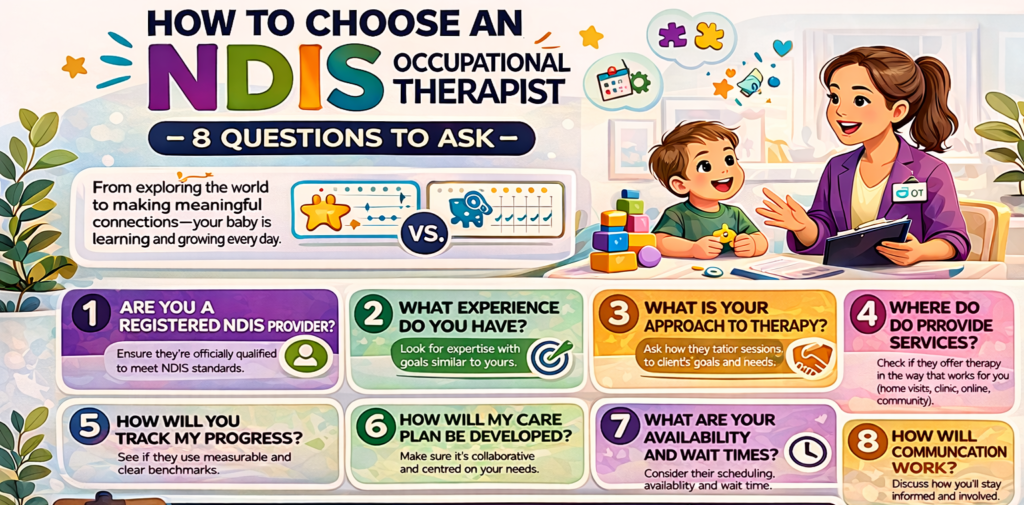
But most people selecting an NDIS OT have never hired one before and have no framework for evaluating quality. They pick from a provider finder, read a website, and hope for the best. This guide gives you a better approach — eight specific questions that, asked in the right way at the right time, will reliably separate capable, experienced NDIS OTs from those who may be competent in other areas but inadequate for the NDIS context you need them for.
In this article
- Why choosing the right OT matters so much
- Question 1 — What is your experience with my condition?
- Question 2 — Do you conduct assessments in my home?
- Question 3 — What standardised assessment tools do you use?
- Question 4 — What does your report process look like?
- Question 5 — What are your current wait times?
- Question 6 — How do you handle NDIA requests for further information?
- Question 7 — What is your therapy approach and how do you measure progress?
- Question 8 — Are you NDIS registered, and what are your fees?
- Red flags to watch for when choosing an OT
- Frequently asked questions
Why Choosing the Right OT Matters So Much
An occupational therapist’s work touches almost every significant NDIS funding decision a participant makes. Consider the chain of consequences:
- The OT’s Functional Capacity Assessment determines how much Core Supports funding the NDIA allocates
- The OT’s AT prescription is the document that unlocks Capital Supports for a wheelchair or communication device
- The OT’s home modification report is what enables a ramp, a roll-in shower, or a ceiling hoist to be funded
- The OT’s SIL assessment justifies the support hours that make independent living possible
- The OT’s therapy goals and progress notes are the evidence the NDIA uses to justify continuing Capacity Building funding at your next review
Get this choice right, and your NDIS plan works. Get it wrong — and a report that is vague, incomplete, or fails to use standardised assessment tools can leave you with a plan that is inadequate, funding that is denied, and a process that requires expensive rework.
Not all OTs have equivalent NDIS experience. Occupational therapy covers a very broad scope of practice — paediatric development, hand therapy, mental health, neurological rehabilitation, vocational OT, and more. An OT who is excellent in one area may have limited experience with NDIS report writing or the specific population you need. The eight questions below help you identify whether a particular OT is right for your specific situation — not just OT in general.
Question 1 — What Is Your Experience with My Condition?
Ask: “How many clients with [my condition] do you currently work with, and what types of assessments and therapy do you provide for them?”
Occupational therapy training provides a broad foundation, but depth of expertise comes from clinical experience with specific populations and disability types. An OT who sees autism cases daily will have substantially more refined clinical judgment — better-calibrated sensory assessments, more nuanced goal-setting, more effective family coaching — than one who sees ASD clients occasionally.
Listen for specifics in the answer. A confident, experienced OT will answer this question readily: “I currently have about fifteen autistic clients ranging from age five to twenty-two — my assessment work uses the SPM-2 and Vineland-3, and my therapy focuses primarily on sensory regulation and daily living skills.” An OT who gives a vague or general answer — “yes, we work with lots of different conditions including autism” — has not answered the question.
Why it matters for NDIS: The NDIA scrutinises assessment reports for clinical credibility. A report produced by an OT with deep condition-specific experience carries more evidentiary weight than one from a generalist who assessed your disability type for the first time last month.
Question 2 — Do You Conduct Assessments in My Home?
Ask: “Will you come to my home to conduct the assessment — or is it clinic-based? If clinic-based, why?”
For most NDIS OT assessments, in-home assessment is not just preferable — it is clinically necessary. The home environment is where daily life actually happens, and assessing a participant in a clinic tells the OT very little about the accessibility barriers in their bathroom, the cognitive hazards in their kitchen, or how they actually manage their morning routine.
In-home assessment is particularly critical for:
- Functional Capacity Assessments — to observe the participant performing real tasks in their actual environment
- Home modification assessments — the OT cannot measure doorways, assess step heights, or evaluate bathroom access without visiting the property
- SIL assessments — the OT needs to understand the participant’s daily environment and routine to produce a credible 28-day support schedule
- AT assessments involving mobility aids — the OT needs to trial the equipment in the space where it will actually be used
A provider who conducts all assessments clinically — particularly for these assessment types — is either prioritising their own efficiency over your clinical needs or lacks the operational capacity to provide mobile services. Either way, it is a red flag.
Why it matters for NDIS: NDIA planners are aware that clinic-based assessments can produce an inaccurate picture of a participant’s real-world functioning. A report that notes the assessment was conducted in the participant’s home environment carries more credibility than one conducted in a clinic.
Question 3 — What Standardised Assessment Tools Do You Use?
Ask: “Which standardised assessment tools do you use for a Functional Capacity Assessment? Do you choose tools based on the participant’s condition?”
Standardised assessment tools are the foundation of clinical credibility in NDIS OT reports. They provide objective, reproducible, norm-referenced data that gives the NDIA something concrete to evaluate — not just the OT’s narrative impression of the participant’s function.
A competent NDIS OT should be able to name specific assessment tools without hesitation. Common tools for different contexts include:
- For most adults: WHODAS 2.0, Barthel Index, Functional Independence Measure (FIM)
- For intellectual disability: Vineland Adaptive Behavior Scales — 3rd Edition (Vineland-3), ABAS-3
- For ABI and neurological conditions: FIM, Barthel, Mayo-Portland Adaptability Inventory (MPAI-4), Fatigue Severity Scale (FSS)
- For autism (paediatric): Sensory Processing Measure — 2nd Edition (SPM-2), Sensory Profile 2, BOT-2
- For psychosocial disability: WHODAS 2.0, Life Skills Profile (LSP-16), MOHOST, COPM
An OT who cannot name any specific standardised tools — or who says “I don’t really use standardised assessments, I prefer clinical observation” — is telling you something important about the quality of report they will produce.
Why it matters for NDIS: An NDIA planner making a funding decision needs objective data to validate their decision. Reports without standardised scores are far more likely to receive “requests for further information” — delaying your plan and potentially resulting in reduced funding.
Question 4 — What Does Your Report Process Look Like?
Ask: “After the assessment, what does your report process look like — including turnaround time, whether I receive a draft to review, and what happens if I think something is inaccurate?”
The report process — not just the assessment itself — determines whether the document is useful when it matters most. A well-structured report process has three elements: a reasonable turnaround time, a draft review stage, and a clear revision process.
Turnaround time
A comprehensive FCA typically takes 10–14 business days from assessment to draft. AT assessments and home modification reports may be faster (5–10 days). SIL assessments with 28-day schedules may take longer. An OT who promises a complete FCA within two business days is likely producing a templated document that does not reflect the time required to write a thorough, individualised report.
Draft review
A good OT provider will send you a draft report for review before finalising. This is your opportunity to check for factual errors, ensure your functioning during your worst days is reflected (not just your best-day performance at the assessment), and confirm that the report addresses the specific NDIS purpose it was commissioned for. If a provider does not offer draft review, ask why — and consider whether you want a report you have no ability to check before it goes to the NDIA.
Revision process
Ask directly: “If I believe something in the draft is inaccurate or incomplete, what is your process for addressing that?” A confident answer — “we review all feedback and address factual inaccuracies before finalising” — is a green flag. A defensive answer — “once we’ve written the report, we stand by our clinical opinion” — is a yellow flag. The distinction is between factual accuracy (which is always appropriate to correct) and clinical judgment (which is the OT’s professional call).
Why it matters for NDIS: A report that enters the NDIA without a review stage may contain errors that are costly to correct later — particularly if the plan has already been issued on the basis of the inaccurate document.
Question 5 — What Are Your Current Wait Times?
Ask: “What is your current wait time for [the specific service I need] in [my location]? And if my plan review is [date], can you confirm that the report will be complete in time?”
OT wait times across Australia are significant — often six to sixteen weeks for new FCA referrals in metropolitan areas, longer in regional locations. This is one of the most practical and consequential questions you can ask, and many families and coordinators do not ask it until after they have committed to a provider.
The question has two parts. First: what is the wait time? Second: can you confirm the report will be ready in time for my specific deadline? An OT provider who confirms a start date but cannot confirm a completion date is not giving you what you need to plan a plan review submission.
If a wait time is too long for your needs, ask whether there are any options: can you be added to a cancellation list? Can a different OT in the practice see you sooner? Is there a reduced-scope interim assessment that can begin the process while waiting for a full slot?
Why it matters for NDIS: A plan review submitted without an OT report because the wait time was not checked in time produces a weaker submission, or sometimes a plan issued before the OT report arrives — leaving the participant in the position of having to challenge an already-issued plan rather than having the clinical evidence in place before the decision was made.
Question 6 — How Do You Handle NDIA Requests for Further Information?
Ask: “If the NDIA sends a request for further information (RFI) after receiving your report, how do you respond — and does this attract additional fees?”
An NDIA Request for Further Information (RFI) is a common occurrence — particularly for complex participants or when the first submission has gaps. The NDIA asks the provider to supply additional evidence, clarification, or more specific data before making a funding decision. How an OT handles this tells you a great deal about their NDIS experience and their commitment to your outcome.
A provider with strong NDIS experience will typically:
- Have a process for receiving and responding to RFIs in a timely way
- Be willing to provide clarifying addendum letters or additional data where the original report contained genuine gaps
- Be transparent about whether RFI responses attract additional fees and how those fees are handled
A provider who responds to this question with confusion — “we’ve never had an RFI” — is either very new to NDIS work or is not being truthful about their experience. RFIs are common enough that an experienced NDIS OT should have a clear process for handling them.
Why it matters for NDIS: An unresolved or poorly handled RFI delays a plan decision indefinitely. An OT who is responsive, experienced with the NDIA’s evidentiary requirements, and willing to provide supplementary information keeps the process moving rather than creating bottlenecks.
Question 7 — What Is Your Therapy Approach and How Do You Measure Progress?
Ask: “If I engage you for ongoing therapy, how do you set goals, and how will I know whether the therapy is working?”
This question applies when you are considering engaging an OT for ongoing individual therapy — not just a one-off assessment. The quality of ongoing therapy is difficult to evaluate in advance, but the OT’s answer to this question reveals how they think about therapeutic outcomes.
Goal setting
Effective OT therapy is goal-directed. Goals should be specific, measurable, meaningful to you (not just clinically appropriate), and reviewed regularly. An OT who describes their therapy approach as “working on daily living skills generally” without specifying goals is not offering you a structured, accountable program.
Outcome measurement
Ask whether they use standardised outcome measures — tools like the Canadian Occupational Performance Measure (COPM), Goal Attainment Scaling (GAS), or condition-specific tools — to track progress over time. These tools produce data that demonstrates to the NDIA at your next plan review that the therapy funded is producing measurable outcomes. Without this data, justifying continued therapy funding becomes harder.
Progress reporting
Ask how often the OT will update you on progress, and whether they provide written progress summaries for plan reviews. An OT who produces regular, well-documented progress notes — and a summary letter or report ahead of plan reviews — is your most effective clinical advocate at every review meeting.
Why it matters for NDIS: The NDIA funds ongoing therapy on the basis that it is producing measurable functional improvement or maintenance. An OT who cannot demonstrate outcomes through documented progress is at risk of having your therapy funding questioned or reduced at the next plan review.
Question 8 — Are You NDIS Registered, and What Are Your Fees?
Ask: “Are you NDIS registered? What are your fees, and how do you charge — hourly, fixed price per service, or a quoted scope?”
NDIS registration status affects who can use which provider. If your plan is agency-managed, you must use a registered NDIS provider. If you are plan-managed or self-managed, you can use both registered and unregistered providers — giving you more choice. Check the participant’s plan management type before committing to a provider.
Fees and the PAPL rate
For 2025–26, the NDIS PAPL maximum hourly rate for occupational therapy is $193.99 per hour on weekdays. Registered providers billing agency-managed participants cannot exceed this rate. For plan-managed and self-managed participants, providers are not technically bound by the PAPL — but the NDIA expects reasonable value for money, and a provider charging significantly above PAPL for plan-managed participants without clear justification warrants scrutiny.
Fixed-fee vs hourly billing
Some OT providers quote a fixed fee for a specific scope of work — for example, “$2,200 for a Functional Capacity Assessment including up to 11 hours of OT time.” Others bill hourly against a quoted estimate. Both approaches are legitimate, but make sure you understand what is included. Specifically ask: does the fee include report writing, non-face-to-face time, travel, and draft review? These are all billable OT activities under the NDIS and should not appear as unexpected additions to an initially quoted price.
Travel costs
For in-home assessments, travel to and from your location is a legitimate NDIS cost. Ask whether travel is included in the quoted fee or billed separately, and if separately, at what rate. For regional participants, travel costs can be significant and should be factored into IDL budget planning before committing.
Why it matters for NDIS: Understanding the full fee structure before committing prevents budget surprises that can strand an assessment mid-process. A provider who is transparent about fees before engagement — not in a surprise invoice after — is operating professionally.
Red Flags to Watch for When Choosing an OT
Beyond the eight questions above, there are specific indicators that should make you pause before committing to a provider:
❌ Books without intake conversation
A provider who accepts your referral and books an appointment without first discussing the participant’s situation, funding, and the specific purpose of the referral has not done an intake. This creates scope mismatches and avoidable delays.
❌ Cannot name standardised tools
An OT who cannot name the specific assessment tools they use for your disability type either lacks condition-specific experience or is relying on clinical impression rather than objective measurement.
❌ No draft review offered
Finalising a report without giving the participant or their coordinator the opportunity to check it for accuracy removes a critical quality checkpoint. Not every error is a clinical judgment call — some are simply factual mistakes that should be corrected before submission.
❌ Unusually fast turnaround promises
A comprehensive FCA cannot be written well in 48 hours. Promises of very rapid turnaround — particularly for complex assessments — often indicate templated reports that do not adequately reflect the individual.
❌ Reluctance to come to the home
For FCA, home modification, SIL, and most AT assessments, in-home assessment is clinically necessary. A provider who strongly prefers clinic-based assessment for these services is not structured to deliver the quality you need.
❌ Vague or evasive fee answers
A provider who cannot give you a clear fee structure before the assessment starts — or who adds unexpected charges after the fact — is not operating with the transparency that NDIS participants are entitled to expect.
NDIS Registered — WA · NT · QLD · VIC
TEAH passes all eight questions
In-home assessments. Standardised tools. Draft report review. Below-average wait times. Transparent fees. NDIA-quality reports across Darwin (NT), Perth (WA), Brisbane (QLD), and Victoria.
Frequently Asked Questions
Can I change OTs if I am not happy with my current provider?
Yes — you have the right to change OT providers at any time. Review your service agreement for any notice period requirements, and check with your plan manager or support coordinator that the transition is managed cleanly. If a report is in progress, clarify with the OT how the work completed to date will be handled before ending the engagement.
Does the cheapest OT produce the worst reports?
Not necessarily — but cost is a signal worth examining. If a provider is charging significantly below the PAPL rate of $193.99 per hour, it is reasonable to ask how they are keeping costs down. Common methods include reducing assessment time, using templated reports, or limiting non-face-to-face work. Each of these tradeoffs carries a risk. Below-PAPL pricing is not automatically a problem, but understand what you are getting before committing.
Should I choose an OT who specialises in my condition, or a generalist?
For complex or specialist needs — SIL assessment, complex AT prescription, paediatric sensory assessment, psychosocial FCA — a condition-specialist OT will generally produce a stronger outcome. For simpler assessment needs with a clear primary diagnosis, a well-experienced generalist NDIS OT may be entirely adequate. When in doubt, ask Question 1 directly and evaluate the answer.
Can I use a different OT for assessment and therapy?
Yes — the OT who conducts your FCA does not need to be the same as the OT who delivers your ongoing therapy. You might choose one provider for their assessment expertise and NDIA report-writing track record, and another for therapy based on their clinical approach and geographic availability. Just ensure that the assessing OT’s recommendations inform the therapy OT’s goals, and that both are aware of each other’s work.
How do I know if an OT is AHPRA registered?
You can verify any OT’s AHPRA registration at ahpra.gov.au using the online practitioner search. Registration requires the OT to hold a recognised qualification, meet continuing professional development requirements, and have no current prohibitions on their registration. For NDIS purposes, all OTs providing services must be appropriately qualified and registered.
Does TEAH offer a pre-commitment conversation before confirming a referral?
Yes. Our intake team discusses every referral before confirming — including the participant’s diagnosis and situation, the specific OT service needed, the plan funding available, and an estimated timeframe. We provide a clear scope and cost estimate before any service agreement is signed. Contact us on 1300 203 059 or email referrals@topendalliedhealth.com.au.
Summary — The Eight Questions at a Glance
- What is your experience with my condition? — Look for specific, confident answers with named conditions and assessment approaches.
- Do you conduct assessments in my home? — In-home assessment is standard for FCA, home modification, SIL, and mobility AT.
- What standardised assessment tools do you use? — Named tools for your specific condition signal clinical rigour.
- What does your report process look like? — 10–14 business day turnaround, draft review, and a clear revision process.
- What are your current wait times? — Ask for a specific confirmation that the report will be ready before your deadline.
- How do you handle NDIA requests for further information? — An experienced OT has a clear process; uncertainty here is a flag.
- What is your therapy approach and how do you measure progress? — Specific goals, outcome measures, and progress reporting for plan reviews.
- Are you NDIS registered, and what are your fees? — Registration, transparent fee structure, and clarity on what is included.
Choose TEAH for your OT needs
Darwin (NT) · Perth (WA) · Brisbane (QLD) · Victoria
Related articles
TEAH Allied Health Team
Top End Allied Health (TEAH) is an NDIS-registered allied health provider delivering occupational therapy, speech pathology, physiotherapy, and supported accommodation across WA, NT, QLD, and Victoria. Referrals: referrals@topendalliedhealth.com.au | 1300 203 059