Reading time: 11 minutes | Updated: April 2026 | Written by: TEAH Allied Health Team
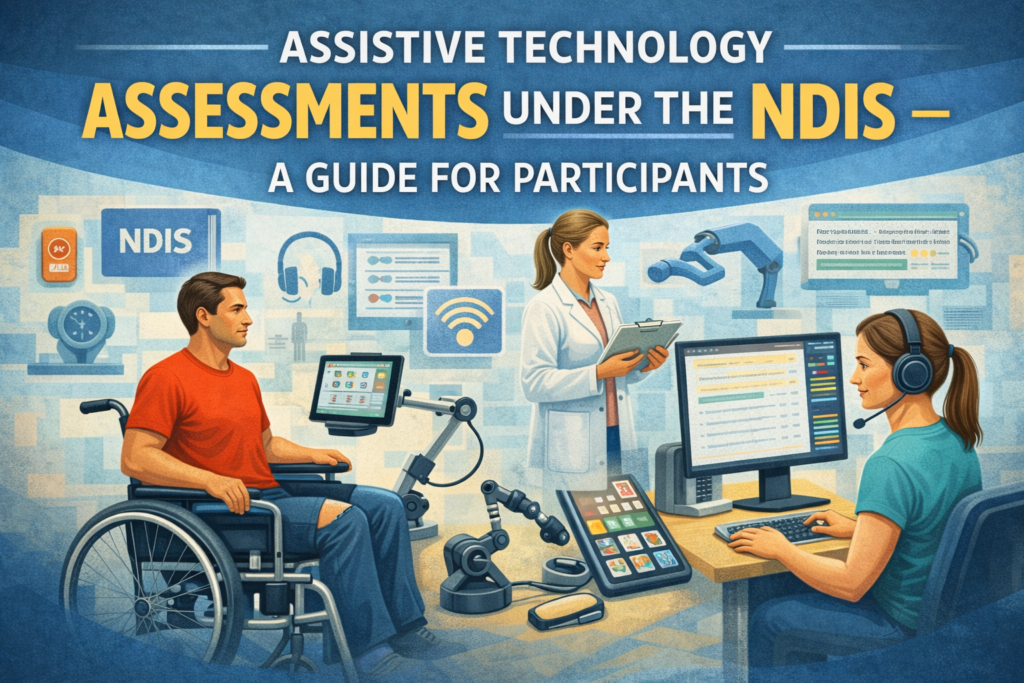
Assistive technology — from customised wheelchairs and communication devices to shower chairs, smart home controls, and vehicle modifications — can be genuinely life-changing for people with disability. And for eligible NDIS participants, a significant range of this equipment is fully funded.
But accessing that funding is not simply a matter of choosing what you want and submitting an invoice. The NDIS requires clinical evidence that the equipment is necessary, appropriate, and the best-value solution for your specific needs. That evidence comes from an NDIS assistive technology assessment — a structured evaluation conducted by a qualified occupational therapist (OT) or other relevant allied health professional.
This guide explains the entire process: what an AT assessment involves, which categories of assistive technology the NDIS funds, how the prescription and approval process works, and how to ensure you get equipment that actually fits your life.
In this article
- What is assistive technology under the NDIS?
- What is an NDIS assistive technology assessment?
- Who needs an AT assessment?
- NDIS AT categories — low, mid, and high cost
- What assistive technology does the NDIS fund?
- What does the OT assess?
- Why AT trials matter — and what they involve
- How the AT assessment and approval process works
- How NDIS funding works for assistive technology
- Tips for getting the right AT outcome
- Frequently asked questions
What Is Assistive Technology Under the NDIS?
Assistive technology (AT) is any device, equipment, or system that helps a person with disability perform tasks they would otherwise find difficult or impossible to do independently. The NDIS defines assistive technology broadly — from simple low-cost items like bath seats and long-handled grabbers, through to sophisticated high-cost equipment like power wheelchairs, ceiling hoists, and augmentative communication devices.
To be funded by the NDIS, assistive technology must be:
- Related to your disability — it must address a functional limitation arising from your NDIS disability, not a general medical or age-related need
- Reasonable and necessary — it must represent value for money, be the most appropriate solution for your needs, and not be more appropriately funded by another system (such as Medicare or private health insurance)
- Safe and fit for purpose — the equipment must meet Australian Standards and be appropriate for your body, environment, and daily activities
- Supported by clinical evidence — for anything above low-cost AT, the NDIA requires a written assessment and prescription from a qualified AT assessor, most commonly an occupational therapist
What Is an NDIS Assistive Technology Assessment?
An NDIS AT assessment is a structured clinical evaluation in which a qualified occupational therapist assesses a participant’s functional needs, trialling relevant equipment and identifying which specific devices, modifications, or systems would best address those needs — then producing a written prescription and report to support NDIS funding.
The assessment is not a simple product recommendation. It is a clinical process that must demonstrate:
- What functional limitation the participant has and how it affects their daily life
- Why assistive technology is an appropriate solution for that limitation
- Which specific product or configuration best meets the participant’s individual needs, body dimensions, environment, and goals
- That the participant or their support network can use the equipment safely
- That the recommended solution represents reasonable value for money compared to alternatives
An AT assessment is not a shopping list. Many participants arrive hoping the OT will simply “approve” the equipment they’ve already found online. In reality, the OT must independently assess your needs and recommend the most clinically appropriate solution — which may or may not be the product you had in mind. This clinical independence is what gives the NDIA confidence in the recommendation.
Who Needs an NDIS Assistive Technology Assessment?
You need a formal AT assessment for any assistive technology that is mid-cost or high-cost — broadly, anything that costs more than $1,500 per item, or anything that requires individual customisation or fitting. This includes:
- Manual or power wheelchairs and scooters
- Customised seating and postural support systems
- Ceiling hoists, mobile hoists, and transfer equipment
- Augmentative and alternative communication (AAC) devices
- Vehicle modifications
- Adjustable beds and pressure care mattresses
- Complex bathing and showering equipment
- Prosthetics and orthotics funded through the NDIS
- Smart home and environmental control systems
- Hearing assistive technology (funded through the NDIS rather than Hearing Australia)
Low-cost AT — items under approximately $1,500 that are “off the shelf” and do not require individual fitting — can generally be purchased directly from your Core or Capital Supports budget without a formal assessment. Examples include bath seats, long-handled grabbers, non-slip mats, and basic communication aids.
NDIS AT Categories — Low, Mid, and High Cost
The NDIS classifies assistive technology into three cost tiers, each with different evidence and approval requirements.
| Category | Cost range | Evidence required | Examples |
|---|---|---|---|
| Low cost | Under ~$1,500 | Minimal — participant self-selects | Bath seats, grab rails, long-handled aids, basic daily living equipment |
| Mid cost | $1,500 – $15,000 | AT assessor recommendation and quote | Manual wheelchairs, basic AAC devices, adjustable beds, simple hoists |
| High cost | Over $15,000 | Full AT assessment report, trial documentation, multiple quotes, NDIA approval | Power wheelchairs, customised seating, ceiling hoist systems, complex AAC, vehicle modifications |
Cost thresholds are indicative. NDIS AT Pricing Arrangements are updated annually. Always confirm with your OT and support coordinator.
What Assistive Technology Does the NDIS Fund?
The NDIS funds a wide range of AT across many areas of daily life. Below is an overview of the most commonly funded categories — though this is not exhaustive, and your OT assessment may identify equipment not listed here.
| AT category | Examples of funded equipment | Who typically assesses |
|---|---|---|
| Mobility & transport | Manual wheelchairs, power wheelchairs, scooters, walking frames, crutches, vehicle modifications | OT (± physiotherapist for mobility) |
| Seating & positioning | Customised wheelchair seating, postural support systems, standing frames, specialised mattresses, pressure care | OT ± physiotherapist |
| Personal care | Shower chairs, commode chairs, bath lifts, ceiling hoists, mobile hoists, transfer boards, hospital beds | OT |
| Communication | Speech generating devices (SGDs), AAC apps and hardware, eye gaze systems, symbol boards | Speech pathologist ± OT |
| Vision & hearing | Screen readers, magnification software, Braille displays, hearing loop systems, alerting devices | OT, audiologist, or low vision specialist |
| Daily living aids | Adapted cutlery, dressing aids, environmental controls, modified kitchen equipment, smart home devices | OT |
| Home & environment | Environmental control units, automated door openers, smart locks, emergency call systems | OT |
| Prosthetics & orthotics | Prosthetic limbs, ankle-foot orthoses (AFOs), spinal braces, custom orthotic insoles | OT ± orthotist/prosthetist |
What Does the OT Assess During an AT Assessment?
A thorough assistive technology assessment looks at the person, the task, and the environment together — not the equipment in isolation. Your OT will assess each of the following:
Your functional abilities and limitations
The OT evaluates your strength, range of motion, balance, coordination, vision, cognition, communication, and endurance as they relate to the tasks the AT will support. This baseline assessment determines which equipment features you need — and which you don’t — and ensures the prescription is genuinely matched to your body.
Your daily tasks and goals
What do you want to do that you currently can’t — or can’t do safely or independently? The OT needs to understand your specific activities, routines, and goals. A power wheelchair prescription for someone who primarily uses their chair outdoors on rough terrain will look very different from one for someone who mainly moves around a small apartment.
Your environments
AT that works beautifully in a clinic may fail completely at home. The OT considers all the environments in which you will use the equipment: the dimensions of your home, the surface types, the distance to be covered, whether you use lifts or stairs, whether you will transport the equipment in a vehicle, and any workplace or school environments where it will be used.
Your support network
If support workers or family members will be involved in using, setting up, or maintaining the equipment, the OT must factor in their capacity to do so safely. A ceiling hoist system, for example, requires support workers to be trained before it can be used — and the OT will note this in their report.
The available options
The OT will consider multiple products that could meet your needs, document why they have recommended one over others, and ensure that the recommended solution represents reasonable value for money. For high-cost AT, this comparative analysis is a requirement of the NDIA.
Why AT Trials Matter — and What They Involve
For most mid- and high-cost assistive technology, the NDIA expects — and in many cases requires — that the participant has trialled the recommended equipment before funding is approved. A trial demonstrates that the AT is safe, that the participant can use it effectively, and that it genuinely meets the identified functional need.
What a trial involves
A trial is typically arranged by the OT through an AT supplier or loan library. You use the equipment in your actual home and community environments — not in a showroom — over a period long enough to assess it properly. For a complex power wheelchair, this might be several sessions over a few weeks. For a communication device, it might be a month-long loan.
What the OT documents from the trial
- Whether the participant was able to operate the equipment safely and effectively
- Any adjustments required to the configuration or settings
- The participant’s feedback on comfort, usability, and fit with their daily routine
- Whether the trial confirmed the original recommendation, or whether a different product should be considered
Trial documentation is not optional for high-cost AT. If you skip the trial or the OT does not document it properly, the NDIA may reject your AT funding request regardless of how well-written the report is. Your OT should arrange and attend the trial as part of the assessment process — not as an afterthought.
What if a trial is not possible?
In some circumstances — such as for bespoke custom-manufactured equipment or when a participant’s condition means a trial would be impractical — the OT can document clinical justification for why a trial was not conducted. This requires careful reasoning in the report and is not a shortcut that should be taken lightly.
How the AT Assessment and Approval Process Works
Referral to an AT-experienced OT
Contact TEAH via our referral form, email, or phone. Our intake team will match you with an OT experienced in the specific AT category you need — whether that’s complex seating, AAC, or daily living equipment.
Initial assessment appointment
Your OT meets with you in your home or a relevant environment to assess your functional needs, tasks, and environments. They will discuss your goals and identify the category of AT most likely to help. For complex AT, this is the beginning of a multi-stage process — not a single appointment.
Product shortlisting and trial arrangement
Based on the initial assessment, your OT identifies two or three candidate products and arranges loan trials through an AT supplier or equipment library. They may attend the trial sessions to observe your use of the equipment in context.
AT report and prescription written
Your OT writes a detailed AT report including your functional assessment, the clinical justification for the recommended equipment, trial documentation, product specifications, and — for customised equipment — precise measurements and configuration details. You receive a draft to review before submission.
Quotes obtained and submitted
For mid-cost AT, one supplier quote is typically sufficient. For high-cost AT, the NDIA generally expects two quotes (or documented justification if only one supplier can provide the equipment). The report and quotes are submitted to the NDIA or your plan manager for approval.
NDIA approval and equipment order
Once approved, your Capital Supports funding is released and the equipment is ordered. Lead times vary significantly — some items are available within days, while custom-manufactured equipment such as power wheelchairs or bespoke seating systems may take 8–16 weeks to manufacture and deliver.
Fitting, handover, and training
When the equipment arrives, your OT and the supplier work together to ensure the fit and setup are correct, make any final adjustments, and provide training to you and your support workers. For complex AT, this handover process is as important as the assessment — poorly fitted or incorrectly set up equipment can cause injury or go unused.
How NDIS Funding Works for Assistive Technology
Assistive technology is funded through the Capital Supports — Assistive Technology budget in your NDIS plan. Like home modifications, this is a separate allocation from your Core and Capacity Building budgets.
Does AT funding need to be in my plan already?
For your plan to fund AT, you generally need Capital Supports — Assistive Technology funding already allocated. If your current plan does not include this, you have two options:
- Request a plan variation — for urgent or clearly identified needs, your support coordinator can request the NDIA add AT funding between plan reviews
- Include it in your next plan review — submit the OT AT report as supporting evidence to have Capital Supports funding included in your new plan
AT assessment costs are separate
The OT assessment itself — all the appointments, trial coordination, report writing, fitting, and training hours — is funded from your Capacity Building — Improved Daily Living budget, not Capital Supports. This is an important distinction that catches many participants and support coordinators off guard.
AT cost at a glance — 2025–26 NDIS rates
| Item | Typical OT hours | Estimated cost | Budget line |
|---|---|---|---|
| Simple AT assessment & report | 3–5 hrs | $580–$970 | CB — Improved Daily Living |
| Complex AT assessment (with trials) | 8–16 hrs | $1,550–$3,100 | CB — Improved Daily Living |
| Fitting, training & handover | 2–4 hrs | $390–$780 | CB — Improved Daily Living |
| The AT equipment itself | — | Varies — $1,500 to $100,000+ | Capital — Assistive Technology |
OT time billed at $193.99/hr (weekday rate, 2025–26). Equipment costs vary widely by product and supplier.
Maintenance, repairs, and replacements
Your Capital Supports budget can also fund the ongoing maintenance and repair of funded AT, and eventually its replacement when it reaches the end of its useful life. Your OT report should note the expected lifespan of the recommended equipment and any maintenance requirements, so these costs can be included in future plan reviews.
Tips for Getting the Right AT Outcome
- Choose an OT with specific AT experience. Not all OTs have equal expertise across all AT categories. An OT who regularly prescribes power wheelchairs will have a very different depth of knowledge from one who primarily conducts functional capacity assessments. Ask your provider about their experience in the specific AT category you need.
- Don’t arrive with a fixed idea of the product you want. It’s fine to share products you’ve researched — in fact, it helps the OT understand your priorities. But be open to the possibility that a different product may better meet your clinical needs. The OT’s job is to match equipment to your body and life, not to approve your shopping preference.
- Insist on a real trial in your actual environments. A showroom demonstration is not a trial. Your OT should arrange for you to use the equipment in your home, your workplace, your community — wherever you will actually use it. This protects you from receiving equipment that doesn’t work in your real life.
- Bring your support workers to the fitting and training. Equipment that your support workers don’t know how to use safely will end up unused — or worse, will cause injury. Make sure they are present for the handover and training session.
- Keep your receipts and warranty information. For repairs, insurance purposes, and future plan reviews, maintain a record of what was funded, when it was purchased, and what the warranty period is.
- Review your AT needs at every plan review. Your functional needs will change over time — and so will the available technology. At each plan review, discuss with your OT whether your current AT still meets your needs or whether an updated assessment is warranted.
NDIS Registered — WA · NT · QLD · VIC
Need an assistive technology assessment?
TEAH’s occupational therapists conduct AT assessments across Darwin (NT), Perth (WA), Brisbane (QLD), and Victoria — with trials, NDIA-quality reports, and full fitting support.
Frequently Asked Questions
Can I buy AT without going through an OT assessment?
For low-cost AT (under approximately $1,500), yes — you can generally purchase directly from your Core or Capital Supports budget without a formal assessment. For mid- and high-cost AT, a formal OT assessment is required by the NDIA before funding will be approved.
What if the NDIA rejects my AT funding request?
If your AT request is rejected, you can request an internal review of the decision. Your OT can provide additional clinical documentation or clarification to support the review. If the internal review upholds the rejection, you can escalate to the Administrative Appeals Tribunal (AAT). A well-prepared OT report significantly reduces the likelihood of rejection in the first place.
My condition is progressive — how do I get AT that will still work in 2–3 years?
A good OT will assess your current needs and your anticipated future needs together, recommending equipment that allows for adjustment as your condition progresses — or that can be replaced when it no longer meets your needs. Discuss your condition’s trajectory openly with your OT and ask how they are accounting for it in their recommendation.
Can I get a second opinion on an AT recommendation?
Yes. If you are not confident in the AT recommendation you’ve received, you have every right to seek an assessment from another OT. A second opinion is particularly valuable for high-cost AT where the funding request is significant and the equipment will be used for many years.
What if the AT I need isn’t listed in the NDIS price guide?
The NDIS can fund AT that isn’t explicitly listed, provided it meets the reasonable and necessary criteria and is supported by clinical evidence from your OT assessment. Your OT and support coordinator can advise on whether a specific item is fundable and how to make the case to the NDIA.
How do I start the AT assessment process with TEAH?
Make a referral via our online form, email referrals@topendalliedhealth.com.au, or call 1300 203 059. Our intake team will confirm your NDIS funding, discuss the AT you need, and match you with an OT who has relevant AT experience in your area.
Summary
An NDIS assistive technology assessment is the clinical gateway to equipment that can genuinely transform daily life — but the process requires careful preparation, the right OT, and a thorough report that gives the NDIA the evidence it needs to fund your equipment.
The key steps are clear: find an OT with relevant AT expertise, expect a multi-appointment process for complex AT, insist on real-world trials, review your draft report carefully, and make sure your support workers are trained when the equipment arrives. Done well, the AT assessment process delivers equipment that fits your body, your home, and your life — and that you will actually use.
At TEAH, our occupational therapists conduct AT assessments and prescriptions across Darwin (NT), Perth (WA), Brisbane (QLD), and Victoria, with experience across mobility, seating, daily living, and environmental control technology.
Book an AT assessment with TEAH
Darwin (NT) · Perth (WA) · Brisbane (QLD) · Victoria
Related articles
TEAH Allied Health Team
Top End Allied Health (TEAH) is an NDIS-registered allied health provider delivering occupational therapy, speech pathology, physiotherapy, and supported accommodation across WA, NT, QLD, and Victoria. Referrals: referrals@topendalliedhealth.com.au | 1300 203 059