Reading time: 10 minutes | Updated: April 2026 | Written by: TEAH Allied Health Team
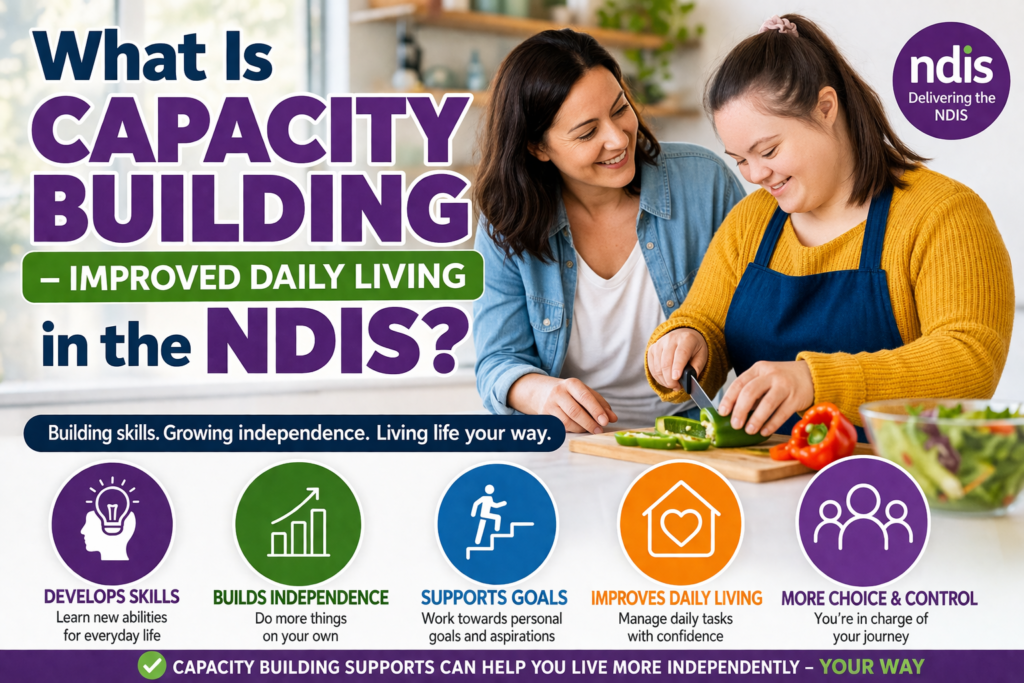
If you have an NDIS plan, you have probably seen the term Capacity Building — Improved Daily Living somewhere in your funding breakdown. It may have a dollar amount next to it, or it may be absent from your plan entirely. Either way, understanding what this budget category actually covers — and how to make the most of it — can make a significant difference to the supports you are able to access.
Improved Daily Living (IDL) is the NDIS funding category that pays for occupational therapy, speech pathology, physiotherapy, psychology, and most other allied health services in a participant’s plan. It is one of the most valuable — and most underutilised — parts of the NDIS funding framework. This guide explains exactly what it covers, what it does not, how to check if you have it, and how to use it strategically to unlock other supports.
In this article
- What is Capacity Building in the NDIS?
- What is Improved Daily Living specifically?
- What does Improved Daily Living fund?
- Improved Daily Living vs Core Supports — what’s the difference?
- Which allied health professionals can I access through IDL?
- How to use IDL strategically — assessments that unlock other funding
- How much IDL funding should be in my plan?
- What if IDL is not in my plan?
- Getting the most from your IDL budget
- Frequently asked questions
What Is Capacity Building in the NDIS?
Every NDIS plan is divided into three broad budget categories. Understanding where Capacity Building sits within this structure is the starting point for understanding IDL.
| Budget category | What it funds | Is it flexible? |
|---|---|---|
| Core Supports | Day-to-day assistance — personal care, community access, consumables, transport | Mostly flexible across subcategories |
| Capital Supports | One-off items — assistive technology, home modifications, SDA | Fixed — earmarked for specific items |
| Capacity Building ★ | Therapy, assessments, skill development, training — investing in future independence | Fixed by subcategory |
Capacity Building is the investment arm of the NDIS. Whereas Core Supports fund the help you need right now, Capacity Building is meant to fund supports that build your skills, reduce your dependence on ongoing funded assistance, and help you live more independently over time. The NDIS’s philosophy is that a dollar spent on therapy today should, over time, reduce the dollars needed for daily support.
Capacity Building is divided into eight subcategories. Each subcategory has its own ring-fenced budget — you cannot move money freely between them. The subcategory that covers the vast majority of allied health services, including all occupational therapy, is Improved Daily Living.
The 8 Capacity Building subcategories
What Is Improved Daily Living Specifically?
Capacity Building — Improved Daily Living (support purpose code 15) funds assessment, training, and therapy that helps a participant develop skills, build capacity, and participate more fully in the activities of daily life. In plain language: it pays for the allied health professionals who assess your needs, deliver therapy, and write the clinical reports your NDIS plan relies on.
The NDIA describes the purpose of IDL as helping participants to “develop, improve or maintain their independence and community participation skills.” This encompasses a wide range of activity — from a one-off assessment that takes two hours, to a structured twelve-week therapy program, to ongoing consultations that support a participant across multiple plan years.
The intent behind IDL: The NDIS funds Improved Daily Living on the premise that investing in therapy and assessment today builds independence that reduces the need for ongoing Core Supports in the future. In practice, many participants use IDL for both capacity-building therapy and for assessments that unlock other types of funding — making it one of the most strategically important budgets in any NDIS plan.
What Does Improved Daily Living Fund?
IDL covers a broader range of supports than most participants realise. Here is a comprehensive breakdown of what it funds:
Allied health assessments
Any assessment conducted by a qualified allied health professional that is related to your disability and NDIS goals is fundable under IDL. This includes:
- Functional Capacity Assessments (FCAs) — the comprehensive OT evaluation that documents your support needs across all areas of daily life. Learn more about what an FCA involves →
- Home modification assessments — on-site OT evaluations that identify access barriers in your home and produce reports for Capital Supports funding. What a home modification assessment includes →
- Assistive technology assessments and prescriptions — OT evaluations that identify, trial, and prescribe AT funded through your Capital Supports budget. How AT assessments work →
- SIL and SDA assessments — OT reports that support applications for Supported Independent Living and Specialist Disability Accommodation. SIL and SDA assessment guide →
- Speech pathology assessments — communication, swallowing, and language assessments conducted by a speech pathologist
- Physiotherapy assessments — movement, strength, and mobility assessments
- Psychology assessments — functional assessments related to mental health, behaviour, and cognitive capacity
- Positive behaviour support assessments — functional behaviour assessments that inform Behaviour Support Plans
Individual therapy sessions
One-on-one therapy delivered by a qualified allied health professional — occupational therapist, speech pathologist, physiotherapist, psychologist, or positive behaviour support practitioner — is funded under IDL when it is:
- Goal-directed and aligned with the participant’s NDIS plan goals
- Delivered by an appropriately qualified and registered professional
- Designed to build capacity rather than simply maintain current function
- Related to the participant’s NDIS disability, not a general health condition
Group therapy
Therapy delivered in a group setting — such as a social skills group for participants with ASD, a fine motor group for children, or a life skills program — is fundable under IDL. Group therapy rates are lower per participant than individual therapy, making it a cost-effective way to stretch limited IDL budgets while still accessing clinical expertise.
Report writing and non-face-to-face work
The NDIS allows allied health providers to claim for the time they spend writing reports, completing clinical documentation, reviewing existing assessments, and communicating with other providers — up to a reasonable limit. For OTs, this is particularly important because NDIS reports are detailed clinical documents that can take many hours to produce.
Support worker and carer training
An allied health professional can be funded under IDL to train your support workers or family members in specific techniques relevant to your care — manual handling, communication strategies, sensory regulation approaches, behaviour response protocols, or safe use of assistive equipment. This is an underused but high-value use of IDL funding.
Telehealth allied health services
Therapy and some assessment services delivered via video call are fundable under IDL at the same rates as in-person services. Telehealth is particularly valuable for participants in regional and remote areas where local allied health services are scarce.
AT fitting, training, and handover
When your assistive technology is delivered, the OT’s time spent fitting, adjusting, and training you and your support workers to use the equipment is funded from IDL — even though the equipment itself came from Capital Supports.
| What IDL funds | Who delivers it | Typical IDL draw |
|---|---|---|
| Functional Capacity Assessment | Occupational therapist | $1,552–$2,328 |
| Home modification report | Occupational therapist | $388–$776 |
| AT assessment, trial and report | Occupational therapist | $1,164–$3,104 |
| SIL / SDA assessment and report | Occupational therapist | $1,940–$3,880 |
| Individual OT therapy (12 sessions) | Occupational therapist | ~$2,328 |
| Speech pathology assessment | Speech pathologist | $388–$970 |
| Positive behaviour support assessment | PBS practitioner | $970–$2,910 |
| Psychology sessions (12 sessions) | Psychologist | ~$2,700–$3,500 |
| Support worker training by OT | Occupational therapist | $388–$776 |
OT costs calculated at $193.99/hr (2025–26 NDIS weekday rate). Psychology and speech pathology rates vary — confirm with your provider.
Improved Daily Living vs Core Supports — What’s the Difference?
This is one of the most common points of confusion for participants and families navigating an NDIS plan. The distinction is fundamental — and getting it wrong means either trying to fund therapy from the wrong budget, or missing out on therapy entirely because you don’t know which budget to look in.
| Improved Daily Living (CB) | Core Supports | |
|---|---|---|
| Purpose | Build skills and capacity for the future | Support you with everyday tasks right now |
| Who delivers the service | Allied health professionals (OTs, SPs, physios, psychologists) | Support workers, community participation workers |
| Example supports | OT assessment, speech therapy, physiotherapy, FCA report | Personal care, meal preparation assistance, transport to appointments |
| Qualifications required | AHPRA registration or equivalent professional accreditation | Certificate III/IV in Individual Support or equivalent |
| Flexibility | Fixed within subcategory — cannot move to other CB subcategories | Flexible across most Core subcategories |
| Rollover to next plan | Generally does not roll over | May roll over under certain conditions |
The rule of thumb: If a qualified clinician is providing the service, it comes from Improved Daily Living. If a support worker is providing the service, it comes from Core Supports. Mixing these up — for example, trying to pay an OT’s invoice from Core Supports — will result in payment being rejected.
Which Allied Health Professionals Can I Access Through IDL?
Improved Daily Living is not limited to occupational therapy. The budget funds a wide range of qualified allied health professionals, as long as the services they provide are related to your NDIS disability and your plan goals.
Occupational Therapy
FCAs, home modification reports, AT assessments, SIL/SDA reports, daily living therapy, sensory assessments, cognitive rehabilitation, paediatric OT
Speech Pathology
Communication assessments, AAC assessment and training, fluency therapy, language therapy, feeding and swallowing, social communication
Physiotherapy
Mobility assessments, exercise programs, pain management, hydrotherapy, neurological physiotherapy, manual therapy for disability-related conditions
Psychology
Functional cognitive assessments, mental health therapy (where disability-related), behaviour assessment, neuropsychological assessment
Positive Behaviour Support
Functional behaviour assessment, behaviour support planning, restrictive practice authorisation, training for support workers and families
Dietetics
Nutrition assessment and management where eating or swallowing difficulties arise from a participant’s disability
Exercise Physiology
Therapeutic exercise programs for disability-related functional goals — improving strength, endurance, mobility, and community participation
Social Work
Therapeutic counselling, family support, transition planning, psychosocial capacity building where delivered by an accredited social worker
TEAH provides occupational therapy, speech pathology, and physiotherapy services across WA, NT, QLD, and Victoria — all fundable from your Improved Daily Living budget.
How to Use IDL Strategically — Assessments That Unlock Other Funding
One of the least understood aspects of IDL is how it acts as a gateway to other, much larger forms of NDIS funding. Certain OT assessments funded by IDL produce clinical reports that directly unlock Capital Supports — funding that can be worth tens or even hundreds of thousands of dollars.
This means that a well-timed IDL investment in an OT assessment can return many times its cost in new funding access.
Prioritise assessments that unlock Capital Supports. If your plan is approaching its review date and you have limited IDL funding remaining, the highest-return use of that budget is an assessment that produces a clinical report — not just therapy sessions. An OT assessment that unlocks $30,000 of home modification funding is a far better use of $700 than seven hours of therapy.
How Much IDL Funding Should Be in My Plan?
There is no standard IDL allocation. The amount included in your plan depends on what you can demonstrate you need — which is itself determined largely by the clinical evidence submitted at your last plan review. Participants with the same disability can end up with wildly different IDL allocations depending on how thoroughly their therapy needs were documented.
As a practical guide, here is how IDL allocations tend to vary by need level:
| Participant profile | Typical IDL range (annual) | What it generally covers |
|---|---|---|
| Minimal ongoing therapy needs | $1,500–$3,000 | One FCA or AT assessment per plan year |
| Moderate — some ongoing therapy | $3,000–$8,000 | FCA + monthly OT sessions + home modification assessment |
| Significant — regular therapy program | $8,000–$20,000 | OT + SP + PBS or psychology, fortnightly sessions |
| Complex — multiple disciplines, major assessments | $20,000–$50,000+ | SIL/SDA assessments, AT prescriptions, ongoing multidisciplinary therapy |
If your current IDL allocation feels insufficient for the therapy your condition genuinely requires, the solution is better clinical evidence at your next plan review — which means engaging an OT or allied health professional well before your review date to document your needs comprehensively.
What If IDL Is Not in My Plan?
If you look at your NDIS plan and find no Capacity Building — Improved Daily Living allocation, it means either the NDIA did not include it at your plan meeting, or the clinical evidence submitted at the time did not support including it. This is unfortunately common — and it is fixable.
Request a plan variation
If your therapy needs are urgent — for example, you need an FCA to support an imminent plan review, or you need an AT assessment for equipment that is affecting your daily safety — contact the NDIA and request a plan variation. A plan variation is an amendment to your current plan without a full review. You will need supporting evidence from your GP, support coordinator, or an existing allied health provider explaining why the IDL funding is needed now.
Prepare thoroughly for your next plan review
If your therapy needs are not immediately urgent, the most effective approach is to document them clearly before your next scheduled plan review. Gather supporting letters from your GP and any current allied health providers, and if possible, commission a private OT assessment that documents your therapy needs — which can then be submitted as evidence to include IDL funding in your next plan.
Talk to your support coordinator
If you have a support coordinator, they should be actively advocating for IDL funding on your behalf. If your support coordinator has not raised the absence of IDL in your plan, bring it up at your next meeting. Access to therapy is a fundamental part of the NDIS’s purpose — a plan without any IDL funding should be questioned.
NDIS Registered — WA · NT · QLD · VIC
Ready to use your Improved Daily Living budget?
TEAH’s OTs, speech pathologists, and physiotherapists work across Darwin, Perth, Brisbane, and Victoria — helping participants make the most of their Capacity Building funding with low wait times and NDIA-quality reports.
Getting the Most from Your IDL Budget
- Plan your therapy year before the money arrives. Identify your highest-priority OT and allied health needs at the start of your plan year — and book appointments early. IDL budgets that sit untouched for the first nine months of a plan are frequently underused or lost at plan expiry.
- Start with assessments, not just therapy. If you have not had a recent FCA or AT assessment, prioritise those first. They produce clinical reports that may unlock significantly more funding — both Capital Supports and additional IDL in your next plan — making subsequent therapy more fundable.
- Use your IDL budget to justify more IDL in your next plan. The NDIA bases your next plan’s IDL allocation partly on how much you used in the current plan and what your allied health providers recommend. Consistent, well-documented therapy use, with clear goal-progress notes from your OT, is the strongest foundation for a larger allocation next time.
- Don’t let your IDL budget expire unused. Unspent Capacity Building funding generally does not roll over. Set a calendar reminder three months before your plan expiry to review your IDL balance and schedule any remaining appointments.
- Ask your OT to write goal-aligned progress notes. For every therapy session, your OT should be documenting progress toward your NDIS goals. These notes are the evidence base for retaining or increasing your IDL allocation at plan review — and they protect against the NDIA questioning whether therapy is producing measurable outcomes.
- Consider group therapy to extend your budget. If your IDL budget is limited, group therapy delivered by a qualified OT or speech pathologist costs roughly half the individual rate per person. It is not right for every participant, but for social skills, life skills, and some fine motor programs it can be highly effective and cost-efficient.
Frequently Asked Questions
Can I move money from Improved Daily Living to another Capacity Building subcategory?
No. Capacity Building subcategories are ring-fenced — money in Improved Daily Living can only be spent on IDL supports. You cannot shift it to Support Coordination, Improved Relationships, or any other Capacity Building subcategory. If you consistently have money left over in one subcategory and not enough in another, raise this at your next plan review.
Does Improved Daily Living funding roll over if I don’t use it all?
Generally no. Capacity Building — Improved Daily Living funding does not automatically carry over to your next plan if it is unspent. This is different from Core Supports, which may roll over under certain conditions. Use-it-or-lose-it applies — which is why planning your therapy year in advance and booking appointments early in the plan year matters.
Is Improved Daily Living the same as therapeutic supports?
They are closely related but not identical. “Therapeutic supports” is the NDIS’s broader term for supports delivered by allied health professionals. Improved Daily Living is the Capacity Building subcategory that funds most therapeutic supports. Some therapeutic supports may also sit under other Capacity Building subcategories — such as Improved Relationships (for some behaviour support activities) or Improved Health and Wellbeing (for some exercise physiology).
Can a therapy assistant deliver IDL-funded services?
Yes — under the supervision of a registered allied health professional. Allied health assistants (therapy assistants) can deliver specific, delegated therapy activities under an OT’s or speech pathologist’s supervision at a lower hourly rate, which stretches your IDL budget further. The supervising allied health professional remains clinically responsible for the participant’s therapy program.
What if my allied health needs span multiple Capacity Building subcategories?
This is common for participants with complex needs. For example, Positive Behaviour Support may be funded from Improved Relationships rather than Improved Daily Living. Your support coordinator can help map your therapy needs to the correct subcategories and ensure each is funded appropriately in your plan. Getting this mapping right at plan review prevents scenarios where one subcategory runs out while another sits unspent.
How do I know which OT services are covered by my IDL budget?
Any OT service delivered by an AHPRA-registered occupational therapist that is related to your NDIS disability and your NDIS goals can be funded from Improved Daily Living. When you make a referral to TEAH, our intake team will confirm which specific services are appropriate for your plan before your first appointment. Call us on 1300 203 059 or submit a referral online.
Summary
Capacity Building — Improved Daily Living is the NDIS funding subcategory that makes therapy, assessments, and allied health supports possible. It covers the full range of OT services — from Functional Capacity Assessments and home modification reports through to ongoing individual therapy and support worker training — as well as speech pathology, physiotherapy, psychology, and more.
Used strategically, IDL funding is far more than a therapy budget. It is the gateway to Capital Supports for assistive technology and home modifications, the clinical evidence base for SIL and SDA applications, and the foundation of every NDIS plan review. Understanding how it works — and using it deliberately — is one of the most effective things a participant or support coordinator can do to maximise outcomes under the scheme.
TEAH works with NDIS participants across Darwin (NT), Perth (WA), Brisbane (QLD), and Victoria to make the most of every dollar of Improved Daily Living funding — with assessments that produce NDIA-quality reports and therapy programs aligned to measurable goals.
Use your IDL budget with TEAH
Darwin (NT) · Perth (WA) · Brisbane (QLD) · Victoria
Related articles
- How does the NDIS fund occupational therapy in 2025–26?
- What is a Functional Capacity Assessment and what does it include?
- Assistive technology assessments under the NDIS — a guide for participants
- SIL and SDA OT assessments — what support coordinators need to know
- Our Occupational Therapy Services — Darwin, Perth, Brisbane & Victoria
TEAH Allied Health Team
Top End Allied Health (TEAH) is an NDIS-registered allied health provider delivering occupational therapy, speech pathology, physiotherapy, and supported accommodation across WA, NT, QLD, and Victoria. Referrals: referrals@topendalliedhealth.com.au | 1300 203 059