
Reading time: 10 minutes | Updated: April 2026 | Written by: TEAH Allied Health Team
Your NDIS plan review is the moment that determines whether your funding for the next 12 months — or longer — reflects what you actually need. It is not a rubber stamp. The NDIA will scrutinise the evidence submitted, and plans that arrive without strong clinical documentation routinely come back with funding reduced, supports removed, or critical items simply not included.
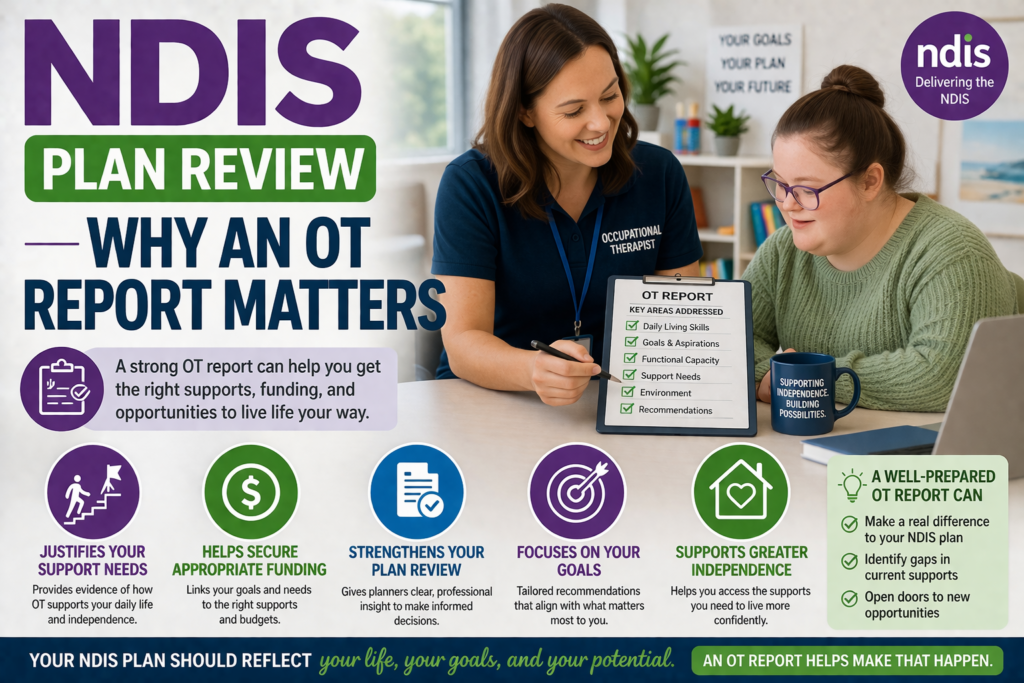
Of all the supporting documents you can submit for a plan review, an occupational therapy report is the most consistently powerful. It is objective, standardised, clinically grounded, and speaks directly to the “reasonable and necessary” language the NDIA uses to make every funding decision. This article explains exactly why that is, what an OT report needs to contain to be effective at review, and how to time and plan your OT engagement to give your review the best possible outcome.
In this article
- What is an NDIS plan review?
- Why an OT report is the most powerful evidence you can submit
- What the NDIA looks for at plan review
- What an OT report must do to be effective at review
- Which OT reports matter most — and when
- Timing — when to commission your OT report
- What if your plan has already been reduced?
- Building your full review evidence package
- Frequently asked questions
What Is an NDIS Plan Review?
An NDIS plan review is a formal process in which the NDIA reassesses a participant’s funded supports and produces a new plan for the coming period. Reviews typically occur annually, though some participants are on longer or shorter review cycles depending on their disability and circumstances.
There are two types of reviews:
Scheduled plan review
Occurs at the end of your current plan period. The NDIA reviews all funded supports and produces a new plan. Your submitted evidence directly determines what is included.
Change of circumstances review
Triggered when something significant changes — a new diagnosis, deterioration in function, change in living situation, or loss of informal support. Can occur at any time during a plan year.
In both cases, the NDIA makes funding decisions based on the evidence presented. The quality and completeness of that evidence — not the severity of a participant’s disability in isolation — is often the determining factor in whether a plan is adequate, generous, or insufficient.
The hard truth about plan reviews: Two participants with identical disabilities and identical real-world support needs can receive radically different plans based solely on the evidence submitted at their review. A participant with a comprehensive OT report may receive fully funded personal care, SIL, AT, and home modifications. A participant without one may receive a fraction of those supports — not because their needs are less real, but because the NDIA had no clinical evidence to justify them.
Why an OT Report Is the Most Powerful Evidence You Can Submit
Participants and support coordinators submit many types of supporting documentation at plan reviews — GP letters, specialist reports, support worker notes, carer statements, and participant statements. All of these have value. But none of them consistently carries the weight of a comprehensive occupational therapy report. Here is why.
1. OT reports use the NDIA’s own language
The NDIA makes funding decisions based on whether a support is “reasonable and necessary” — meaning it relates to the participant’s disability, represents value for money, and is the most appropriate way to address the identified need. A well-written OT report is structured precisely around this framework. It documents functional impairment, links it to specific supports, and justifies why those supports are both necessary and appropriate. GP letters and carer statements rarely do this with the same precision.
2. OT reports provide objective, standardised evidence
Standardised assessment tools — the WHODAS 2.0, Functional Independence Measure, Barthel Index, and others — produce numerical scores that give the NDIA objective, comparable data on functional capacity. A carer saying “my son really struggles with personal care” is advocacy. An OT documenting a Barthel ADL score of 35/100 with observed deficits in showering, dressing, and transfers is clinical evidence. The NDIA is trained to respond differently to each.
3. OT reports are produced by AHPRA-registered professionals
The NDIA gives significant weight to evidence from registered health professionals who are bound by professional standards, ethics codes, and registration requirements. An occupational therapist who signs an assessment report is professionally accountable for its contents in a way that a carer or support coordinator is not. This professional accountability increases the credibility of the report in the NDIA’s assessment process.
4. OT reports address the specific funding items under review
An experienced OT writing a plan review report will structure their findings and recommendations around the specific support categories being reviewed — Core Supports hours, Capacity Building needs, Capital Supports items. They know which evidence the NDIA requires for each category and write accordingly. A general letter from a GP does not provide this targeted clinical foundation.
5. OT reports are the gateway to Capital Supports
An OT report is not just evidence for plan review — it is often the mechanism that unlocks entirely separate funding categories. An FCA supporting a plan review may simultaneously generate evidence for a SIL application, while an AT assessment report unlocks Capital Supports for equipment. Submitting an OT package at review can therefore open multiple funding streams at once.
What the NDIA Looks for at Plan Review
Understanding what the NDIA is actually assessing when it reads your plan review submission helps you understand what your OT report needs to contain. The NDIA is asking a specific set of questions:
Is this person’s disability permanent and significant?
Your OT report should document the nature and permanence of the functional impairment — not just the diagnosis. The NDIA funds functional limitations, not diagnoses.
What support does this person actually need — and how much?
The OT report should quantify support needs by task, frequency, and time — not just assert that the person “needs help with daily activities.”
Can informal supports cover any of these needs?
The NDIA will always consider whether family, carers, or community supports could meet some needs. The OT report must address informal support — what is available, what its limits are, and why it cannot fully substitute for funded support.
Have previous supports been used, and did they achieve anything?
The NDIA considers whether funded supports from the current plan year were used and whether they generated measurable progress. OT progress notes and outcome summaries are the primary evidence of this.
Are the supports requested reasonable value for money?
The OT report justifies why the recommended level and type of support represents the most appropriate and cost-effective solution — not merely the most convenient or preferred option.
What an OT Report Must Do to Be Effective at Plan Review
Not every OT report carries equal weight at plan review. The difference between an effective review report and an ineffective one is not primarily about length — it is about clinical rigour, goal alignment, and the specificity with which it addresses the NDIA’s evidence requirements.
It must use standardised assessment tools — and cite the scores
An OT report that presents conclusions without standardised assessment data is vulnerable to challenge. The NDIA’s planners have seen many reports that make strong claims without objective foundations. A report that cites a WHODAS 2.0 score of 68% (severe limitation), a Barthel ADL index of 40/100, and Vineland-3 composite scores in the 2nd percentile presents the same clinical conclusion in a form the NDIA cannot easily dismiss.
It must describe your typical day — not your best day
The report must reflect how you function on a representative, ordinary day — including your worst days and the natural variability in your condition. An OT who visits once and sees the participant performing well, then writes the report around that visit, is providing a misleadingly optimistic picture. Strong reports explicitly acknowledge variability and incorporate carer and support worker input on typical functioning.
It must quantify support needs precisely
Statements like “requires significant personal care support” are insufficient at plan review. The report should specify: which tasks require support, what level of support (supervision, prompting, physical assistance, full hands-on care), how long each task takes, and how frequently it occurs across a representative week. This level of specificity allows the NDIA to validate proposed support hours against clinical evidence — and makes it much harder to reduce those hours without clinical justification.
It must be written by an OT with NDIS plan review experience
An OT who regularly writes reports for NDIS plan reviews understands the evidentiary framework the NDIA applies. They know which sections of the report drive funding decisions, which language resonates with NDIA planners, and how to structure recommendations so they are clinically defensible. This experience is not universal among occupational therapists — it is developed through repeated engagement with the NDIS system.
It must connect support needs directly to NDIS goals
Every recommended support in the OT report should be explicitly linked to a goal in the participant’s current or proposed NDIS plan. A recommendation for personal care support should explain how it enables the participant to pursue their independence or community participation goals. This goal-alignment is not just best practice — it is the architecture through which the NDIA evaluates whether a support is “reasonable and necessary.”
It must address the plan period ahead, not just the present
For participants with progressive conditions, a strong plan review OT report considers not only current functional capacity but the likely trajectory of needs over the next plan period. This ensures the plan includes sufficient supports to remain adequate as the condition advances — rather than requiring another plan variation six months into the new plan.
Which OT Reports Matter Most — and When
Different OT reports serve different purposes at plan review. The most effective review submissions include a combination of these, depending on the participant’s situation:
| OT report type | Primary purpose at review | Use when |
|---|---|---|
| Functional Capacity Assessment (FCA) | Justifies Core Supports hours, therapy funding, and overall plan level | Every review where Core Supports or therapy needs have changed — or where an FCA hasn’t been done in 2+ years |
| Therapy progress summary | Demonstrates that current therapy funding is being used and generating measurable goal progress | Every review where Capacity Building — IDL therapy is included in the plan |
| AT assessment report | Justifies inclusion of Capital Supports — Assistive Technology for specific equipment | Where participant needs new or replacement AT not in the current plan |
| Home modification report | Justifies Capital Supports — Home Modifications for building works not yet approved | Where home access barriers have been identified that require structural changes |
| SIL assessment + 28-day schedule | Justifies SIL funding level and staffing ratios for the coming plan period | Every SIL review — the NDIA expects updated clinical evidence, not just a rollover of previous support hours |
| Plan review summary letter | Synthesises OT findings, progress, and recommendations specifically for the review | Where a full new FCA is not required but a clinical update is needed — bridges the gap between the last FCA and the upcoming review |
For most participants going through a plan review, the most impactful combination is an updated FCA (where the previous one is more than 18–24 months old) plus a therapy progress summary from the treating OT. For participants with AT or home modification needs, those reports should be added to the package.
Timing — When to Commission Your OT Report
Timing is one of the most underestimated factors in a successful plan review. An OT report that arrives one week before a review meeting — or, worse, after the plan has already been issued — contributes little to the outcome it was intended to support.
Make your OT referral
Contact TEAH and book your FCA or OT review appointment. Factor in current wait times — TEAH’s are below average, but all providers have some lead time. Leaving this any later creates serious risk of missing your review deadline.
Assessment appointment
Your OT conducts the assessment in your home. You discuss your goals, current difficulties, and what the upcoming plan needs to include. Have your carer or support coordinator present if possible.
Draft report received and reviewed
Your OT sends you a draft report. Review it carefully with your support coordinator. Check that it reflects your typical functioning — not your best day. Raise any inaccuracies or gaps before the report is finalised.
Final report issued — build your evidence package
Combine your finalised OT report with your GP letter, therapy progress summary, participant statement, and any other supporting documents. Your support coordinator should review the full package for consistency before submission.
Submit evidence package to the NDIA
Submit all supporting documents well ahead of your scheduled plan review meeting. Earlier submission gives the planner time to read and consider the evidence rather than receiving it cold on the day.
Review meeting with NDIA planner
Your plan review meeting proceeds with the full evidence package already in the NDIA’s hands. Your OT report is the anchor for every conversation about support levels, funding categories, and new plan inclusions.
The late submission trap: Many participants commission their OT report in the weeks immediately before their plan review — or, more often, in response to a plan that has already been issued with inadequate funding. By this point the report can only support an internal review appeal rather than influencing the original plan. Commission your OT report 3–4 months before your review date, not 3–4 weeks.
What If Your Plan Has Already Been Reduced?
If you have received a new plan with reduced or inadequate funding, you are not without recourse. An OT report is also one of the most effective tools available for challenging a plan through an internal review or administrative appeal.
Request an internal review
You have the right to request an internal review of any NDIA funding decision within three months of receiving your new plan. During an internal review, the NDIA reconsiders its decision in light of additional evidence. An updated or more detailed OT assessment report — particularly one that addresses the specific reasons the NDIA gave for reducing funding — is the most useful evidence you can provide.
Escalate to the AAT
If the internal review does not produce an adequate outcome, you can escalate to the Administrative Appeals Tribunal (AAT). AAT hearings are more formal and require strong clinical documentation. An OT who has experience writing reports specifically for AAT proceedings — addressing the NDIA’s reasoning and providing comprehensive standardised assessment data — is essential at this stage.
Common reasons plans are reduced — and how OT reports address them
❌ NDIA reason: “Informal supports can meet this need”
OT report response: Document the specific informal support currently provided, who provides it, and provide a clinical assessment of whether this is sustainable and adequate. The OT should explicitly address whether the informal support is reasonable to expect to continue — particularly for ageing carers or families with competing demands.
❌ NDIA reason: “Capacity Building funding was not used in the previous plan”
OT report response: Provide progress notes from existing therapy documenting what has been delivered and why the full allocation was not utilised (wait times, family disruption, health episodes). Provide a forward-looking therapy plan demonstrating a realistic and costed program for the next plan period that the participant can and will engage with.
❌ NDIA reason: “The participant’s functional capacity has improved”
OT report response: Commission an updated FCA with standardised assessment tools that objectively demonstrate current functional capacity. If the NDIA’s assertion is incorrect, the assessment data will refute it. If there has been genuine improvement, the report should note residual deficits and why ongoing support is still required to maintain that improvement.
❌ NDIA reason: “Insufficient clinical evidence to justify the requested supports”
OT report response: This is the most straightforward to address — it means the previous submission lacked what the NDIA needed. Commission a comprehensive OT assessment with standardised tools, explicit task-level quantification, and clear links between observed impairment and the specific supports requested. This is exactly the evidence the NDIA was asking for.
Building Your Full Review Evidence Package
An OT report is your most important document — but it works best as part of a complete evidence package. Here is what the strongest plan review submissions typically contain:
📋 Plan Review Evidence Package
Clinical evidence
- Updated Functional Capacity Assessment — the anchor document of the package
- Therapy progress summary from your treating OT — what was achieved and what remains
- AT or home modification assessment (if applicable)
- Letters from specialist medical providers — neurologist, psychiatrist, paediatrician
- GP letter summarising diagnosis, treatment, and support requirements
Support and coordination evidence
- Support coordinator’s review report — progress against plan goals, gaps, future recommendations
- Roster of care (for SIL reviews) — aligned with the OT’s functional findings
- Provider reports from support workers documenting observed functioning
Participant and family voice
- Participant statement — your own words about what works, what doesn’t, and what your next plan needs to achieve
- Carer or family statement — the view from those who know you day to day
- Advocate’s report (if applicable)
Internal consistency matters. The NDIA will read your evidence package as a whole and look for contradictions. If your OT report documents moderate support needs but your support coordinator is requesting 24-hour active SIL, the discrepancy weakens both documents. Before submission, your support coordinator should review the full package for consistency — and the OT should have been briefed on what is being requested before writing their report.
NDIS Registered — WA · NT · QLD · VIC
Plan review coming up? Start your OT report now.
TEAH’s occupational therapists produce thorough, NDIA-quality plan review reports across Darwin (NT), Perth (WA), Brisbane (QLD), and Victoria. Refer 3–4 months before your review date for the best outcome.
Frequently Asked Questions
Do I need a new OT report for every plan review?
Not necessarily a full new FCA every time — but some form of current OT documentation is strongly recommended for every review. If your circumstances are stable and your last FCA was conducted within the past 12–18 months, a therapy progress summary letter from your treating OT may be sufficient. If your needs have changed significantly, or your last FCA is more than two years old, a new FCA is almost always worthwhile.
Can I use an OT report that’s more than two years old?
You can submit it — but the NDIA may give it limited weight, particularly if your condition is progressive or if your circumstances have changed. A planner can reasonably question whether a two-year-old report reflects your current functional capacity. For high-stakes reviews involving significant funding, an updated assessment is almost always a better investment than relying on an older report.
My OT report was submitted but the NDIA still reduced my plan. What do I do?
Request an internal review of the decision within three months of receiving your new plan. In your review request, specifically address the NDIA’s reasons for reduction — either by asking your OT to provide additional clinical information, or by commissioning a more detailed assessment. If the internal review does not resolve the issue, escalate to the AAT. Contact TEAH to discuss an urgent updated assessment for review or appeals purposes.
How do I know if my current OT report is strong enough for my plan review?
Ask your support coordinator to review the report against the NDIA’s reasonable and necessary criteria before submission. A strong review report should include: standardised assessment scores, task-specific support quantification, an account of informal support, explicit links to NDIS goals, and recommendations stated in terms the NDIA uses. If it is missing any of these elements, ask your OT to strengthen those sections before the report is finalised.
Can I use an OT report from a different provider to the one I normally see?
Yes. The NDIA does not require OT reports to come from your regular treating OT. An independent OT assessment — sometimes commissioned specifically for plan review purposes — can be more objective and more comprehensively structured than a report from your ongoing therapy provider, who may have less specific experience with the NDIA’s evidence requirements for plan reviews.
How far in advance should I book a plan review OT assessment with TEAH?
We recommend booking 3–4 months before your scheduled plan review date. This allows time for the intake process, assessment appointment, report writing (10–14 business days), your review of the draft, any amendments, and submission to the NDIA well ahead of the review meeting. Call us on 1300 203 059 to check current availability in your area.
Summary
An NDIS plan review is one of the highest-stakes moments in a participant’s journey through the scheme. The evidence submitted at review — and the quality and completeness of that evidence — directly determines whether the next plan is adequate, generous, or insufficient. Of all supporting documents, a comprehensive, well-timed OT report is the most consistently powerful.
The key principles: commission your OT report 3–4 months before your review date, ensure it uses standardised assessment tools and quantifies support needs precisely, align it with your NDIS goals, combine it with a full evidence package, and check it for internal consistency before submission. If your plan has already been reduced, an updated OT report is your strongest tool for an internal review or AAT appeal.
TEAH’s occupational therapists produce NDIS plan review reports across Darwin (NT), Perth (WA), Brisbane (QLD), and Victoria — with the clinical expertise and NDIA familiarity that produces results.
Book your plan review OT report
Darwin (NT) · Perth (WA) · Brisbane (QLD) · Victoria
Related articles
- What is a Functional Capacity Assessment and what does it include?
- How to prepare for your NDIS Functional Capacity Assessment
- How much does an NDIS OT assessment cost in Australia?
- SIL and SDA OT assessments — what support coordinators need to know
- Our Occupational Therapy Services — Darwin, Perth, Brisbane & Victoria
TEAH Allied Health Team
Top End Allied Health (TEAH) is an NDIS-registered allied health provider delivering occupational therapy, speech pathology, physiotherapy, and supported accommodation across WA, NT, QLD, and Victoria. Referrals: referrals@topendalliedhealth.com.au | 1300 203 059