
Reading time: 10 minutes | Updated: April 2026 | Written by: TEAH Allied Health Team
From 1 July 2025, the NDIA halved the rate at which occupational therapists can recover the cost of travelling to see participants. What looked like a technical pricing adjustment in a dense government document has translated, in real communities, into something much more concrete: OTs who previously made home visits are now making fewer of them — or none at all.
For participants who rely on in-home OT — for Functional Capacity Assessments, home modification assessments, SIL reviews, or ongoing therapy delivered where daily life actually happens — this change has quietly and significantly reduced what they can access. This article explains exactly what changed, why it matters clinically, who is most affected, and what you can do about it.
In this article
- What exactly changed on 1 July 2025
- The numbers — what travel now costs a provider vs what they recover
- Why in-home OT matters clinically — what you lose with a clinic appointment
- Who is most affected by the travel cuts
- How providers are responding — what you are likely being told
- What travel costs are still billable — your rights as a participant
- Regional and remote participants — the compounding effect
- What you can do — practical steps for participants and coordinators
- Frequently asked questions
What Exactly Changed on 1 July 2025
Under the NDIS Pricing Arrangements and Price Limits (PAPL), providers can bill for certain non-contact costs beyond the hourly clinical rate. One of these categories is travel time — the time an OT spends travelling to and from a participant’s home, which cannot be used for another billable appointment.
Before 1 July 2025, NDIS-registered OT providers could claim travel time at the full service rate: $193.99 per hour. From 1 July 2025, the NDIA reduced the maximum travel time labour cost to 50% of the hourly service rate — $96.99 per hour.
This change applied across all NDIS allied health disciplines where travel billing was previously permitted. For OT specifically, the change sits on top of an already-frozen clinical rate — $193.99 unchanged since 2019 — making the combined effect on mobile OT practices particularly severe.
What was not changed in the July 2025 revision:
- Vehicle cost reimbursement (cents per kilometre at the ATO rate) — still billable
- Accommodation costs for FIFO or overnight travel — still billable at reasonable commercial rates
- The ability to bill for travel at all — travel billing was not eliminated, only reduced
| Travel cost component | Before 1 July 2025 | From 1 July 2025 |
|---|---|---|
| Travel time labour cost | $193.99/hr (full service rate) | $96.99/hr (50% of service rate) |
| Vehicle costs (km rate) | ATO rate per km | ATO rate per km — unchanged |
| Flights / accommodation (FIFO) | Reasonable commercial rates | Reasonable commercial rates — unchanged |
| Travel billing altogether | Permitted | Still permitted — rate only changed |
The Numbers — What Travel Now Costs a Provider vs What They Recover
To understand why this change has produced real-world consequences for home visit availability, it helps to run the actual economics.
Consider an OT visiting a participant who lives 30 minutes from the OT’s base — a typical urban or suburban scenario across Darwin, Perth, Brisbane, and Melbourne.
In-home FCA — a worked example (30-min travel each way)
Before 1 July 2025
$484.98
$387.98
$775.96
~$1,649
After 1 July 2025
$484.98
$193.98 (−$194)
$775.96
~$1,455 (−$194)
That $194 reduction — for a single FCA with modest travel — is a real operating cost absorbed by the provider. Now extend that to a participant 60 minutes away: the reduction doubles to approximately $388 per FCA. For a provider conducting five in-home assessments per week at 60 minutes’ travel each, the annual revenue impact is roughly $100,000 — against an OT clinical wage of $80,000–$110,000.
This is why providers are making economically rational decisions to reduce home visiting, consolidate appointments to clinic settings, or pull back from outer-suburban and regional postcodes where travel times are longest. The math has changed.
This was not announced as a policy change — it was buried in the 2025–26 PAPL. Many participants and even support coordinators were not aware of the travel billing reduction until their OT provider notified them of changed service arrangements. The NDIA did not issue a dedicated participant communication about how this change would affect home visit availability. The practical consequences — reduced in-home access — have arrived quietly.
Why In-Home OT Matters Clinically — What You Lose with a Clinic Appointment
For many NDIS participants, the shift from in-home to clinic-based OT is not just an inconvenience — it is a clinical quality issue. Understanding why requires understanding what an OT actually needs to see to do their job well.
Functional Capacity Assessment — why home is necessary
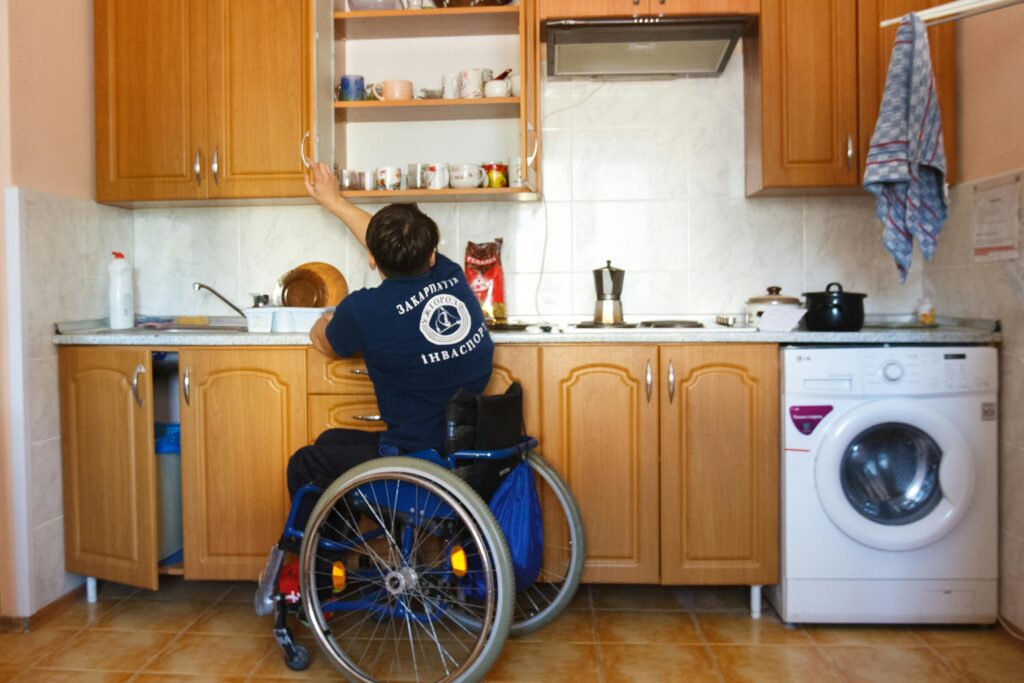
A Functional Capacity Assessment is the primary clinical document driving NDIS plan funding. It documents how a participant functions in their actual daily environment. An FCA conducted in a clinic cannot assess the participant’s real bathroom, real kitchen, real staircase, or real bedroom — the specific spaces where daily living challenges arise. It cannot observe how the participant navigates their particular environment with their particular mobility aids, their particular furniture layout, and their particular daily routine.
The NDIA’s own guidance acknowledges that in-home assessment produces more ecologically valid functional evidence than clinic assessment. An FCA produced from a clinic interview is, by definition, missing its most important data — direct observation of the participant in the environment where their funded supports will operate.
Home modification assessment — clinic is simply impossible
A home modification assessment cannot be conducted anywhere except the home. The OT must physically measure doorway widths, corridor clearances, step heights, bathroom access, turning radii for mobility aids, and gradient angles for ramps. No remote or clinic equivalent exists for this work. If a provider tells you they can conduct a home modification assessment via telehealth or at their rooms, they are not conducting a home modification assessment — they are conducting an interview that cannot produce the specifications required for NDIS Capital Supports funding.
SIL assessment — the same applies
A Supported Independent Living assessment must include a home visit to produce the 28-day roster of care that a SIL application requires. The OT needs to see the participant’s actual living environment to assess what tasks they need support with, in what physical context, and for how long. An SIL assessment produced without a home visit is clinically incomplete and will face NDIA scrutiny.
Ongoing therapy — home is often more effective
For therapy goals that relate to daily living — morning routines, meal preparation, medication management, household management — therapy delivered in the participant’s home produces skills that transfer directly to the environment where they need to be applied. Generalisation from clinic to home is not automatic, and for participants with cognitive impairment, it may not occur at all without home-based practice.
Know the clinical difference between assessment types. For FCA, home modification, SIL, and mobility AT assessments — in-home delivery is the clinical standard. For some individual therapy goals (e.g. fine motor skill-building requiring specialist clinic equipment, formal sensory integration therapy), clinic delivery is appropriate. Ask your OT to explain why the proposed setting is appropriate for the specific service — not just what is convenient for the provider.
Who Is Most Affected by the Travel Cuts
Participants in outer suburbs and growth corridors
Metropolitan participants in outer suburbs — the Hills district in Perth, outer northern or southern Darwin, Logan and Ipswich in Brisbane, outer eastern Melbourne — are typically 30–60 minutes from most OT providers’ bases. These are exactly the participants for whom the travel cost reduction has the greatest impact on provider economics. Some providers that previously serviced these areas are now drawing geographic boundaries closer to their base.
Participants in regional centres
Participants in regional centres — Geraldton, Bunbury, Kalgoorlie in WA; Katherine, Tennant Creek in NT; Cairns, Townsville, Rockhampton in QLD; Ballarat, Shepparton, Bendigo in Victoria — are facing the most severe access reduction. These centres previously had intermittent OT access through providers willing to travel from capital cities. With travel time now recovered at half rate, many of those providers have contracted their service radius.
Participants in remote communities
Remote community access has been most severely affected. For communities that relied on FIFO OT services — where flight, accommodation, and extended travel were the only access pathway — the reduced travel time rate stacks on top of unchanged flight and accommodation costs that providers still bear but can now recover at a lower labour rate. OTA’s 2025 survey found 92% of providers had already cut back on travel and outreach before the year was out.
Complex participants requiring multiple in-home contacts
Participants with complex presentations — where the OT may need multiple home visits to complete an assessment adequately (e.g. across different times of day to capture fatigue patterns, or across different episodes for participants with fluctuating conditions) — are disproportionately affected because the travel cost burden compounds across each visit.
How Providers Are Responding — What You Are Likely Being Told
Since 1 July 2025, NDIS OT providers across Australia have been adjusting their service models in response to the travel rate reduction. The responses fall into several patterns:
“We’re moving to a clinic-based model”
Some providers have restructured entirely to clinic delivery, citing the travel rate as the primary driver. This is a legitimate business decision — but it does not serve participants who need in-home assessment for FCAs, home modification, or SIL purposes. If you receive this notification, you have the right to find a different provider who still offers home visits for the assessment type you need.
“We can only service within [X] km of our clinic”
Some providers have introduced geographic service radii — typically 20–30 km from their base — beyond which they no longer provide home visits. This is a direct response to the travel rate cut making longer-distance home visiting unviable. Participants outside the new radius are being told to either travel to the clinic or find another provider.
“Travel is now charged at a higher rate to participants”
For plan-managed and self-managed participants, some unregistered providers are charging above-PAPL rates for travel — effectively passing the cost differential onto the participant. For registered providers billing agency-managed participants, this is not permissible — the PAPL caps their travel billing regardless. Understand which applies to you before signing a service agreement with changed travel terms.
“We’re offering telehealth for the interview component”
Some providers are offering a hybrid model — telehealth for the intake and assessment interview, followed by a single home visit for the environmental assessment. This is a reasonable compromise for some assessment types (the interview component of an FCA can be conducted via telehealth), but it cannot replace the full in-home visit for home modification assessments, SIL assessments, or mobility AT assessments.
What Travel Costs Are Still Billable — Your Rights as a Participant
One of the most common misconceptions following the July 2025 change is that the NDIS “no longer covers travel” or that travel costs cannot be billed at all. This is not correct. Travel billing was reduced, not eliminated. Here is what remains billable from your IDL budget:
- Travel time: still billable at $96.99 per hour (50% of the $193.99 service rate)
- Vehicle costs: still billable at the ATO cents-per-km rate — unchanged
- Flights for FIFO visits: still billable at reasonable commercial rates
- Accommodation for FIFO visits: still billable at reasonable commercial rates
- Road tolls and parking: still billable as incidentals at cost
If a provider tells you that the NDIS “doesn’t cover travel anymore” and that this is why they cannot come to your home, this statement is inaccurate. The NDIS covers travel — at a reduced labour rate. The decision to stop home visiting is a business decision the provider has made; it is not a regulatory requirement imposed on them by the NDIA.
You have the right to seek a provider who still offers in-home services and bills travel at the reduced-but-still-permitted rates. Your IDL budget can fund this travel, and your support coordinator should be able to help identify providers who have maintained home-visiting capacity.
NDIS Registered — WA · NT · QLD · VIC
TEAH maintains in-home OT across all four locations
TEAH has maintained in-home delivery as our standard approach for FCA, home modification, SIL, and mobility AT assessments — across Darwin (NT), Perth (WA), Brisbane (QLD), and Victoria. Travel costs are disclosed transparently at intake.
Regional and Remote Participants — The Compounding Effect
For participants outside metropolitan areas, the travel rate cut compounds an already-difficult access environment in ways that are worth understanding separately.
The cost structure of a FIFO assessment has not changed — only how much of it is recovered
A FIFO OT visit to a remote community involves real costs: flights (typically $400–$1,200 return depending on location), accommodation ($100–$250 per night), ground transport in the community, and the OT’s travel time to and from airports. These costs existed before July 2025 and they exist after. What changed is that the labour component of that travel time — the hours the OT spends on planes, in airports, and driving between destinations — is now recovered at half the previous rate.
For an OT spending 8 hours of travel time reaching and returning from a remote community, the change reduces travel time recovery from $1,551.92 to $775.92. The $776 difference must be absorbed by the provider, recovered through other billing, or passed on as a decision to not make the trip at all. Most providers have chosen option three.
FIFO OT remains available and fundable — from providers who still offer it
The NDIS fully funds FIFO OT visits to remote communities. Flight costs, accommodation, vehicle hire, and travel time (at the reduced labour rate) are all billable. The issue is not that remote access is prohibited — it is that the economics of remote access have become harder, and fewer providers are willing to bear the overhead.
TEAH continues to discuss FIFO assessment arrangements for participants in regional NT, regional WA, and regional QLD where local OT provision is limited. If you are in a remote or regional area and your previous FIFO OT provider has ceased visits, contact our intake team to discuss what arrangements can be made for your location.
If you live in a remote or regional area and have lost OT access: document this and report it. Contact the NDIA on 1800 800 110. Contact your federal MP’s office. Report it through OTA’s advocacy channel. The NDIS system does not know that access has been lost unless participants tell it. Your report becomes part of the evidence base for policy change.
What You Can Do — Practical Steps for Participants and Coordinators
Ask directly whether home visits are available before committing
When contacting any new OT provider, ask explicitly: “Do you still conduct in-home assessments? What is the maximum distance from your base that you will travel for a home visit?” Get the answer before signing a service agreement. Discovering after intake that the provider does not do home visits — when your participant needs an FCA or home modification assessment — wastes time, wastes IDL budget on the intake process, and delays access to care.
If your provider has moved to clinic-only, you can change
You have the right to change OT providers at any time. If your current provider has notified you that they are no longer offering home visits and you need in-home assessment for FCA, home modification, or SIL purposes, begin looking for an alternative immediately. Do not wait for your plan review deadline to become imminent before acting — wait times are already long and finding a provider who still offers home visits in a contracting market takes time.
For agency-managed participants — consider plan management
Agency-managed participants are restricted to NDIS-registered providers. In the post-travel-cut environment, many registered providers with home-visiting capacity are at or near capacity. Switching to plan management opens access to unregistered OTs who may have more home-visiting availability and are not bound by the PAPL rate ceiling. Plan management is funded by the NDIA separately from your support budget — requesting it does not reduce your IDL or Core Supports allocation.
For support coordinators — build a provider map that accounts for the new landscape
The provider landscape has materially changed since July 2025. A provider list built before the travel cut may include providers who have since withdrawn home-visiting from your participant’s postcode. Actively audit your provider relationships: call the OT providers you regularly refer to and confirm their current home-visiting service areas. Update your referral practices to reflect the current market rather than the pre-July 2025 one.
Frequently Asked Questions
The NDIS travel cut reduced what providers recover — does it change what comes out of my NDIS budget?
Yes — it reduces the amount billed from your IDL budget for travel, because the provider can only charge the lower rate. In practice, this means your FCA costs slightly less overall if it includes travel — travel time is billed at $96.99/hr rather than $193.99/hr. The change is financially better for participants in one sense: each home visit costs less to the IDL budget. The problem is that fewer providers are choosing to do home visits at all because the reduced rate makes the economics harder for them.
My OT told me the NDIS no longer covers travel. Is this true?
No — this is inaccurate. Travel billing was reduced from July 2025, not eliminated. The travel time labour component is now billed at $96.99/hr (50% of the service rate) rather than $193.99/hr. Vehicle costs, flights, accommodation for remote visits, and other travel incidentals remain fully billable. If your provider is saying travel “isn’t covered,” they may mean it is no longer economically viable for their practice model — which is a business decision, not an NDIS rule.
Can I get a home modification assessment without an OT visiting my home?
No. A home modification assessment requires the OT to physically visit the property — to measure doorways, assess bathroom access, evaluate step heights and turning radii, and observe the participant navigating the actual space with their actual mobility aids. No telehealth or clinic-based alternative can produce a valid home modification assessment. If a provider suggests a remote alternative for a home modification assessment, they are not able to produce the clinical document you need for NDIS Capital Supports funding.
I live 45 minutes from the nearest OT. Will anyone still come to my home?
Some providers will, some will not — and which providers this applies to has changed since July 2025. The best approach is to call directly and ask: “Do you provide in-home assessments? Do you service my postcode? What is your travel policy?” TEAH provides in-home assessments across Darwin, Perth, Brisbane, and Victoria — contact our intake team on 0484 705 911 to discuss your postcode and current availability.
Can TEAH do FIFO assessments for remote NT, WA, or QLD participants?
Yes — TEAH can discuss FIFO assessment arrangements for participants in regional and remote areas where local OT is limited or absent. FIFO assessment costs (travel time at reduced rate, flights, accommodation, vehicle) are fully fundable from your IDL budget. Contact our intake team to discuss your location, your assessment needs, and what arrangements can be made before committing to a booking.
How do I report that I have lost access to in-home OT due to the travel cuts?
Contact the NDIA directly on 1800 800 110 and report that you are unable to access in-home OT services in your area. Contact your federal MP’s office as a constituent concern — OTA’s campaign specifically asks participants and families to do this. You can also submit feedback to OTA (otaus.com.au) to add your experience to the sector’s advocacy data. The NDIA needs to know where real-world access failures are occurring — your report is part of the evidence base for policy change.
Summary
The July 2025 NDIS travel reimbursement cut — halving what OT providers can recover for travel time to participant homes — has had a tangible and documented effect on in-home OT availability, particularly in outer suburbs, regional centres, and remote communities. The economics of mobile OT have changed, and the provider response has been to reduce home visiting.
Travel billing was not eliminated — it was reduced. Providers that have stopped home visits have made a business decision, not responded to a regulatory prohibition. Participants who need in-home assessment for FCAs, home modification reports, SIL assessments, and mobility AT prescriptions have the right to seek providers who have maintained that capacity. TEAH is one of them — across Darwin, Perth, Brisbane, and Victoria, with transparent travel cost disclosure and in-home delivery as standard for the assessments where it matters most.
In-home OT — still available with TEAH
Darwin (NT) · Perth (WA) · Brisbane (QLD) · Victoria
Related articles
- NDIS changes 2025–26 — what they mean for your OT funding
- NDIS price freeze — why your OT may be getting harder to access
- In-home vs clinic-based OT — which is better for NDIS participants?
- What is an NDIS home modification assessment?
- Our Occupational Therapy Services — Darwin, Perth, Brisbane & Victoria
TEAH Allied Health Team
Top End Allied Health (TEAH) is an NDIS-registered allied health provider delivering occupational therapy, speech pathology, physiotherapy, and supported accommodation across WA, NT, QLD, and Victoria. Referrals: referrals@topendalliedhealth.com.au | 0484 705 911