Reading time: 11 minutes | Updated: April 2026 | Written by: TEAH Allied Health Team
An acquired brain injury (ABI) can change everything — how you think, move, communicate, manage emotions, and get through the tasks of daily life. Whether the injury was caused by stroke, traumatic brain injury (TBI), hypoxia, or another event, the functional consequences are often profound, complex, and highly individual.
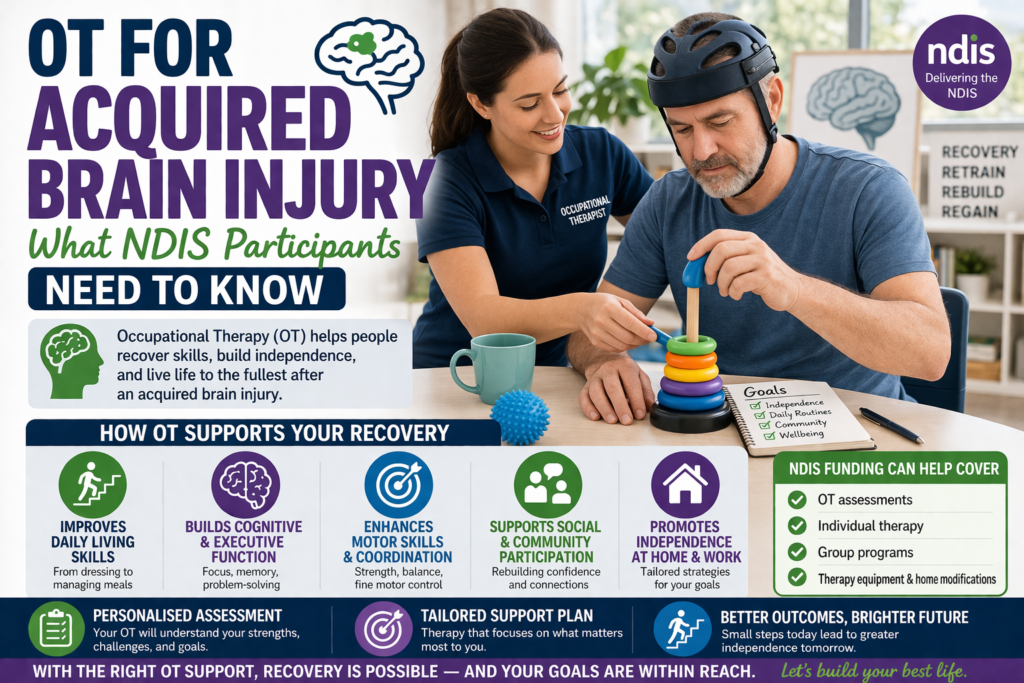
For NDIS participants living with ABI, occupational therapy is one of the most important ongoing supports available. OT addresses the full spectrum of ABI-related challenges — from relearning how to dress and cook, to managing fatigue and cognitive difficulties, to returning to work and community participation. It also produces the clinical reports that underpin NDIS plan funding for personal care, home modifications, assistive technology, and supported living arrangements.
This guide explains what occupational therapy does for ABI, which assessment tools are used, how NDIS funding works for this cohort, and what to look for in an OT with genuine brain injury experience.
In this article
- What is an acquired brain injury?
- How ABI affects daily functioning
- What occupational therapy does for ABI
- Key OT intervention areas for ABI
- OT assessments for acquired brain injury
- ABI fatigue — the invisible barrier OT addresses
- OT across the ABI recovery stages
- How the NDIS funds OT for ABI
- OT reports that matter most for ABI NDIS plans
- What to look for in an ABI-experienced OT
- Frequently asked questions
What Is an Acquired Brain Injury?
An acquired brain injury is any injury to the brain that occurs after birth — distinguishing it from congenital or genetic conditions present from birth. ABI is an umbrella term covering a range of causes and presentations:
Traumatic causes
- Road traffic accidents
- Falls
- Sport injuries
- Assaults
- Workplace injuries
Non-traumatic causes
- Stroke (ischaemic or haemorrhagic)
- Hypoxic brain injury (cardiac arrest, near-drowning)
- Brain tumour
- Encephalitis or meningitis
- Toxic exposure
No two ABI presentations are identical — the nature and extent of functional impairment depends on which areas of the brain were injured, the severity of the injury, the person’s age at the time of injury, their pre-injury health and functioning, and how much time has passed since the injury. This variability makes ABI one of the most complex and demanding areas of OT practice.
How ABI Affects Daily Functioning
ABI can affect virtually every aspect of daily functioning, often in ways that are invisible to others. Understanding the range of functional consequences is essential for participants, families, and support coordinators navigating the NDIS.
| Domain | How ABI commonly affects it | Impact on daily life |
|---|---|---|
| Cognition | Memory impairment, reduced attention and concentration, slowed processing speed, executive dysfunction | Forgetting appointments, losing belongings, difficulty managing finances, inability to plan and sequence tasks |
| Physical / motor | Hemiplegia or hemiparesis, spasticity, ataxia, tremor, reduced strength and endurance | Difficulty walking, dressing, using hands for fine tasks, cooking, driving |
| Communication | Aphasia (expressive or receptive), dysarthria, word-finding difficulties | Difficulty expressing needs, understanding conversations, reading and writing, using the phone |
| Fatigue | Neurological fatigue — qualitatively different from normal tiredness; not resolved by rest alone | Severely limits the number and type of activities that can be completed in a day; fluctuates unpredictably |
| Emotional regulation | Emotional lability, reduced frustration tolerance, impulsivity, anxiety, depression | Difficulty managing relationships, maintaining employment, and coping with the demands of daily life |
| Perception and vision | Visual field deficits, neglect, visual processing difficulties, perceptual impairment | Bumping into objects, difficulty reading, problems navigating the home or community safely |
| Behaviour | Disinhibition, reduced self-awareness, perseveration, social judgment difficulties | Challenging behaviour in public, relationship breakdown, difficulty maintaining employment |
ABI is frequently an invisible disability. Many people with ABI look physically well and can hold a conversation — yet they may be profoundly impaired in their capacity to manage daily life, hold employment, or live independently. This invisibility creates significant challenges in the NDIS context, where clinical evidence must clearly document the functional impact of impairments that are not apparent to a casual observer. An experienced ABI OT knows how to capture and report these hidden impairments effectively.
What Occupational Therapy Does for ABI
Occupational therapy sits at the centre of ABI rehabilitation and ongoing support. Where physiotherapy focuses on movement and physical function, and speech pathology addresses communication and swallowing, occupational therapy addresses the full picture of how a person engages with the activities of daily life — and what they need to participate safely and meaningfully.
For ABI, OT serves three broad functions:
- Rehabilitation — rebuilding lost skills and functions through structured, evidence-based therapeutic intervention. This is most active in the early post-injury period but continues as long as the person is making measurable progress.
- Compensation — developing alternative strategies, routines, and tools that allow the person to manage daily activities despite residual impairments. Compensation becomes increasingly central as the period of maximum neurological recovery passes.
- Environmental modification and AT — changing the physical environment and providing assistive technology to reduce the functional impact of impairments and support safer, more independent participation in daily activities.
Key OT Intervention Areas for ABI
Personal care and self-care
Relearning or adapting the skills required for showering, dressing, grooming, toileting, and eating is frequently the first priority after ABI. OTs break these tasks down into component steps, identify where the breakdown occurs — whether due to motor, cognitive, perceptual, or fatigue factors — and develop task-specific strategies, adaptive equipment, and graduated practice programs to restore or compensate for lost function.
Cognitive rehabilitation
Cognitive OT addresses the thinking-related consequences of ABI — memory, attention, processing speed, executive function, and self-awareness. Intervention may include memory aids and systems (diaries, calendars, apps), attention training, error monitoring strategies, task structuring and sequencing supports, and metacognitive approaches that help the person understand and manage their own cognitive limitations. Cognitive rehabilitation is one of the most evidence-supported areas of ABI OT.
Fatigue management
Neurological fatigue after ABI is qualitatively different from ordinary tiredness and cannot be managed simply by resting more. OTs develop structured fatigue management programs — mapping the person’s energy across the day, identifying high-demand and high-drain activities, introducing planned rest periods, and building energy management strategies that allow meaningful participation without repeated crashes. See the dedicated fatigue section below.
Home safety and modification
The home environment is a significant source of risk for people with ABI — particularly in the early post-discharge period. OTs conduct home safety assessments to identify fall risks, cognitive hazards (such as leaving the stove on), and accessibility barriers. They recommend home modifications and equipment to make the home safer and more navigable, and work with support workers on supervision strategies for high-risk activities.
Assistive technology
AT plays a major role in supporting ABI-related functional limitations. Commonly prescribed items include memory aids and reminder systems, adapted kitchen equipment, one-handed tools and adaptive utensils, communication apps and devices for those with aphasia, environmental control systems, and mobility and transfer equipment. An OT with ABI experience conducts the AT assessment, coordinates trials, and writes the clinical prescription that unlocks NDIS Capital Supports funding.
Return to work and community
Returning to employment or meaningful community roles is a priority for many ABI survivors — and OT plays a critical role in assessing vocational capacity, recommending workplace accommodations, and developing graded return-to-work programs. OTs also support community reintegration — the gradual rebuilding of social participation, driving reassessment, and engagement in meaningful leisure and recreational activities.
Carer and family training
Family members and carers are often the primary support for people with ABI — and an OT who trains them effectively multiplies the impact of therapy enormously. OT-delivered carer training covers manual handling, cognitive support strategies, communication approaches, behaviour management techniques, and how to support participation in daily activities without creating unhelpful dependence.
Driving assessment and rehabilitation
For many ABI survivors, returning to driving represents independence and community access. Driving assessment after ABI requires specialist OT training and involves both an off-road cognitive and perceptual assessment and an on-road evaluation. This is a specialist area requiring an OT with specific driver assessment qualifications — not all OTs provide this service.
OT Assessments for Acquired Brain Injury
ABI OT assessments are typically more complex and multi-domain than assessments for other disability types, reflecting the breadth of functional areas that may be affected. A comprehensive ABI OT assessment for NDIS purposes usually incorporates several of the following:
| Assessment tool | What it measures | Why it matters for NDIS |
|---|---|---|
| Functional Independence Measure (FIM) | Self-care, sphincter control, transfers, locomotion, communication, social cognition across 18 items | Widely recognised by the NDIA; provides standardised support level scores per domain |
| Barthel Index of ADL | Independence in 10 personal care and mobility tasks; total score 0–100 | Objective, widely cited; low scores strongly support Core Supports and SIL funding |
| WHODAS 2.0 | Disability across 6 domains: cognition, mobility, self-care, relationships, daily activities, community participation | Directly aligns with NDIS “functional capacity” framework; broad coverage across life domains |
| Mayo-Portland Adaptability Inventory (MPAI-4) | Ability, adjustment, and participation post-ABI; identifies community reintegration barriers | ABI-specific; supports community participation, employment, and social integration funding |
| Dysexecutive Questionnaire (DEX) | Executive function difficulties in everyday life; self and informant ratings | Captures the everyday impact of executive dysfunction that cognitive tests may miss |
| Rivermead Behavioural Memory Test (RBMT) | Everyday memory function — prospective memory, face recognition, route recall, story memory | Documents functional memory impairment in real-world terms the NDIA can understand |
| Assessment of Motor and Process Skills (AMPS) | Quality of motor and process skills observed during performance of chosen daily tasks | Observational — captures how the person actually performs, not just what they report |
| Fatigue Severity Scale (FSS) | Severity of fatigue and its impact on daily functioning | Quantifies fatigue impact — essential for justifying reduced support hours and activity limitations |
For NDIS plan review purposes, the most important OT assessment for ABI participants is a comprehensive Functional Capacity Assessment (FCA) that incorporates multiple standardised tools from the above list, structured direct observation of daily task performance, and explicit documentation of how the ABI affects each area of daily functioning.
ABI Fatigue — The Invisible Barrier OT Addresses
Neurological fatigue after ABI is one of the most disabling and most misunderstood consequences of brain injury. It deserves particular attention because it is so frequently underestimated in NDIS plans — and because an OT who does not address it thoroughly in their assessment and report will produce a plan that is inadequate for many hours of the day.
How ABI fatigue is different
Neurological fatigue after ABI is not simply feeling tired. It is a neurological phenomenon — caused by the brain’s increased metabolic demand when neural pathways are damaged and the brain works harder than normal to process and respond to information. Key features include:
- It is disproportionate to the physical or cognitive effort expended
- It does not reliably resolve with rest or sleep
- It is highly variable — the person may function reasonably well in the morning but be severely impaired by the afternoon
- It is worsened by environmental demands — noise, crowds, fluorescent lighting, competing sensory inputs
- It is worsened by emotional or cognitive effort — a stressful conversation or a difficult decision can be as fatiguing as physical activity
- The impact of fatigue on daily functioning is rarely visible — the person may appear physically unchanged even when cognitively and functionally depleted
What OT does about ABI fatigue
An ABI-experienced OT will assess fatigue as a specific domain — using tools like the Fatigue Severity Scale alongside structured diary recording across multiple days — and will develop an individualised fatigue management program. This program typically includes:
- Pacing strategies that distribute activity and rest across the day to prevent energy crashes
- Activity prioritisation — identifying which tasks are essential and scheduling them during peak energy windows
- Environmental modifications to reduce unnecessary cognitive and sensory load
- Sleep hygiene strategies, where sleep disruption is contributing to daytime fatigue
- Education for the participant, family, and support workers about what fatigue looks like and how to respond
Fatigue must be documented explicitly in NDIS reports. A participant who functions reasonably in the morning but is fully dependent on support by mid-afternoon needs a plan that reflects this — not just an average picture of daily functioning. Your OT should document the time-of-day variability in your functioning, not just an overall capacity rating. This is what justifies afternoon and evening support hours in NDIS plans that would otherwise be questioned.
OT Across the ABI Recovery Stages
The role of OT changes significantly across the ABI recovery trajectory. Understanding what OT looks like at each stage helps participants and families know what to expect — and what to advocate for — at different points in the recovery journey.
Acute stage (hospital inpatient)
In the early post-injury period, OTs work within hospital rehabilitation teams to address immediate safety concerns, prevent complications such as contractures and pressure injuries, begin early mobilisation and orientation, assess basic cognitive and physical function, and prepare for discharge. NDIS is generally not the primary funding mechanism at this stage — Medicare and state-funded hospital services apply.
Subacute rehabilitation (inpatient or outpatient)
The period of most intensive rehabilitation — typically in the weeks to months following the acute phase — is where OT has its greatest therapeutic impact. Neural plasticity is highest immediately after injury, and intensive, task-specific intervention during this window has the strongest evidence base. NDIS can co-fund OT during this stage, alongside inpatient rehabilitation funding, where the participant is an existing NDIS participant.
Community reintegration (months to years post-injury)
As the participant transitions from rehabilitation settings back to home and community, OT shifts toward functional independence in real-world environments. This stage is where NDIS-funded community OT has its primary role — home visits, functional assessments, community-based skill building, fatigue management, return to work, and ongoing AT and home modification support.
Long-term maintenance and plan reviews
For many ABI participants, some level of ongoing OT support is required indefinitely — particularly for fatigue management, cognitive strategy maintenance, and adaptation to new challenges as life circumstances change. Regular OT review — and updated NDIS assessments at plan review time — ensures the plan remains adequate as the person’s needs evolve.
How the NDIS Funds OT for ABI
ABI is one of the most complex disability types in the NDIS — and consequently, plans for ABI participants are often among the most substantial. Understanding how the funding flows is essential for participants and support coordinators.
Capacity Building — Improved Daily Living
All OT professional time — assessments, therapy sessions, report writing, carer training — is funded from Capacity Building — Improved Daily Living. For ABI, this budget is typically higher than average because the assessment needs are more complex, therapy sessions are often more frequent, and multiple types of OT reports (FCA, AT, home modification) may be needed within a single plan year.
Core Supports — Daily Activities
The OT’s FCA is the primary clinical document that justifies the level of Core Supports — personal care, community access, and supervision — funded in an ABI participant’s plan. The FCA must quantify support needs by task, time, and frequency to provide the NDIA with the evidence base for Core Supports funding. For ABI participants with significant support needs, Core Supports can represent hundreds of thousands of dollars per year — making the quality of the OT report enormously consequential.
Capital Supports — Assistive Technology and Home Modifications
ABI participants commonly require both assistive technology and home modifications to support safe and independent functioning. Each requires an OT-produced report: an AT assessment and prescription for equipment, and a home modification assessment and specifications for building works. Both reports are funded from IDL; the equipment and building works from Capital Supports.
Supported Independent Living (SIL)
ABI participants with high support needs — particularly those requiring overnight supervision, assistance with complex medical routines, or 24-hour monitoring — may require SIL. The SIL OT assessment is the cornerstone of the NDIA’s funding decision for supported accommodation.
Typical IDL funding ranges for ABI participants
| ABI participant profile | Typical IDL range (annual) | What it covers |
|---|---|---|
| Mild ABI, community-based, working toward return to work | $4,000–$8,000 | FCA + monthly OT (cognitive rehab, fatigue management) |
| Moderate ABI, significant cognitive and physical impairments | $8,000–$18,000 | FCA + fortnightly OT + AT assessment + home mod assessment |
| Severe ABI, high support needs, SIL application | $15,000–$40,000+ | FCA + SIL assessment + AT + home mods + multidisciplinary OT program |
OT Reports That Matter Most for ABI NDIS Plans
For ABI participants, the OT report is the single most consequential piece of evidence in the NDIS system. Here is what each report type contributes and when it is most needed:
Functional Capacity Assessment
The FCA is essential at every plan review for ABI participants with significant support needs. It must document cognitive, physical, fatigue, communication, and behavioural impairments in functional terms — not just neuropsychological test scores — and must address the time-of-day variability that characterises ABI. The FCA is the primary document justifying Core Supports hours, SIL, and ongoing therapy funding.
Cognitive capacity and decision-making report
Where ABI affects the participant’s capacity to make decisions — particularly for financial matters, medical decisions, or plan self-management — an OT (usually in conjunction with a neuropsychologist) may produce a cognitive capacity assessment. This report has legal and administrative implications beyond the NDIS and must be handled carefully.
AT prescription report
Prescribing AT for ABI requires detailed functional assessment and product knowledge specific to the consequences of brain injury — one-handed kitchen equipment, memory aids, communication devices, environmental control systems, and adapted computer access are all commonly prescribed for ABI. The AT report must justify why the specific product was chosen over alternatives and how it addresses the identified functional need.
Home modification report
ABI-related home modification needs often extend beyond physical access barriers to include safety features — stove guards, door alarms, visual reminders, and simplified environments that reduce cognitive load. The OT home modification report for an ABI participant should address both physical access and cognitive safety.
NDIS Registered — WA · NT · QLD · VIC
Occupational therapy for acquired brain injury
TEAH’s occupational therapists work with ABI participants across Darwin (NT), Perth (WA), Brisbane (QLD), and Victoria — delivering comprehensive assessments, NDIS reports, and evidence-based rehabilitation and community reintegration programs.
What to Look for in an ABI-Experienced OT
The complexity of ABI makes clinician experience more critical here than in almost any other disability category. Here is what to look for:
Genuine ABI caseload experience
Ask directly what proportion of the OT’s caseload involves ABI participants, and what injury types and severities they commonly work with. An OT who sees occasional ABI clients alongside a general caseload will have different depth of knowledge from one who specialises primarily in ABI rehabilitation and community reintegration.
Familiarity with the full spectrum of ABI consequences
Cognitive rehabilitation, fatigue management, perceptual assessment, and behaviour support after ABI each require specific clinical training. Ask whether the OT has experience across these domains, or whether they tend to focus primarily on physical rehabilitation — which may not be sufficient for participants whose primary challenges are cognitive or emotional.
Experience with NDIS ABI funding pathways
ABI NDIS plans are complex — they frequently involve Core Supports, Capital Supports, SIL, and multiple Capacity Building categories simultaneously. An OT who understands how the NDIS funds ABI, and who knows how to write reports that meet the NDIA’s evidentiary standards for this cohort, is significantly more valuable than one who is clinically skilled but NDIS-naive.
Willingness to conduct in-home and community assessments
For ABI, clinic-based assessment is almost never sufficient on its own. The OT must see the participant in the actual environment where they live and function — to assess real-world cognitive performance, identify environmental hazards, observe functional task completion in context, and understand the demands of the participant’s daily routine. Insist on in-home assessment for any ABI FCA or home modification assessment.
Frequently Asked Questions
Is it too late to start OT years after a brain injury?
No. While the period of maximum neurological recovery occurs in the weeks to months immediately following injury, functional improvement through OT is possible at any stage. Even many years after ABI, OT can help with developing new compensatory strategies, addressing emerging challenges (such as age-related changes on top of ABI), managing fatigue more effectively, and accessing AT or home modifications that have not previously been funded. It is never too late to refer.
Can OT help after a stroke?
Yes — stroke is one of the most common causes of ABI, and OT is central to stroke rehabilitation. Post-stroke OT addresses upper limb function, personal care, cognitive difficulties (including memory, attention, and communication), perceptual impairments such as neglect, home safety and modification, AT prescription, and return to community participation. NDIS-funded OT is available for stroke survivors who meet NDIS eligibility criteria.
How does fatigue affect what is included in an NDIS plan for ABI?
Fatigue directly affects the number and type of supports an ABI participant needs throughout the day. A participant who can function independently in the morning but requires significant support by afternoon should have a plan that includes afternoon and evening support hours, not just morning assistance. The OT’s FCA must document time-of-day variability explicitly — not just average functioning — to justify support hours across the full day.
Does the NDIS fund OT alongside compensation or insurance claims?
This is complex and depends on the circumstances of the injury and the state. Where a compensation claim (such as a motor vehicle accident claim or workers’ compensation claim) is active, the NDIS generally expects the compensation scheme to fund reasonable treatment and support first. The NDIS may still fund supports that fall outside what the compensation scheme covers. If you are navigating an active compensation claim alongside NDIS, seek specific advice from your support coordinator and, if necessary, a specialist disability lawyer.
Can I access NDIS if I acquired my brain injury as an adult?
Yes. ABI meets the NDIS eligibility criteria as a permanent disability — regardless of the age at which it was acquired. To access the NDIS, you must be under 65 at the time of first access, be an Australian citizen or permanent resident, and have a permanent and significant disability. ABI — including stroke, TBI, and other acquired causes — is explicitly recognised as an eligible disability type under the NDIS Act.
How do I refer someone with ABI to TEAH?
Submit a referral via our online form at topendalliedhealth.com.au/referral, email referrals@topendalliedhealth.com.au, or call 1300 203 059. Include information about the type and timing of the injury, the participant’s current functional challenges, and the purpose of the referral (assessment, therapy, or both). Our intake team will check NDIS funding and match the participant with an OT experienced in ABI across Darwin, Perth, Brisbane, or Victoria.
Summary
Occupational therapy is indispensable for NDIS participants living with acquired brain injury. It addresses the full spectrum of ABI consequences — cognitive, physical, fatigue-related, perceptual, and behavioural — through rehabilitation, compensation, environmental modification, and assistive technology. It also produces the clinical reports that justify every major funding category in an ABI participant’s NDIS plan.
The quality of the OT assessment and report is the single biggest determinant of whether an ABI participant’s NDIS plan adequately reflects their real support needs. Choosing an OT with genuine ABI experience, commissioning in-home assessments that capture real-world functioning, and ensuring fatigue and cognitive variability are thoroughly documented are the most important steps you can take to secure a plan that works.
TEAH’s occupational therapists work with ABI participants across Darwin (NT), Perth (WA), Brisbane (QLD), and Victoria — delivering comprehensive in-home assessments, NDIA-quality reports, and evidence-based community rehabilitation programs.
Refer for ABI OT with TEAH
Darwin (NT) · Perth (WA) · Brisbane (QLD) · Victoria
Related articles
- What is a Functional Capacity Assessment and what does it include?
- What is an NDIS home modification assessment?
- Assistive technology assessments under the NDIS
- SIL and SDA OT assessments — what support coordinators need to know
- NDIS plan review — why an OT report matters
- Our Occupational Therapy Services — Darwin, Perth, Brisbane & Victoria
TEAH Allied Health Team
Top End Allied Health (TEAH) is an NDIS-registered allied health provider delivering occupational therapy, speech pathology, physiotherapy, and supported accommodation across WA, NT, QLD, and Victoria. Referrals: referrals@topendalliedhealth.com.au | 1300 203 059