Reading time: 10 minutes | Updated: April 2026 | Written by: TEAH Allied Health Team
For people living with an intellectual disability, independence in daily life is not a given — it is something that must be actively built, practised, and supported. The capacity to get dressed in the morning, prepare a meal, manage a bus journey, or handle money does not develop automatically; for many people with intellectual disability, it requires structured, patient, skilled therapeutic support to achieve.
Occupational therapy is central to that process. OT for intellectual disability focuses on building the practical skills of daily life — not on the diagnosis, not on IQ scores, and not on a fixed ceiling of what is possible. OTs who work well with this population understand that every person has the capacity to grow toward greater independence, and that the goal is always to build the most meaningful life possible, not to normalise or standardise.
This guide explains what OT does for people with intellectual disability across the lifespan, how the NDIS funds this support, what assessments are most useful, and how to find an OT who is genuinely effective with this population.
In this article
- What is intellectual disability?
- How intellectual disability affects daily functioning
- What occupational therapy does for intellectual disability
- Key OT intervention areas
- Task analysis — the OT’s core tool for building daily living skills
- OT across the lifespan for intellectual disability
- OT assessments for intellectual disability
- How the NDIS funds OT for intellectual disability
- SIL and SDA — OT’s role in supported living for ID
- What to look for in an ID-experienced OT
- Frequently asked questions
What Is Intellectual Disability?
Intellectual disability (ID) is characterised by significant limitations in both intellectual functioning — including reasoning, learning, and problem-solving — and adaptive behaviour, which covers the everyday social and practical skills required for daily life. For a diagnosis of intellectual disability, both types of limitation must originate before the age of 22.
Intellectual disability exists on a spectrum of severity:
| Severity level | IQ range (approximate) | Daily living implications |
|---|---|---|
| Mild | 50–70 | May live independently with some support; can often hold employment with appropriate accommodations; requires help with complex tasks |
| Moderate | 35–50 | Requires significant daily support; can develop self-care skills with structured support; may participate in supported employment |
| Severe | 20–35 | Requires substantial ongoing support for most daily activities; may develop some self-care skills with intensive instruction |
| Profound | Below 20 | Requires comprehensive support for all daily activities; often co-occurs with physical disabilities and complex health needs |
Common conditions associated with intellectual disability include Down syndrome, Fragile X syndrome, fetal alcohol spectrum disorder (FASD), Angelman syndrome, Prader-Willi syndrome, and some chromosomal disorders. Intellectual disability also frequently co-occurs with autism spectrum disorder, cerebral palsy, epilepsy, and sensory impairments — a combination that significantly increases the complexity of OT intervention.
Intellectual disability is not a fixed ceiling. The goal of OT for intellectual disability is not to determine what a person cannot do — it is to build what they can. Research consistently shows that people with intellectual disability can continue to develop daily living skills throughout their lives with appropriate support and structured instruction. The trajectory is always toward greater independence and participation, not away from it.
How Intellectual Disability Affects Daily Functioning
For NDIS purposes, what matters is not the IQ score but the functional impact — how the intellectual disability affects the person’s capacity to perform the activities of daily life. These functional impacts vary considerably between individuals but commonly include:
Learning and problem-solving
- Slower acquisition of new skills
- Difficulty generalising skills across different contexts
- Need for repeated practice and structured instruction
- Limited ability to problem-solve novel situations
- Difficulty with abstract concepts such as money and time
Self-care and personal hygiene
- Difficulties with multi-step self-care tasks
- Need for prompting or supervision for hygiene
- Challenges with menstrual management in women
- Medication self-management difficulties
Domestic and household tasks
- Difficulty sequencing multi-step cooking tasks
- Limited ability to manage money and budgeting
- Challenges with reading and following instructions
- Safety awareness around appliances and hazards
Community access and participation
- Difficulty navigating public transport independently
- Vulnerability to exploitation and abuse
- Challenges with phone use and digital technology
- Limited ability to manage health appointments independently
What Occupational Therapy Does for Intellectual Disability
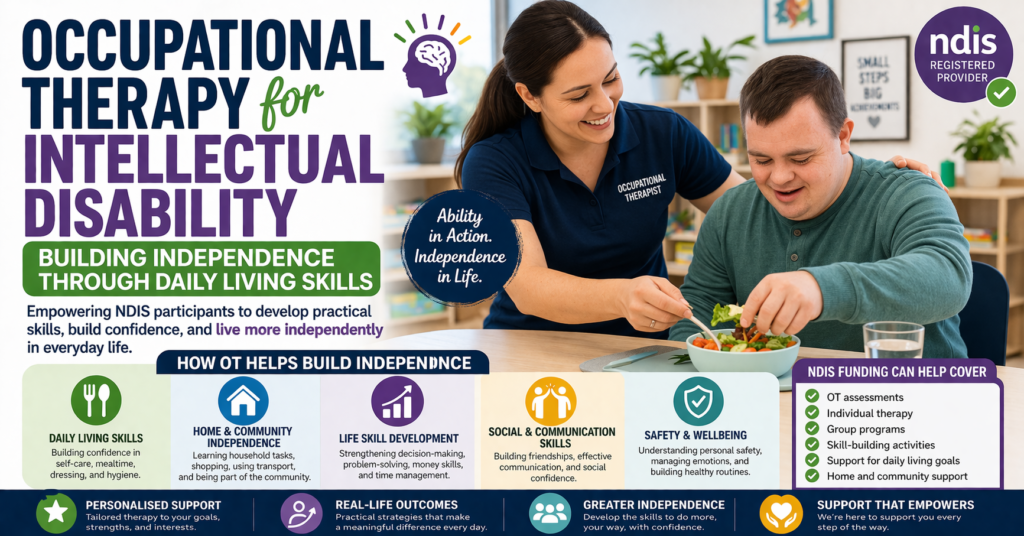
OT for intellectual disability is grounded in a simple but powerful principle: every person, regardless of the severity of their intellectual disability, deserves the opportunity to be as independent as possible in the activities that give their life meaning and dignity. The OT’s role is to identify what that looks like for the individual, and to build it systematically.
In practice, this means:
- Assessing current functional capacity — understanding what the person can do independently, what they can do with prompting or assistance, and what is currently beyond their reach
- Identifying priority goals — with the person and their family or support network, identifying which skills would make the greatest difference to their daily life and independence
- Designing structured skill-building programs — breaking target skills into achievable steps and teaching them using evidence-based approaches such as task analysis, errorless learning, and positive reinforcement
- Training support workers and carers — ensuring that the strategies developed in OT are implemented consistently across all settings and by all people who support the participant
- Recommending AT and environmental modifications — identifying tools and environmental changes that reduce the cognitive demands of daily tasks and support independent function
- Producing NDIS reports — documenting functional capacity, support needs, and OT recommendations in the clinical reports that underpin NDIS plan funding
Key OT Intervention Areas for Intellectual Disability
Personal care and self-care
For many people with intellectual disability, developing independence in personal care — showering, dressing, grooming, toileting, and dental hygiene — is both a priority and an ongoing OT goal. OTs use structured teaching approaches, visual supports, and adaptive equipment to support skill development in these areas. For participants with moderate to profound ID, the OT’s FCA also quantifies the support that will remain necessary despite skilled instruction — which is essential for justifying Core Supports in the NDIS plan.
Cooking and meal preparation
Preparing food is a fundamental daily living skill — and one that many people with intellectual disability can develop to a meaningful degree with structured OT support. This may range from making a simple sandwich with visual prompts, through to preparing a basic cooked meal using a microwave, through to more complex cooking for participants with milder ID. OTs sequence and teach cooking tasks, identify safety risks, and recommend adapted kitchen equipment that makes cooking more accessible.
Money and financial management
Managing money is one of the most significant determinants of adult independence — and one of the most challenging for people with intellectual disability. OT addresses money management through structured programs using physical money, visual tools, and payment apps; building shopping skills; and recommending the right level of financial decision-making support to keep the person safe without removing their agency unnecessarily.
Community access and public transport
The ability to use public transport independently opens up employment, community participation, social connection, and healthcare access. OTs conduct travel training programs — systematically teaching bus, train, or tram use through structured practice in real environments, using visual supports, GPS apps, and graduated independence — to build the community access skills that dramatically expand a person’s life.
Social skills and relationships
People with intellectual disability often benefit from structured support in developing social skills — understanding social expectations, managing relationships appropriately, recognising and responding to social cues, and understanding personal safety and healthy relationships. OT contributes to social participation through individual skill building, group programs, and environmental support that facilitates meaningful social connection.
Workplace skills and supported employment
Many people with mild to moderate intellectual disability are capable of meaningful paid employment with the right support. OT contributes to vocational participation through workplace skill assessment, identification of tasks that match the person’s abilities, recommendations for workplace accommodations, and collaboration with employment support providers to ensure the work environment is set up for success.
Safety and risk management
Understanding and managing risk is a significant challenge for people with intellectual disability — from kitchen safety, to road safety, to the risk of exploitation in community and online settings. OT addresses safety through structured safety education, environmental modification, AT (such as induction cooktops that replace gas burners), and building the awareness and response skills that keep the person safer without unnecessarily restricting their freedom.
Assistive technology
AT plays an important role in reducing the cognitive demands of daily tasks for people with intellectual disability. Commonly prescribed AT includes AAC devices and communication apps, picture-based recipe and task guides, reminder and scheduling apps, GPS navigation tools, adapted kitchen equipment, and visual timers and schedules. An OT assesses which tools genuinely reduce cognitive load and increase independence, conducts trials, and writes the AT prescription that unlocks NDIS Capital Supports funding.
Task Analysis — The OT’s Core Tool for Building Daily Living Skills
Task analysis is the foundational technique that makes OT for intellectual disability effective. It is the process of breaking a complex daily living skill — such as making a cup of tea, washing hands, or catching a bus — into its smallest component steps, so that each step can be taught systematically before the full sequence is assembled.
How task analysis works in practice
Consider making a bowl of breakfast cereal. For a person without intellectual disability, this is automatic. For a person with a moderate intellectual disability, it involves a sequence of perhaps 12–15 distinct steps: getting a bowl from the cupboard, selecting the cereal, opening the packet, pouring the cereal, getting milk from the fridge, opening the milk, pouring the milk, replacing the milk, getting a spoon, and so on.
An OT conducting task analysis will:
- Observe the person attempting the task to identify which steps they can complete independently and where breakdown occurs
- Break the task into the smallest achievable components
- Decide on the teaching sequence — either forward chaining (teaching from the first step) or backward chaining (teaching from the last step, which gives the person the experience of completing the task at the end of each session)
- Develop the visual supports, verbal prompts, or physical guidance hierarchy that will be used to teach each step
- Train support workers and carers to use the same approach consistently across all settings
- Measure progress and modify the approach as skills are acquired
Generalisation is the hardest part. People with intellectual disability often learn a skill in one setting but struggle to transfer it to another — the person who can make a cup of tea in the OT session may not generalise this to home without specific practice in that environment. An effective ID OT builds generalisation into the program deliberately — teaching skills across multiple settings, with multiple people, using varied materials — not just in the clinic.
OT Across the Lifespan for Intellectual Disability
Children with intellectual disability (ages 7–17)
For children with intellectual disability, OT focuses on building the foundational skills for school participation and daily independence. Key goals typically include self-care independence (dressing, hygiene, feeding), fine motor skills for schoolwork and play, participation in the school environment, community access skills, and social interaction. OTs work closely with families and teachers, delivering therapy in home, school, and community settings.
The transition from school to adult life — occurring in the late teenage years — is one of the most important OT focus areas for this group. Transition planning should begin well before Year 12, addressing adult daily living skills, employment readiness, community access, and housing options. OTs play a critical role in this planning, assessing capacity, identifying goals, and providing the clinical reports that support NDIS transition planning.
Adults with intellectual disability
For adults, OT focuses on consolidating and extending independent living skills, supporting community participation and employment, and addressing the changing support needs that come with ageing. Adults with intellectual disability are living longer than ever — and OTs need to plan for the changing functional capacities that accompany ageing in this population, which may occur earlier and with different patterns than in the general population.
Ageing and intellectual disability
People with intellectual disability, particularly those with Down syndrome, experience age-related cognitive and physical decline earlier than the general population. Down syndrome is associated with a significantly elevated risk of early-onset Alzheimer’s disease, often emerging in the 50s or 60s. OT for ageing participants with intellectual disability addresses both the ongoing daily living skill support needs and the new challenges presented by cognitive decline — including safety assessment, modified care approaches, home modification, and updated NDIS reporting that reflects changing support needs.
OT Assessments for Intellectual Disability
Assessment for intellectual disability focuses primarily on adaptive behaviour — the practical skills of daily life — rather than on cognitive testing (which is the domain of psychologists). The key assessment instruments used by OTs in this population include:
| Assessment tool | What it measures | Why it matters for NDIS |
|---|---|---|
| Vineland Adaptive Behavior Scales — 3rd Ed (Vineland-3) | Communication, daily living skills, socialisation, and motor skills across the lifespan | Gold standard for adaptive behaviour; directly documents functional capacity across all NDIS-relevant daily living domains |
| Adaptive Behavior Assessment System — 3rd Ed (ABAS-3) | Conceptual, social, and practical adaptive skills — birth through 89 years | Comprehensive adaptive behaviour measure; standardised scores provide the objective data NDIA requires for support funding decisions |
| WHODAS 2.0 | Disability across 6 life domains — maps directly to NDIS functional capacity framework | Used across all disability types; provides the NDIA with familiar, comparable functional capacity data |
| Barthel ADL Index | Independence across 10 personal care and mobility tasks (0–100) | Simple, widely recognised; useful for documenting personal care support needs in Core Supports funding submissions |
| Life Skills Profile (LSP-16) | Self-care, non-turbulence, social contact, communication, and responsibility | Useful for adults with ID and co-occurring mental health conditions; documents functional capacity in community living contexts |
| Task-specific observational assessment | Direct observation of the person performing daily tasks in their actual environment | Essential for ID — standardised testing alone cannot capture the nuance of real-world performance; OT observation is the gold standard for understanding actual daily functioning |
For NDIS plan review purposes, the most important OT document is a comprehensive Functional Capacity Assessment (FCA) that combines standardised adaptive behaviour assessment with direct observation of the participant performing daily tasks, and clearly documents both current capacity and the support required to maintain safety and participation.
How the NDIS Funds OT for Intellectual Disability
Capacity Building — Improved Daily Living
All OT professional time — assessments, therapy sessions, task analysis program development, carer training, report writing — is funded from Capacity Building — Improved Daily Living at the 2025–26 NDIS rate of $193.99 per hour (weekday). For participants with intellectual disability who have active therapy programs, IDL allocation needs to be sufficient to cover not just assessment and reporting but the ongoing therapy program that delivers skill-building outcomes.
Core Supports
Support workers who assist with daily living activities are funded from Core Supports. For participants with intellectual disability — particularly those with moderate, severe, or profound ID — Core Supports is often the largest budget in the plan. The OT’s FCA is the primary clinical document that justifies the level of Core Supports. A well-written FCA that clearly documents what the participant can and cannot do independently, and what level of support (prompting, supervision, or hands-on assistance) is required for each task, directly determines whether Core Supports funding is adequate.
Capital Supports — AT
AT prescribed by the OT — AAC devices, adapted equipment, visual supports, safety technology — is funded from Capital Supports — Assistive Technology. The OT assessment and prescription are funded from IDL; the equipment itself from Capital.
How much IDL should an ID participant have?
| Participant profile | Typical IDL range (annual) | What it covers |
|---|---|---|
| Mild ID — building independence, targeted skill programs | $3,000–$8,000 | FCA + monthly–fortnightly OT + AT assessment |
| Moderate ID — structured daily living programs, regular therapy | $8,000–$18,000 | FCA + fortnightly–weekly OT + carer training + AT + reports |
| Severe/profound ID — complex needs, SIL assessment, multidisciplinary | $15,000–$35,000+ | FCA + SIL/SDA assessment + ongoing OT + PBS collaboration + complex AT |
SIL and SDA — OT’s Role in Supported Living for Intellectual Disability
Many adults with intellectual disability live in Supported Independent Living (SIL) arrangements — either alone or with other participants — with support workers providing daily assistance. SIL is one of the most significant and expensive supports in the NDIS, and the occupational therapist’s assessment is the cornerstone of the NDIA’s funding decision.
The SIL OT assessment for ID
A SIL assessment for a participant with intellectual disability must document the specific support required across all daily living tasks — personal care, cooking, cleaning, medication management, community access, and overnight needs — with sufficient precision that the NDIA can validate the proposed hours in the roster of care. For participants with ID, this means:
- Documenting the level of support required for each task — not just “needs help with cooking” but “requires verbal prompting at each of 12 steps of meal preparation and cannot safely use the stove unattended”
- Distinguishing between tasks where skill-building OT can reduce support needs over time, and tasks where the intellectual disability creates a permanent limitation
- Addressing the overnight support needs — particularly for participants with significant safety risks, medical routines, or behavioural support needs that occur at night
- Producing a clinically justified 28-day roster that is internally consistent with the FCA findings
For participants who also have Specialist Disability Accommodation needs — particularly those with profound ID or co-occurring physical disabilities requiring a High Physical Support environment — the OT also produces the SDA eligibility report that supports the housing funding application. Read more about this in our guide to SIL and SDA OT assessments.
NDIS Registered — WA · NT · QLD · VIC
Occupational therapy for intellectual disability
TEAH’s occupational therapists work with NDIS participants with intellectual disability across Darwin (NT), Perth (WA), Brisbane (QLD), and Victoria — delivering skill-building programs, FCA and SIL assessments, and NDIS-quality reports.
What to Look for in an OT with Intellectual Disability Experience
OT for intellectual disability requires specific clinical approaches, patience, and a genuine commitment to the person’s autonomy and dignity. Here is what to look for:
Experience with the full spectrum of ID severity
Ask directly what range of participants the OT works with — mild ID only, or across the full spectrum including moderate, severe, and profound? An OT who primarily works with mild ID may not have the skills and approaches needed for a participant with severe ID, and vice versa. The intervention approach, the tools used, the session structure, and the role of carers all differ significantly across the severity spectrum.
Person-centred and rights-based approach
People with intellectual disability have the same rights as anyone else to make decisions about their own lives — even when those decisions involve risk. A good ID OT supports decision-making capacity, works toward what the person genuinely wants for their life, and does not default to restriction and supervision as the first response to risk. They understand the concept of supported decision-making and apply it in practice.
Experience with positive behaviour support integration
Many participants with intellectual disability also have behaviour support needs — and the OT’s role is closely connected with the Positive Behaviour Support (PBS) practitioner’s work. An OT who understands the interface between daily living skills, environmental modification, and behaviour support is far more effective than one who works in isolation from the PBS plan.
Strong family and carer engagement
For many participants with intellectual disability, family members and support workers are deeply involved in implementing the OT’s recommendations across daily life. An OT who provides clear, practical, written guidance for carers — not just a report filed away — and who takes time to train and coach the people who are with the participant every day, produces significantly better outcomes than one who focuses exclusively on the therapy session.
NDIS SIL and FCA report-writing experience
For NDIS purposes, the OT must produce comprehensive FCA reports that meet NDIA evidentiary standards — and, for participants seeking SIL funding, the specialised SIL assessment and 28-day roster. An OT without experience producing these reports may be clinically effective but administratively inadequate for the NDIS context.
Frequently Asked Questions
Can OT help people with severe or profound intellectual disability?
Yes. While the goals and approaches differ significantly from those used with mild or moderate ID, OT for severe and profound intellectual disability is valuable and meaningful. Goals may focus on participation in daily routines with support, sensory engagement, comfort and positioning, communication with support workers, and maximising whatever level of independence is achievable for the individual. OT also produces the clinical assessments that underpin the SIL funding that supports their care.
How is OT different from the support provided by a support worker?
A support worker assists the participant to complete daily tasks — this is funded from Core Supports. An OT builds the participant’s capacity to perform those tasks more independently, develops the skill programs that support workers implement, and produces the clinical assessments that justify Core Supports funding. Both are essential — the OT’s work should directly inform and improve the support worker’s practice, not operate in parallel to it.
How long does OT for intellectual disability typically continue?
For many participants with intellectual disability, some level of OT engagement is beneficial throughout the lifespan — though the frequency, intensity, and focus change over time. Active skill-building programs are typically more intensive in childhood and during major life transitions (school-to-adult, moving to independent living). Maintenance periods with less frequent contact are appropriate when skills are consolidated. OT needs should be reviewed at each NDIS plan review to ensure the current level of engagement reflects current goals and needs.
My family member with ID has challenging behaviours. Can OT help?
OT can contribute significantly to understanding and reducing challenging behaviour — particularly where behaviour is related to communication limitations, sensory processing differences, or unmet daily living skill needs. OT works closely with Positive Behaviour Support practitioners for participants with significant behaviour support needs. The OT contributes expertise in task analysis, environmental modification, and daily living skill development that directly reduces the triggers for challenging behaviour.
What is the difference between OT and speech pathology for someone with intellectual disability?
Speech pathology addresses communication — including AAC assessment and training, language development, social communication, and where relevant, feeding and swallowing. OT addresses daily living participation — self-care, cooking, community access, employment, and the practical daily tasks that require functional skill. Both are typically part of a multidisciplinary support plan for participants with significant intellectual disability, and both are funded from Capacity Building — Improved Daily Living.
How do I refer someone with intellectual disability to TEAH for OT?
Submit a referral via our online form at topendalliedhealth.com.au/referral, email referrals@topendalliedhealth.com.au, or call 1300 203 059. Include information about the participant’s diagnosis and support level, the primary areas of concern, and whether the referral is for assessment, therapy, or both. Our intake team will check NDIS funding and match the participant with an experienced ID OT across Darwin, Perth, Brisbane, or Victoria.
Summary
Occupational therapy for intellectual disability builds independence — one skill, one step, one day at a time. Whether the goal is making a cup of tea, catching a bus, or managing an independent tenancy, OT provides the structured, evidence-based support that makes meaningful progress possible. It also produces the clinical assessments and reports that underpin the NDIS plan funding that makes ongoing support sustainable.
The most effective OT for intellectual disability is person-centred and rights-based, rooted in task analysis and real-world practice, deeply engaged with carers and support workers, and strategically integrated with the broader NDIS support plan. At TEAH, our occupational therapists bring all of these qualities to participants across Darwin (NT), Perth (WA), Brisbane (QLD), and Victoria.
Refer for intellectual disability OT with TEAH
Darwin (NT) · Perth (WA) · Brisbane (QLD) · Victoria
Related articles
- What is a Functional Capacity Assessment and what does it include?
- SIL and SDA OT assessments — what support coordinators need to know
- Occupational therapy for autism (ASD) under the NDIS
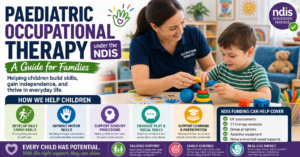
- Paediatric OT under the NDIS — a guide for families
- NDIS plan review — why an OT report matters
- Our Occupational Therapy Services — Darwin, Perth, Brisbane & Victoria
TEAH Allied Health Team
Top End Allied Health (TEAH) is an NDIS-registered allied health provider delivering occupational therapy, speech pathology, physiotherapy, and supported accommodation across WA, NT, QLD, and Victoria. Referrals: referrals@topendalliedhealth.com.au | 1300 203 059