Reading time: 10 minutes | Updated: April 2026 | Written by: TEAH Allied Health Team
Psychosocial disability is one of the most misunderstood and underserved categories in the NDIS — and yet it represents one of the largest and fastest-growing cohorts in the scheme. People living with severe mental health conditions such as schizophrenia, bipolar disorder, borderline personality disorder, severe depression, or PTSD can experience profound functional limitations that affect every aspect of daily life — from getting out of bed in the morning to maintaining housing, employment, and relationships.
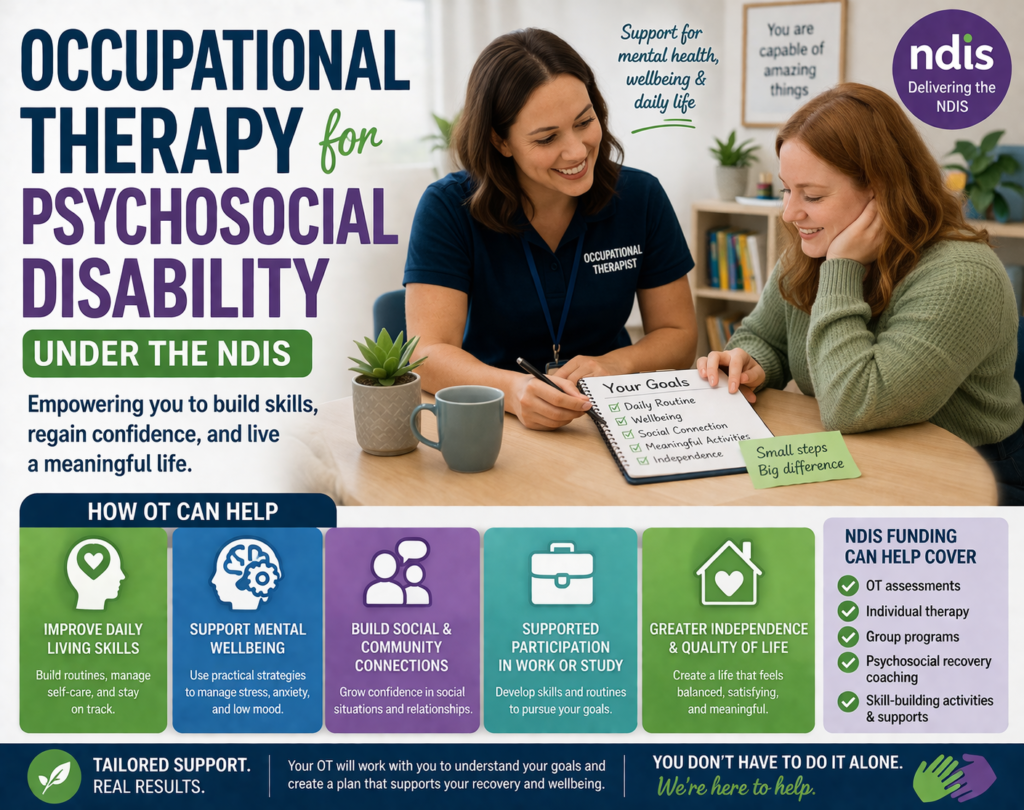
Occupational therapy plays a distinctive and powerful role in supporting psychosocial NDIS participants. Unlike clinical mental health treatment — which focuses on symptoms and diagnosis — OT focuses on function. What can the person actually do, and what do they want to be able to do? What gets in the way? And what practical supports, strategies, and environmental changes can close that gap?
This guide explains what OT does for psychosocial disability under the NDIS, which assessments are most useful, how NDIS funding works for this cohort, and how to navigate the often-confusing boundary between NDIS-funded OT and mental health system supports.
In this article
- What is a psychosocial disability?
- How psychosocial disability affects daily functioning
- What occupational therapy does for psychosocial disability
- Key OT intervention areas
- OT assessments for psychosocial NDIS participants
- NDIS OT vs mental health system supports — understanding the boundary
- How the NDIS funds OT for psychosocial disability
- SIL for psychosocial disability — OT’s role
- What to look for in an OT with psychosocial experience
- Frequently asked questions
What Is a Psychosocial Disability?
A psychosocial disability arises when a mental health condition creates significant, long-term impairments in a person’s ability to participate in daily life — in their social roles, employment, housing, self-care, and relationships. The disability is defined not by the diagnosis alone, but by the functional impact of that diagnosis on the person’s capacity to participate in everyday activities.
Common mental health conditions that can give rise to a psychosocial disability include:
Mood and anxiety disorders
- Severe and treatment-resistant depression
- Bipolar disorder (I and II)
- Post-traumatic stress disorder (PTSD)
- Complex PTSD (C-PTSD)
- Severe anxiety disorders
- OCD with significant functional impact
Psychotic and personality disorders
- Schizophrenia
- Schizoaffective disorder
- Borderline personality disorder (BPD)
- Other personality disorders with significant functional impairment
- Eating disorders (where functional impairment is severe)
Important distinction for NDIS purposes: A diagnosis of a mental health condition alone does not automatically create a psychosocial disability under the NDIS. What matters is the functional impact — whether the condition creates permanent and significant impairment in the person’s daily functioning. Many people live with mental health conditions without meeting the NDIS disability threshold. An OT assessment that documents functional impairment across daily life domains is the most effective way to establish psychosocial disability for NDIS purposes.
How Psychosocial Disability Affects Daily Functioning
The functional consequences of psychosocial disability are often less visible than physical impairments — but they can be just as profound. Understanding the specific ways mental health conditions affect daily function is essential for framing effective OT intervention and for writing NDIS reports that accurately capture the extent of disability.
| Functional domain | How psychosocial disability commonly affects it |
|---|---|
| Self-care and personal hygiene | Difficulty initiating or completing showering, dressing, grooming; neglect of personal hygiene during depressive or psychotic episodes; medication side effects affecting motivation and physical capacity |
| Meal preparation and nutrition | Executive function difficulties with planning and sequencing meals; avolition (inability to initiate tasks) during depressive phases; financial management challenges affecting food access |
| Home management | Inability to maintain a clean and organised living environment; hoarding behaviours in some conditions; difficulty managing bills, correspondence, and household administration |
| Medication management | Forgetting or refusing medication; difficulty managing complex medication schedules; poor insight into need for medication during psychotic or manic episodes |
| Community access and social participation | Severe social anxiety limiting ability to use public transport, attend appointments, or participate in community activities; paranoia or social withdrawal in psychotic conditions; isolation during depressive episodes |
| Employment and education | Episodic nature of many mental health conditions making consistent employment difficult; cognitive effects of illness and medication on concentration and performance; social demands of workplace environments |
| Sleep and daily routine | Severely disrupted sleep during manic, psychotic, or high-anxiety phases; hypersomnia during depressive phases; reversal of day-night cycle disrupting all daily activities |
| Financial management | Impulsive spending during manic phases; inability to manage bills and correspondence due to cognitive difficulties, anxiety, or avoidance; accumulation of debt leading to housing instability |
Variability is the defining characteristic of psychosocial disability. Many mental health conditions are episodic — the person may function reasonably well during periods of wellness, then experience severe functional impairment during a relapse or crisis. An OT assessment conducted during a stable period will produce a misleadingly optimistic picture. Effective OT assessment for psychosocial disability explicitly addresses the frequency and severity of relapses, the functional capacity during the person’s worst episodes, and what supports are needed to maintain safety and basic functioning during those periods.
What Occupational Therapy Does for Psychosocial Disability
Occupational therapy for psychosocial disability is firmly grounded in the person’s real life — not in symptom management or diagnostic categories. An OT working with a psychosocial NDIS participant asks: what activities and roles matter to this person, what is getting in the way, and what practical changes can make meaningful participation possible?
This is distinct from clinical mental health treatment. While a psychiatrist manages medication and a psychologist addresses cognitive patterns and trauma, the OT addresses what the person can actually do — building the practical skills, routines, and environmental supports that make daily life manageable and meaningful, even in the context of an ongoing mental health condition.
The three pillars of psychosocial OT are:
- Skill building — developing the practical skills for daily living that the mental health condition has impaired or prevented the person from developing
- Routine and structure — establishing and maintaining daily routines that provide stability, predictability, and a framework for participation that is robust enough to survive periods of reduced capacity
- Recovery-oriented practice — working toward the participant’s own goals for their life — housing, employment, relationships, community participation — rather than a clinician-defined notion of wellness
Key OT Intervention Areas for Psychosocial Disability
Daily living skills
For many people living with severe mental illness, basic daily living skills — self-care, cooking, cleaning, budgeting, managing appointments — have been significantly disrupted or never fully developed. An OT works with the participant to identify which skills are most limiting, develops graded, achievable programs to build those skills, and provides practical tools (visual schedules, alarms, checklists, simplified routines) that support independence during both stable and difficult periods.
Routine and daily structure
A predictable, structured daily routine is one of the most protective factors for people with severe mental illness — and one of the things most likely to break down during relapse. OT intervention often focuses heavily on establishing morning and evening routines, building meaningful activity into the day, and creating flexible but robust structures that the participant can maintain or return to after periods of illness.
Housing stability support
Housing instability is a pervasive consequence of psychosocial disability — and occupational therapists play an important role in supporting participants to establish and maintain safe, stable housing. OT may involve assessing the participant’s capacity to manage tenancy responsibilities, identifying barriers to home management, developing practical systems for managing household tasks, and recommending AT or environmental modifications that reduce cognitive load and support independent living.
Social participation and community access
Social isolation is both a symptom and a consequence of many mental health conditions. OT supports community participation through graduated exposure to social environments, practical skills for navigating public spaces and transport, identification of meaningful community activities that align with the participant’s interests and values, and, where relevant, support in managing anxiety responses in community settings.
Employment and vocational support
Many psychosocial NDIS participants have employment goals — returning to work, maintaining current employment, or exploring new vocational pathways. OT contributes to employment participation through functional assessments of vocational capacity, identification of workplace accommodations, support with work-related daily living skills, and graded return-to-work programs.
Medication management support
For participants whose mental health condition requires complex medication regimens, OT can develop systems and strategies — dosette boxes, app-based reminders, simplified medication schedules, and packaging modifications — that support consistent, safe self-administration. Where medication management capacity is significantly impaired, the OT assessment documents this for NDIS support planning purposes.
Carer and family education
Family members and support workers are often the primary support network for people with psychosocial disability — and an OT who equips them with practical understanding of the condition’s functional impact, and effective strategies for supporting without enabling dependency, multiplies the impact of therapy significantly.
OT Assessments for Psychosocial NDIS Participants
Assessing functional capacity in psychosocial disability requires a different approach than assessment for physical or cognitive disabilities. Standardised tools must capture the episodic nature of the disability, the variability between well and unwell states, and the functional impact across all areas of daily life — not just what was observable during a single clinical appointment.
Key assessment tools for psychosocial OT
| Assessment tool | What it measures | Why it matters for NDIS |
|---|---|---|
| WHODAS 2.0 | Disability across 6 life domains — cognition, mobility, self-care, relationships, daily activities, community participation | Directly maps to NDIS functional capacity framework; accepted across all disability types including psychosocial |
| Role Checklist | Current and desired occupational roles — worker, student, home maintainer, family member, friend | Captures participation in meaningful roles and the gap between current and desired engagement |
| Occupational Circumstances Assessment Interview and Rating Scale (OCAIRS) | Participation, roles, habits, values, goals, and environment — using structured interview | Designed specifically for use with mental health populations; captures the person’s own perspective on their occupational life |
| Model of Human Occupation Screening Tool (MOHOST) | Motivation, patterning, communication, process skills, motor skills, and environment across daily occupations | Comprehensive occupational profile — particularly effective for capturing barriers to participation in psychosocial populations |
| Canadian Occupational Performance Measure (COPM) | Self-rated performance and satisfaction across self-care, productivity, and leisure | Person-centred; tracks meaningful goal progress across therapy — essential for demonstrating that IDL funding is producing outcomes |
| Life Skills Profile (LSP-16 or LSP-39) | Self-care, non-turbulence, social contact, communication, and responsibility in people with serious mental illness | Specifically designed for psychosocial disability populations; widely used in NDIS FCA reports for this cohort |
| Assessment of Motor and Process Skills (AMPS) | Observed quality of motor and process skills during chosen daily living tasks | Observational — captures real task performance rather than relying on self-report, which may be affected by lack of insight |
Multisource information gathering
For psychosocial disability in particular, relying solely on the participant’s self-report produces an incomplete picture. An effective psychosocial OT assessment incorporates:
- The participant’s own account of their daily functioning
- Input from carers, family members, or support workers who observe the participant across a range of situations
- Review of existing clinical documentation — psychiatric history, crisis presentations, medication records
- Direct observation in the participant’s home or community environment where possible
- Information about the participant’s functioning during unwell periods, not just the current stable state
NDIS OT vs Mental Health System Supports — Understanding the Boundary
One of the most frequently asked questions for psychosocial NDIS participants and their support networks is: what can the NDIS fund, and what should be funded by the mental health system? This boundary is genuinely complex — and getting it wrong in either direction leads to either unfunded need or rejected NDIS claims.
| Support type | Funded by | Who delivers it |
|---|---|---|
| Diagnosis, medication management, and clinical mental health treatment | Health system (Medicare, public mental health) | Psychiatrists, GPs, public mental health teams |
| Evidence-based psychotherapy (CBT, DBT, EMDR, etc.) | Health system (Medicare, Better Access) | Psychologists, accredited mental health social workers |
| Crisis intervention and acute inpatient psychiatric care | Health system | Public and private hospitals, crisis teams |
| Functional capacity assessment — documenting disability for NDIS planning | NDIS — CB Improved Daily Living | Occupational therapist |
| Daily living skill building — cooking, self-care, budgeting, routines | NDIS — CB Improved Daily Living | Occupational therapist |
| Community access support and social participation | NDIS — Core Supports | Support workers, community participation workers |
| SIL — supported accommodation with ongoing daily support | NDIS — Core Supports | SIL providers, support workers |
| Psychology-delivered therapy focused on building functional capacity | Can be either — depends on purpose | Depends on whether delivered for clinical treatment or functional capacity building |
The key question for the NDIA: Is this support addressing the functional impact of the disability on daily participation — or is it treating the underlying condition? OT that helps a participant build the daily living skills affected by their schizophrenia is clearly NDIS-fundable. Medication prescribing and clinical psychological treatment is not. Many supports fall in a grey zone — your support coordinator and OT can help navigate this.
How the NDIS Funds OT for Psychosocial Disability
Capacity Building — Improved Daily Living
All OT professional time for psychosocial NDIS participants is funded from Capacity Building — Improved Daily Living. This includes functional capacity assessments, individual therapy sessions focused on daily living skill building, progress reports, non-face-to-face work, and carer training delivered by the OT.
Core Supports
Support workers who assist with daily living activities — personal care, meal preparation, community access — are funded from Core Supports. The OT’s FCA is the primary document that justifies the level of Core Supports in a psychosocial participant’s plan. Without a clear, well-evidenced FCA that documents the functional limitations arising from the mental health condition, Core Supports funding can be inadequate or absent.
Capacity Building — Improved Relationships
Positive behaviour support and some social skill building programs may be funded under Capacity Building — Improved Relationships rather than Improved Daily Living. For participants with significant behavioural challenges related to their mental health condition, a PBS practitioner may work alongside the OT. Ensure your support coordinator maps support types to the correct subcategory to avoid budget conflicts.
How much IDL funding is typical for psychosocial participants?
| Participant profile | Typical IDL range (annual) | What it covers |
|---|---|---|
| Mild-moderate functional impact, community-dwelling | $3,000–$6,000 | FCA + monthly OT sessions targeting daily living skills |
| Significant functional impact, multiple daily living domains affected | $6,000–$15,000 | FCA + fortnightly OT + progress reporting + carer training |
| Complex psychosocial disability, SIL application or multiple reports needed | $12,000–$25,000+ | FCA + SIL assessment + OT + PBS OT collaboration + ongoing therapy |
SIL for Psychosocial Disability — OT’s Role
Psychosocial NDIS participants can access Supported Independent Living — and for those with the most significant functional impairments, SIL may be essential to safe and stable housing. However, SIL for psychosocial disability is one of the more challenging areas to evidence effectively, precisely because the impairments are not always visible and the need for support fluctuates with the person’s mental state.
The OT assessment for SIL in a psychosocial context must:
- Document functional capacity across all daily living domains using standardised tools
- Explicitly address the episodic nature of the disability — what the person needs during stable periods and during relapses
- Justify the level and intensity of support required on a typical day, distinguishing between prompting, supervision, and hands-on assistance
- Address the safety risks associated with unsupported living — including self-harm risk, inability to manage medication independently, and risk of housing abandonment
- Explain why informal supports — family or friends — cannot adequately or sustainably meet the identified needs
- Produce a clinically justified 28-day roster that reflects both stable and episode-related support requirements
For psychosocial participants, the SIL OT report is often one of the most demanding documents an OT produces. An OT without specific psychosocial SIL experience is unlikely to produce a report that meets NDIA evidentiary standards for this population.
NDIS Registered — WA · NT · QLD · VIC
Occupational therapy for psychosocial disability
TEAH’s occupational therapists work with psychosocial NDIS participants across Darwin (NT), Perth (WA), Brisbane (QLD), and Victoria — delivering comprehensive functional assessments, NDIS reports, and practical recovery-oriented OT programs.
What to Look for in an OT with Psychosocial Experience
Psychosocial OT is a distinct area of practice that requires specific clinical skills, attitudes, and approaches that differ meaningfully from physical rehabilitation or paediatric OT. Here is what to look for when choosing an OT for a psychosocial NDIS participant:
Direct experience with mental health populations
Ask directly: what proportion of the OT’s current caseload involves psychosocial disability? Have they worked in community mental health settings, assertive outreach programs, or hospital-based psychiatric rehabilitation? Experience in these settings produces a depth of understanding of the functional consequences of severe mental illness that cannot be replicated by reading alone.
Recovery-oriented practice
A recovery-oriented OT approaches their work from the person’s own vision of a meaningful life — not from a clinician-defined notion of what recovery or wellness looks like. They work collaboratively on goals the person genuinely cares about, accept the non-linear nature of mental health recovery, and maintain optimism about the person’s capacity for growth and change regardless of their current clinical state.
Willingness to work in the person’s actual environment
Psychosocial OT assessment and therapy conducted only in a clinical setting misses the reality of the person’s daily life. An effective psychosocial OT will visit the participant’s home, accompany them to community settings, and assess functioning in the actual environments where daily life happens — not in a consulting room that is inherently different from anywhere the person actually lives.
Understanding of the NDIS boundary with mental health
An OT who can clearly articulate what the NDIS can and cannot fund for psychosocial participants, and who writes reports that address the NDIA’s specific evidentiary requirements for this population, is substantially more valuable for NDIS purposes than one who is clinically skilled but unfamiliar with the scheme’s funding framework.
Sensitivity to stigma and disclosure
People living with psychosocial disability have often experienced significant stigma — including in clinical settings. An effective psychosocial OT approaches the relationship with genuine respect, is transparent about how information will be used, and actively works to create a safe and non-judgmental space for honest discussion of daily functioning.
Frequently Asked Questions
Can someone with depression or anxiety access NDIS OT?
Depression and anxiety that is severe, treatment-resistant, and creates significant long-term functional impairment can meet the NDIS psychosocial disability eligibility criteria. The NDIS does not fund supports for mild or moderate mental health conditions that respond to standard treatment. An OT-produced FCA that documents the functional impact across daily life domains is the most effective evidence for establishing NDIS eligibility or justifying OT in an existing plan.
Will the NDIS fund OT if I am already seeing a psychologist?
Yes — OT and psychology serve different purposes and can be funded concurrently. Psychology funded through Medicare (Better Access) addresses clinical treatment of the mental health condition itself. NDIS-funded OT addresses the functional consequences of that condition on daily living, participation, and independence. The two are complementary — an integrated approach involving both a psychologist and an OT often produces better outcomes than either alone.
How does the NDIS assess whether a mental health condition creates a psychosocial disability?
The NDIA assesses whether the mental health condition is permanent (or likely to be permanent) and creates significant functional impairment across daily life — not whether the diagnosis is severe in clinical terms. This is assessed through supporting evidence including OT functional capacity assessments, psychiatric reports, GP letters, and the participant’s own account of daily functioning. A comprehensive OT FCA is typically the most influential piece of evidence in this assessment.
Can an OT report help if my NDIS plan doesn’t reflect the impact of my mental health condition?
Yes — an updated or more comprehensive OT assessment is often the most effective tool for strengthening a plan that underestimates the functional impact of a psychosocial disability. The new FCA can document current functioning, address the episodic nature of the disability, and provide the specific evidence the NDIA needs to increase Core Supports, add Capacity Building for therapy, or support a SIL application. Contact TEAH to discuss your situation.
What is the difference between OT and a support worker for someone with psychosocial disability?
An OT assesses functional capacity, develops therapy programs, and builds the skills and strategies that support independent participation. Their time is funded from Capacity Building — Improved Daily Living. A support worker provides hands-on daily assistance — helping with personal care, meal preparation, community access. Their time is funded from Core Supports. The OT’s FCA and therapy program inform and guide what the support worker does — both roles are important but they are funded differently and serve different purposes.
How do I refer a psychosocial NDIS participant to TEAH?
Submit a referral via our online form at topendalliedhealth.com.au/referral, email referrals@topendalliedhealth.com.au, or call 1300 203 059. Include information about the participant’s primary diagnosis, current functional challenges, and the purpose of the referral. Our intake team will check NDIS funding and match the participant with an OT experienced in psychosocial disability.
Summary
Occupational therapy for psychosocial disability is a distinctive and evidence-based area of practice that addresses the functional consequences of mental health conditions on daily life — not the conditions themselves. For NDIS participants, OT builds daily living skills, establishes stabilising routines, supports community participation and employment, and produces the clinical reports that justify Core Supports, SIL, and ongoing therapy funding.
The most important principles for effective psychosocial OT under the NDIS are: assessment that captures the episodic nature of the disability and the person’s functioning during unwell periods, recovery-oriented goals that reflect what the participant genuinely wants for their life, and clinical reports written to meet the NDIA’s specific evidentiary requirements for psychosocial disability.
TEAH’s occupational therapists work with psychosocial NDIS participants across Darwin (NT), Perth (WA), Brisbane (QLD), and Victoria — bringing clinical experience in mental health populations, NDIS reporting expertise, and a recovery-oriented approach to every engagement.
Refer for psychosocial OT with TEAH
Darwin (NT) · Perth (WA) · Brisbane (QLD) · Victoria
Related articles
- What is a Functional Capacity Assessment and what does it include?
- SIL and SDA OT assessments — what support coordinators need to know
- NDIS plan review — why an OT report matters
- What is Capacity Building — Improved Daily Living in the NDIS?
- Our Occupational Therapy Services — Darwin, Perth, Brisbane & Victoria
TEAH Allied Health Team
Top End Allied Health (TEAH) is an NDIS-registered allied health provider delivering occupational therapy, speech pathology, physiotherapy, and supported accommodation across WA, NT, QLD, and Victoria. Referrals: referrals@topendalliedhealth.com.au | 1300 203 059