Reading time: 11 minutes | Updated: April 2026 | Written by: TEAH Allied Health Team
If your child has recently been diagnosed with a disability or developmental delay, or if you are navigating the NDIS for the first time on their behalf, you may have heard that occupational therapy is one of the most important early supports you can access. But what does paediatric OT actually involve? What will the therapist do with your child, what can you realistically expect from it, and how does NDIS funding make it possible?
This guide is written for families — not clinicians. It explains what paediatric occupational therapy is, what areas it addresses, what to expect from assessments and therapy sessions, how NDIS funding works for children, and how to choose the right OT for your child’s needs.
In this article
- What is paediatric occupational therapy?
- Which children benefit from OT?
- What areas does paediatric OT address?
- What to expect — assessment and therapy sessions
- OT for school-age children — what it looks like
- Early intervention — why earlier is better
- How NDIS funds paediatric OT
- Your role as a parent — how to get the most from paediatric OT
- Choosing the right OT for your child
- Frequently asked questions
What Is Paediatric Occupational Therapy?
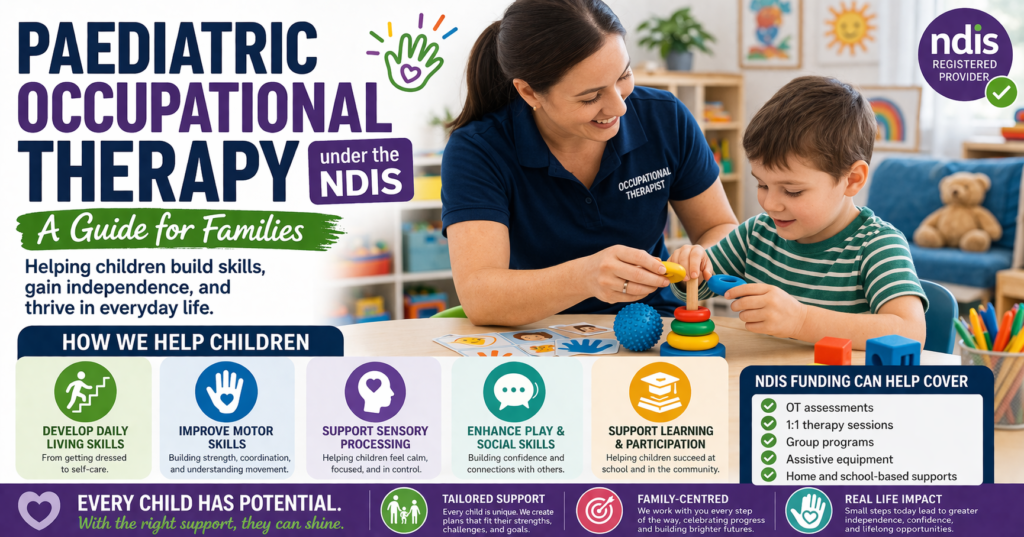
Occupational therapy for children focuses on helping children participate in the “occupations” that make up their daily lives. For children, those occupations are play, learning, self-care, and social participation — the activities through which children develop, grow, and engage with their world.
A paediatric OT assesses how a child’s disability or developmental difference is affecting their ability to participate in these activities, identifies the specific skills or environmental factors creating barriers, and develops a therapeutic program to address those barriers — building skills, providing adaptive strategies, and recommending the environmental modifications and equipment that will support participation.
Unlike adult OT — which is often focused on maintaining or recovering function — paediatric OT is largely about building function during a critical developmental window. The brain’s neuroplasticity in early childhood means that skill-building interventions have a far greater potential impact in early years than at any other time of life. This is why early intervention is so important, and why families are encouraged to access OT as soon as a developmental concern is identified — not to wait for a definitive diagnosis.
Paediatric OT is not what many parents imagine. OT for children is not a formal, sit-at-a-desk exercise. It is typically play-based, engaging, and child-led — particularly for younger children. A skilled paediatric OT embeds therapeutic activity into games, movement, creative tasks, and sensory experiences that the child genuinely enjoys. The goal is to build skills through meaningful engagement, not through rote drilling of isolated exercises.
Which Children Benefit from Paediatric OT?
Paediatric OT is relevant for a broad range of children with developmental differences, disabilities, and health conditions. Under the NDIS, children from age 7 (and through the NDIS Early Childhood approach, from birth to age 9) can access OT where their disability or developmental delay meets eligibility criteria.
Developmental conditions
- Autism Spectrum Disorder (ASD)
- Developmental coordination disorder (DCD)
- Developmental delay
- Intellectual disability
- Attention deficit hyperactivity disorder (ADHD)
- Language disorders
Physical and neurological conditions
- Cerebral palsy
- Spina bifida
- Muscular dystrophy
- Acquired brain injury
- Limb difference
- Childhood stroke
Sensory and behavioural
- Sensory processing disorder
- Feeding difficulties related to sensory or motor issues
- Significant emotional regulation challenges
- Trauma-related functional impacts
Signs that may prompt OT referral
- Difficulty with buttons, zips, or cutlery
- Poor pencil grip or handwriting struggles
- Extreme distress with certain textures, sounds, or clothing
- Difficulty with transitions or daily routines
- Falls frequently or appears clumsy
- Struggles with self-care tasks for their age
What Areas Does Paediatric OT Address?
Sensory processing
Many children with developmental conditions experience differences in how they process sensory information — the degree to which they notice and respond to touch, sound, movement, taste, smell, and visual input. Sensory processing difficulties can affect almost every area of daily life: getting dressed in the morning, tolerating certain foods, sitting in a busy classroom, or participating in group play.
A paediatric OT assesses a child’s sensory processing profile using tools such as the Sensory Processing Measure — 2nd Edition (SPM-2) or the Sensory Profile 2, and develops a personalised sensory diet — a daily program of sensory activities designed to help the child maintain an optimal level of alertness and regulation throughout the day.
Fine motor skills
Fine motor skills — the small, precise movements of the hands and fingers — underpin a huge range of childhood activities: holding a pencil, using scissors, doing up buttons, using cutlery, managing a keyboard, or assembling a puzzle. Children who struggle with fine motor skills often find schoolwork physically exhausting, have messy or effortful handwriting, and may avoid activities that highlight their difficulties.
Paediatric OT addresses fine motor development through targeted play activities, therapeutic putty and grip exercises, handwriting programs (such as Handwriting Without Tears), and adaptive equipment where needed.
Gross motor skills and coordination
Gross motor skills — whole-body movements involving balance, coordination, strength, and body awareness — affect a child’s ability to participate in physical education, sport, playground activities, and daily physical tasks like climbing stairs or riding a bike. Developmental coordination disorder (DCD), sometimes called dyspraxia, is one of the most common reasons children are referred to OT for gross motor concerns.
Self-care and daily living skills
Getting dressed, managing personal hygiene, preparing simple food, and managing belongings are the daily living skills that support a child’s independence and participation at home and school. OT supports children to develop these skills through task analysis, graded practice, adaptive equipment, and visual supports.
Play skills
Play is a child’s primary occupation — it is how children learn, develop social skills, build creativity, and process their experiences. For children with disabilities, access to meaningful play can be significantly limited by motor, sensory, cognitive, or social differences. Paediatric OT supports the development of play skills in a broad sense — from simple cause-and-effect play in infancy through to complex cooperative and imaginative play in school-age children.
Social participation
For children with ASD, social anxiety, or significant sensory processing differences, participating in social environments — classrooms, playgrounds, birthday parties — can be genuinely difficult. OT can support social participation by developing the sensory and regulatory skills that allow the child to be more comfortable in social settings, building social interaction skills through structured group programs, and working with parents and teachers on environmental and routine modifications that reduce barriers.
School participation and learning support
School is one of the most complex environments a child with a disability must navigate — it involves sustained attention, fine motor demands, sensory management, social complexity, and executive function challenges all at once. Paediatric OTs conduct school-based assessments, work collaboratively with teachers, and develop tailored plans that support the child’s participation and learning within the school environment. Common school OT goals include handwriting and written output, attention and regulation in the classroom, managing transitions, and participating in physical education.
Assistive technology for children
AT for children covers a wide range of tools: communication devices and AAC apps, adapted grip equipment, seating and postural support, keyboard and mouse alternatives, screen readers, and sensory equipment. A paediatric OT with AT experience assesses which tools would best support the child’s participation, conducts trials, and writes the NDIS AT prescription that unlocks Capital Supports funding.
What to Expect — Assessment and Therapy Sessions
The initial OT assessment
Your child’s first contact with the OT will typically involve a structured assessment. For younger children, this is usually play-based and takes place in your home, your child’s childcare or school environment, or an OT clinic with appropriate sensory and play equipment. The assessment typically includes:
- A detailed interview with you about your child’s history, daily routines, strengths, and difficulties
- Standardised assessment tools appropriate to your child’s age and the areas being assessed
- Direct observation of your child performing relevant tasks and play activities
- If relevant, observation in the school or childcare environment
- Review of any existing reports (paediatrician, speech pathologist, psychologist, school reports)
Following the assessment, you will receive a written report summarising findings, the child’s strengths and areas of difficulty, and the OT’s recommendations for therapy and supports. For NDIS purposes, this assessment report is often used as supporting evidence in plan reviews.
What ongoing therapy sessions look like
Once the assessment is complete, the OT will develop a therapy plan with specific goals, a recommended frequency of sessions, and the approaches they will use. For most children, therapy sessions are between 45 and 60 minutes. You should expect to:
- Be involved in sessions — particularly for younger children and early intervention, parents and carers are an essential part of the therapy process
- Receive home activities between sessions — strategies and activities to practise at home are how the greatest gains are achieved; OT once or twice a week makes limited impact without follow-through between appointments
- See gradual, measurable progress toward specific goals — ask your OT how they are tracking progress and what outcome measures they are using
- Review and update goals regularly — children develop quickly, and goals that were relevant six months ago may have been achieved (or may need to change direction)
Parent involvement is the biggest predictor of paediatric OT outcomes. Children who practise between sessions, whose parents understand and implement the OT’s strategies across daily routines, and whose families are actively engaged in the therapy process make significantly greater gains than children who attend sessions in isolation. A good paediatric OT will invest time in educating and coaching you, not just working with your child in a room with the door closed.
OT for School-Age Children — What It Looks Like
The transition to school brings a significant shift in what paediatric OT prioritises. School-age children (5–12 years) face a range of occupational demands that often bring previously unrecognised difficulties to light for the first time — handwriting, seated attention, peer relationships, and the executive function demands of managing a school day.
Handwriting and written output
Handwriting difficulties are one of the most common reasons school-age children are referred to OT. Poor pencil grip, letter reversals, inconsistent sizing, slow writing speed, and painful or effortful writing all affect a child’s ability to participate in classroom learning and complete assessments. OT addresses handwriting through structured programs, fine motor skill building, sensory strategies for the writing environment, and — where handwriting is unlikely to become functional — transition to keyboard or alternative output methods.
Attention and classroom participation
Children with sensory processing differences often struggle to maintain attention in the sensory-rich environment of a classroom — fluorescent lights, background noise, uncomfortable seating, and the proximity of other children can create significant sensory overload. OT supports attention and classroom participation through sensory strategies (movement breaks, seating modifications, noise-cancelling headphones), environmental modifications, and communication with teachers about the child’s needs.
Transition management
Transitions — from home to school, between subjects, from inside to outside — are often the most difficult parts of a school day for children with ASD, ADHD, or sensory processing differences. OT works with children and their school to develop transition supports: visual schedules, preparation strategies, sensory regulation tools, and teacher communication approaches that make transitions more predictable and manageable.
School-based OT — where does it happen?
NDIS-funded OT can be delivered in the school environment — during class time, at recess, or after school — as well as in the home and clinic. Delivery within the school is often the most effective approach because the OT can observe the specific challenges the child faces in their actual school setting, collaborate directly with teachers, and implement strategies in real time. TEAH’s OTs will discuss the most appropriate therapy environment for your child’s needs at intake.
Early Intervention — Why Earlier Is Better
The evidence for early intervention in childhood disability is overwhelming: the earlier developmental support begins, the greater the impact. This is because the developing brain in infancy and early childhood has extraordinary neuroplasticity — the capacity to form new neural connections in response to experience. Therapeutic intervention during this window can redirect developmental trajectories in ways that become progressively harder to achieve as the brain matures.
For NDIS purposes, the Early Childhood Approach (ECA) supports children under 9 with developmental delays or disabilities — including children who do not yet have a formal diagnosis. The ECA connects children and families with early intervention services, including OT, without requiring a full NDIS plan in the first instance. Families can access ECA-funded supports by contacting the NDIS directly or through a partner in the community.
What early intervention OT looks like (ages 0–5)
For very young children, OT early intervention is typically delivered in the home and in natural environments like childcare — the places where the child actually lives and plays. The focus at this age is on:
- Supporting the development of foundational sensory, motor, and cognitive skills
- Coaching parents in strategies to embed therapeutic support into everyday routines — bath time, mealtimes, dressing, play
- Identifying and addressing sensory regulation needs before they escalate into significant behavioural challenges
- Supporting feeding skill development where eating difficulties are present
- Providing parents with information about their child’s developmental profile and what to expect
You don’t need to wait for a diagnosis to access OT. Through the NDIS Early Childhood Approach, children under 9 with developmental concerns can access OT-based early intervention before a formal diagnosis is confirmed. If you have concerns about your child’s development, act now — the NDIS ECA is designed precisely for this situation, and early action is always more effective than waiting.
How the NDIS Funds Paediatric OT
NDIS Early Childhood Approach (children under 9)
Children under 9 with developmental delay or disability can access the NDIS Early Childhood Approach (ECA). Under the ECA, a partner organisation (usually an early childhood intervention provider) conducts an initial assessment and connects the child with appropriate early intervention services — including OT — funded through the NDIS. The ECA does not require the child to have a formal NDIS plan in the first instance, making it a faster pathway to support for young children.
Standard NDIS plan (children 7–17)
TEAH works with NDIS participants from age 7. Children with an NDIS plan access OT through the Capacity Building — Improved Daily Living budget at the standard 2025–26 OT rate of $193.99 per hour. This budget funds all OT professional time — assessments, therapy sessions, report writing, and carer coaching.
How much IDL should a child’s NDIS plan include?
| Child’s profile | Typical IDL range (annual) | What it covers |
|---|---|---|
| Lower support needs — targeted assessment and programme | $3,000–$6,000 | Assessment + monthly OT sessions + school liaison |
| Moderate support needs — regular OT program | $6,000–$15,000 | Comprehensive assessment + fortnightly/weekly OT + school visits + report writing |
| High support needs — intensive therapy, AT assessment, multiple disciplines | $15,000–$35,000+ | Weekly OT + speech pathology + AT assessment + school-based delivery + FCA |
Capital Supports for paediatric AT
Where an OT recommends assistive technology — communication devices, adapted seating and postural supports, adaptive equipment, sensory tools, or mobility aids — the equipment is funded from Capital Supports — Assistive Technology. The OT’s assessment and AT prescription are funded from IDL; the device or equipment itself from Capital. Both budgets must be present in the child’s plan for the full process to proceed.
Getting enough IDL in your child’s plan
The most effective way to secure adequate IDL for your child’s therapy is to submit a comprehensive OT assessment report at your plan review that documents the child’s current functional profile, the therapy recommended, the frequency and duration proposed, and the goals the therapy aims to achieve. A report that says “the child would benefit from OT” is far less effective than one that specifies “fortnightly 1-hour OT sessions over 12 months targeting fine motor development and classroom participation, estimated cost $3,880 from IDL.”
Your Role as a Parent — How to Get the Most from Paediatric OT
Paediatric OT is not something that happens to your child for one hour a week and then stops. The greatest gains come when therapy principles are embedded into daily life — and that requires active, informed, engaged parents and carers.
Be present and participatory during sessions
Where possible, observe your child’s sessions. Ask the OT to explain what they are doing and why. Ask what you should be doing at home. The most effective paediatric OT involves parents as co-therapists — not waiting rooms.
Implement home programs consistently
Your OT will typically provide home activities or strategies between sessions. These are not optional extras — they are the primary mechanism through which gains are consolidated and generalised from the clinic to real life. Consistent home program implementation makes the difference between a child who progresses steadily and one who effectively plateaus between sessions.
Communicate openly with the OT
Tell the OT what is and is not working at home and at school. Share teacher feedback. Flag when your child has had a difficult week, when a new challenge has emerged, or when a previous goal has been achieved. The OT can only adjust the therapy plan based on information you provide — the more context they have, the better calibrated the intervention will be.
Ask for progress updates
Ask your OT how they are measuring progress — what standardised or observational measures they are using, what the goals are, and how you will know when a goal has been reached. Therapy should be measurable and time-limited, not open-ended attendance with no defined outcome.
Bring OT reports to school meetings
An OT report is one of the strongest forms of evidence you can bring to a school meeting about your child’s learning support needs. OT assessments and reports can inform adjustments, inclusive education planning, and access to additional school-based support. Ask your OT to write reports that are accessible to teachers as well as to the NDIS.
NDIS Registered — WA · NT · QLD · VIC
Paediatric OT for your child with TEAH
TEAH’s paediatric occupational therapists work with children across Darwin (NT), Perth (WA), Brisbane (QLD), and Victoria — delivering in-home, school-based, and clinic-based OT, with comprehensive assessments and NDIS-quality reports.
Choosing the Right OT for Your Child
Paediatric OT is a relationship — your child will spend significant time with this person, and the therapeutic alliance matters enormously to outcomes. Here is what to look for:
Experience with your child’s specific age and condition
A paediatric OT who primarily works with school-age children with handwriting difficulties may not have the same depth of experience as one who specialises in early intervention for children with ASD. Ask specifically about the OT’s experience with children in your child’s age group and with your child’s primary diagnosis or developmental profile.
A child-friendly, engaging approach
The best paediatric OTs are those who can engage children — particularly reluctant ones — through play, creativity, and genuine warmth. Your child will not engage meaningfully with a therapist they find boring, threatening, or confusing. Ask whether you can observe a session before committing, and trust your instinct about whether the OT’s style is a good fit for your child’s personality.
Willingness to work in your child’s natural environments
Particularly for early intervention and school-age children, OT delivered in the home, school, or childcare setting is significantly more effective than clinic-only delivery. The OT should be willing and able to visit your child’s school to observe and consult with teachers, and to conduct home visits to assess and support daily living skill development.
Clear goal-setting and progress tracking
A good paediatric OT sets specific, measurable goals at the start of therapy, reviews progress against those goals regularly, and updates the therapy plan as goals are achieved or new priorities emerge. Be cautious of OTs who cannot articulate specific goals or who do not use any form of outcome measurement.
NDIS report-writing experience
For NDIS-funded children, you need an OT who can write assessment reports and progress summaries that meet NDIA evidentiary standards. An OT who is clinically skilled but produces vague reports is a liability at plan review time. Ask whether the OT has experience producing reports for NDIS plan reviews and whether they can show you an example of the report format they use.
Frequently Asked Questions
How old does my child need to be to access NDIS OT?
TEAH works with NDIS participants from age 7. However, through the NDIS Early Childhood Approach (ECA), children under 9 with developmental delays or disabilities can access OT-based early intervention — often before a formal NDIS plan is in place. Contact the NDIS or an ECA partner in your area for information on accessing early intervention if your child is under 7.
Does my child need a formal diagnosis before seeing an OT?
No. Through the NDIS Early Childhood Approach, children under 9 can access OT-based early intervention based on developmental concerns — a formal diagnosis is not required. An OT can assess a child and begin therapeutic support while a diagnostic assessment is still in progress. Early intervention during this pre-diagnostic period is often the most impactful support you can access.
How often will my child see an OT?
Session frequency depends on the child’s goals, the therapy approach being used, and the available IDL budget. Many children in active therapy programs receive OT weekly or fortnightly. Your OT will recommend a frequency at the start of therapy and review it as goals are achieved. Consistency matters more than frequency — a child who attends fortnightly and practises daily at home will typically make better progress than one who attends weekly but does nothing between sessions.
Can OT help with my child’s handwriting?
Yes — handwriting difficulties are one of the most common reasons school-age children are referred to OT. OT addresses the underlying fine motor, sensory, and perceptual skills that support handwriting, uses structured handwriting programs, and where handwriting is unlikely to become functional, helps the child transition to keyboard or alternative output. If your child’s school is raising handwriting concerns, an OT assessment is usually the recommended first step.
What is a sensory diet and does my child need one?
A sensory diet is a personalised daily program of sensory activities designed to help your child maintain an optimal level of alertness, regulation, and readiness for learning. It is not a food diet — it refers to the sensory “nourishment” the child’s nervous system needs throughout the day. If your child has sensory processing differences that affect their behaviour, attention, or participation, a sensory diet developed by an OT is often one of the most practical and immediately impactful supports you can implement.
Can the OT come to my child’s school?
Yes — NDIS-funded OT can be delivered in the school environment where this is clinically appropriate. School-based OT allows the OT to observe the specific challenges the child faces in their school setting, work collaboratively with teachers, and implement strategies in real time. TEAH’s OTs discuss the most appropriate delivery environment for each child at intake.
How do I refer my child for paediatric OT with TEAH?
Submit a referral via our online form at topendalliedhealth.com.au/referral, email referrals@topendalliedhealth.com.au, or call 1300 203 059. Include your child’s age, primary diagnosis or areas of concern, and the purpose of the referral. Our intake team will check NDIS funding and match your child with a paediatric OT across Darwin, Perth, Brisbane, or Victoria.
Summary
Paediatric occupational therapy under the NDIS supports children with disabilities and developmental differences to participate meaningfully in the activities that matter most to them — play, learning, self-care, and social connection. It addresses sensory processing, fine and gross motor development, daily living skills, school participation, and assistive technology — all funded from Capacity Building — Improved Daily Living in your child’s NDIS plan.
The most important factors in effective paediatric OT are: starting early, choosing an OT with genuine paediatric experience and a child-friendly approach, maintaining consistent home programs between sessions, and being actively involved as a parent in the therapy process. The results — a child who can manage the demands of school, play, and daily life with greater confidence and independence — are worth the investment.
TEAH’s paediatric occupational therapists work with children across Darwin (NT), Perth (WA), Brisbane (QLD), and Victoria — in your home, at school, and in the community.
Refer your child for OT with TEAH
Darwin (NT) · Perth (WA) · Brisbane (QLD) · Victoria
Related articles
TEAH Allied Health Team
Top End Allied Health (TEAH) is an NDIS-registered allied health provider delivering occupational therapy, speech pathology, physiotherapy, and supported accommodation across WA, NT, QLD, and Victoria. Referrals: referrals@topendalliedhealth.com.au | 1300 203 059