Reading time: 12 minutes | Audience: Support Coordinators & Allied Health Professionals | Updated: April 2026
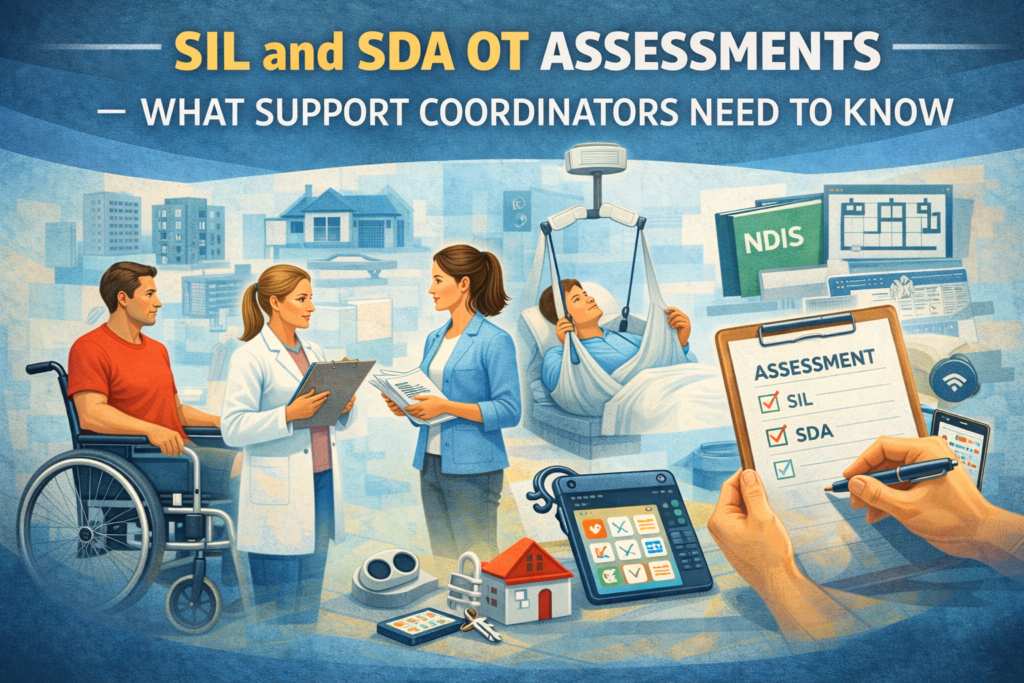
For support coordinators, Supported Independent Living (SIL) and Specialist Disability Accommodation (SDA) applications sit among the most complex and consequential work in the role. Get the clinical evidence right and a participant gains appropriate housing and the support they need to live independently. Get it wrong — or submit an application without a thorough occupational therapy assessment — and the NDIA will almost certainly reject it.
Yet the occupational therapist’s role in SIL and SDA applications remains widely misunderstood, even among experienced support coordinators. Many coordinators treat the OT report as an administrative formality rather than the clinical cornerstone it actually is. This guide sets out exactly what OT assessments for SIL and SDA involve, what distinguishes a strong report from a weak one, when to refer, and how to work effectively with an OT to give your participant the best possible outcome.
In this article
- SIL and SDA — a brief overview
- Why the OT assessment is the most critical piece of evidence
- What an OT assesses for SIL
- What an OT assesses for SDA
- SIL vs SDA assessments — key differences
- What makes a strong SIL or SDA OT report
- Why SIL and SDA applications get rejected
- When to refer your participant for a SIL or SDA OT assessment
- How to work effectively with an OT
- Process and realistic timelines
- Frequently asked questions
SIL and SDA — A Brief Overview
Before examining the OT’s role, it is worth clarifying the distinction between SIL and SDA, as the two are often conflated — including in applications to the NDIA.
Supported Independent Living (SIL)
SIL is a support funding category, not a housing type. It funds the assistance and supervision a participant needs to live as independently as possible in shared or individual accommodation — covering tasks such as personal care, cooking, cleaning, medication management, and community participation. SIL funding is included in a participant’s plan under Core Supports and is typically the most expensive ongoing support in a plan.
Specialist Disability Accommodation (SDA)
SDA is a housing funding category for participants who have an extreme functional impairment or very high support needs and require a home with specific accessibility or design features. SDA funding pays for the physical dwelling — it does not pay for support workers. SDA-eligible participants typically also receive SIL, but the two are assessed and funded separately.
The most common misunderstanding: SIL and SDA are frequently treated as interchangeable. They are not. A participant can receive SIL without SDA (if they live in standard housing that meets their needs). A participant can live in SDA without receiving SIL (if they have significant housing needs but can manage with lower levels of support). Both require separate clinical evidence — and both require OT input.
Why the OT Assessment Is the Most Critical Piece of Evidence
The NDIA does not take SIL or SDA applications at face value. Both require detailed clinical evidence demonstrating that the level of support requested — or the housing design features required — is genuinely necessary given the participant’s disability-related functional impairment.
A support coordinator’s case notes, a carer’s statutory declaration, or a GP letter alone will not satisfy this evidentiary requirement. What the NDIA needs — and what consistently determines whether SIL and SDA applications succeed or fail — is a comprehensive functional assessment from a qualified occupational therapist.
The OT assessment provides three things the NDIA cannot get from any other source:
- An objective, standardised measure of the participant’s functional capacity across all relevant daily living domains — not the participant’s or carer’s subjective account
- A clinically justified link between the observed functional impairment and the specific level or type of support being requested
- A professional attestation from an AHPRA-registered clinician who has directly observed the participant in their actual environment
Without these three elements, the application is built on advocacy rather than evidence — and the NDIA will treat it accordingly.
What an OT Assesses for SIL
A SIL-focused OT assessment is a comprehensive functional capacity evaluation that specifically quantifies the participant’s support needs across all activities of daily living. The goal is not only to establish that the participant needs support, but to document precisely how much support, for which tasks, and at what time of day.
Daily living domains assessed
| Domain | What the OT assesses | Why it matters for SIL |
|---|---|---|
| Personal care | Showering, dressing, grooming, toileting, continence, oral hygiene | Drives morning and evening support hours — the largest component of most SIL rosters |
| Domestic tasks | Cooking, meal prep, cleaning, laundry, shopping, financial management | Determines whether supervision, prompting, or hands-on assistance is required for household management |
| Mobility & transfers | Moving between surfaces, ambulation, wheelchair use, fall risk | Determines staffing ratios for physical transfers and overnight supervision requirements |
| Medication management | Ability to self-administer, recall schedules, manage complex regimens | Supports or rules out the need for medication administration support — a regulated activity |
| Overnight needs | Night-time repositioning, toileting, wandering, seizure monitoring, respiratory support | Determines whether passive overnight (sleepover) or active overnight support is clinically justified |
| Behaviour & safety | Self-harm risk, absconding, property damage, supervision requirements | Justifies increased staffing ratios and specialist support worker requirements |
| Community participation | Transport, social activities, appointments, employment or education | Quantifies support hours for community access within the SIL roster |
What the SIL OT report must quantify
A SIL OT report that simply states “the participant requires 24-hour support” will not be sufficient. The NDIA expects the report to:
- Specify the nature of support required for each task — supervision only, verbal prompting, physical assistance, or full hands-on care
- Estimate time per task and frequency per day or week — so the NDIA can validate the proposed roster of care
- Justify any high staff-to-participant ratios (such as 2:1 support) on clinical grounds
- Differentiate between supports that are disability-related and those that would be required by anyone (such as basic cooking) — the latter are not fundable under SIL
- Explain why informal support alone is insufficient to meet the participant’s needs safely and sustainably
The OT report and the roster of care must align. One of the most common reasons SIL applications stall is a mismatch between the support hours proposed in the roster of care and what the OT’s clinical assessment actually justifies. Work with your OT early to ensure both documents are consistent before submission.
What an OT Assesses for SDA
SDA eligibility is more narrowly defined than SIL. The NDIA funds SDA only for participants who have an extreme functional impairment or very high support needs — and whose housing needs cannot be met by standard or modified housing. The OT assessment for SDA must establish both of these things.
Establishing extreme functional impairment
The OT must document functional impairment that is severe enough to meet the NDIA’s SDA eligibility criteria. This typically involves:
- Standardised assessment scores demonstrating severe limitations in multiple daily living domains
- Documented need for a high-physical-support environment — such as ceiling hoist infrastructure, step-free access throughout, or a highly accessible bathroom designed for full-assistance showering
- Evidence that standard housing — even with assistive technology and minor modifications — cannot adequately meet the participant’s functional needs
SDA design categories and the OT’s role
SDA dwellings are classified into four design categories, and the OT’s assessment determines which category the participant is eligible for:
| SDA design category | Key features | OT assessment focus |
|---|---|---|
| Improved Liveability | Enhanced physical access, better sensory and cognitive features | Sensory processing, cognitive navigation, moderate mobility impairment |
| Fully Accessible | Step-free access throughout, wider doorways, accessible bathroom and kitchen | Wheelchair use, transfer requirements, upper limb function, general accessibility |
| Robust | Resilient materials, secure design, reduced injury risk features | Behaviour support needs, self-harm or property damage risk, elopement risk |
| High Physical Support | Ceiling hoist infrastructure, hospital-grade accessible bathroom, backup power, emergency call system | Extreme physical impairment, full-assistance personal care, powered wheelchair use, respiratory or complex medical needs |
The OT report must clearly articulate which design category is required and why — not simply assert that the participant “needs SDA.” The NDIA expects the clinical reasoning to map specific functional impairments to specific design features.
SIL vs SDA Assessments — Key Differences
| SIL OT assessment | SDA OT assessment | |
|---|---|---|
| Primary question | How much support does this person need, for which tasks, and when? | What housing design features does this person require, and why? |
| Budget line | Core Supports | Capital Supports — SDA |
| OT assessment focus | Task-level functional capacity, support hours, staffing ratios, overnight needs | Severity of physical impairment, design category eligibility, built environment requirements |
| Typical OT hours | 10–20 hours (complex participants) | 6–12 hours |
| Report output | FCA with support hours, roster recommendations, and 28-day schedule | SDA eligibility report specifying design category with clinical justification |
| Can be combined? | Yes — many OTs produce combined SIL + SDA reports for participants who need both | Yes — but each component must be clearly delineated in the report |
What Makes a Strong SIL or SDA OT Report
Not all OT reports are equal — and the difference between a strong SIL or SDA report and a weak one is frequently the difference between approval and rejection. Here is what distinguishes the best reports:
Standardised assessment tools are used and cited
Strong reports reference validated, standardised assessment instruments — such as the WHODAS 2.0, Functional Independence Measure (FIM), Barthel Index, or condition-specific measures — and present the scores alongside narrative interpretation. A report based solely on interview and observation, without standardised measures, lacks the objective grounding the NDIA expects for high-cost decisions like SIL and SDA.
Support needs are task-specific and time-quantified
For SIL, vague statements like “requires 24-hour care” are insufficient. The NDIA expects to see exactly what support is needed, for which tasks, for how long, and at what frequency — across a representative 28-day period. An OT who can produce a well-evidenced 28-day schedule directly aligned with their functional findings gives the support coordinator the strongest possible foundation for the SIL submission.
The clinical rationale is explicit, not implied
Every recommended support level or design feature must be linked to a specific observed impairment. The report should never expect the reader to make clinical inferences. If a participant requires 2:1 support for showering, the report must explain why — not simply state it.
The environment has been directly observed
For SDA in particular, the OT must have visited the participant’s current housing to document why it is inadequate. An SDA report based only on an interview without a home visit is far more likely to be questioned by the NDIA.
Future needs are considered
For participants with progressive conditions, a strong report addresses not only current needs but the trajectory of those needs — and recommends SDA design features or SIL structures that will remain appropriate as the condition advances.
Why SIL and SDA Applications Get Rejected
Understanding the most common failure points allows support coordinators to prevent them before submission, rather than managing a rejected application after the fact.
❌ The OT report does not justify the hours in the roster
The NDIA cross-references the roster of care against the OT assessment findings. If the OT documents moderate support needs but the roster proposes 24-hour active support, the discrepancy triggers rejection or significant plan reduction.
❌ The report describes the participant’s best day, not their typical day
An OT who visits once and sees a participant performing well will document a misleadingly high level of functioning. Strong reports explicitly address variability and include carer input on typical day-to-day capacity — not just what was observed on a single visit.
❌ For SDA, the eligibility criteria are asserted rather than demonstrated
Stating “this participant has extreme functional impairment and requires SDA” without tying it to objective assessment data is insufficient. The NDIA expects the report to show, not just tell — with standardised scores, specific functional limitations, and clear links to the requested design category.
❌ Informal support is not adequately addressed
The NDIA always considers whether informal support networks (family, partners) could meet the participant’s needs. If a participant currently receives significant family support, the OT report must address whether that support is sustainable and whether the family are willing and able to continue providing it long term.
❌ The report is not written by an OT with SIL/SDA experience
SIL and SDA assessments are among the most technically complex reports in the NDIS ecosystem. An OT without specific experience in this area may produce a report that is clinically accurate but fails to address the specific evidence requirements the NDIA expects — leading to avoidable delays and rejections.
When to Refer Your Participant for a SIL or SDA OT Assessment
Timing is critical. Referring too late creates pressure to rush a report that should be thorough, while waiting for “more evidence” can leave a participant in unsuitable housing for months longer than necessary.
Refer for a SIL OT assessment when:
- A participant is transitioning from the family home to independent or supported living for the first time
- A participant’s current SIL hours are due for review and you believe they are insufficient or excessive
- A participant’s condition has deteriorated significantly since their last assessment
- A participant’s informal support network has changed — such as an ageing parent who can no longer provide care
- A participant has been discharged from hospital or rehabilitation and needs supported housing for the first time
- A participant in an existing SIL arrangement wants to move to a different setting with different support requirements
Refer for a SDA OT assessment when:
- A participant’s current housing cannot be adequately modified to meet their access needs, even with home modifications
- A participant is on a SDA waitlist and needs an updated assessment to confirm eligibility
- A participant’s physical impairment has progressed to the point where standard housing is no longer appropriate
- A participant requires High Physical Support design features — such as ceiling hoist infrastructure — that cannot be retro-fitted to standard housing
- A participant is leaving the family home and the family home cannot be modified to meet their needs
Allow enough lead time. For complex SIL or SDA applications, the full process — from referral to NDIA decision — can take 3 to 6 months. Refer early. A participant waiting in unsuitable housing while an avoidable administrative delay resolves is a poor outcome for everyone.
How to Work Effectively with an OT as a Support Coordinator
The relationship between an OT and a support coordinator on a complex SIL or SDA application should be genuinely collaborative — not transactional. Here is how to make that collaboration work well:
Brief the OT thoroughly at referral
Don’t simply make a referral and wait. At the point of referral, share everything the OT needs: the participant’s current plan goals, existing reports, family situation, current support arrangements, any behaviour support plan, and what you are specifically trying to achieve with the application. A well-briefed OT produces a more targeted and useful report.
Arrange for carer or family input during the assessment
For participants who have difficulty self-reporting — which includes many SIL applicants — the OT needs direct input from the person who knows them best. Make sure a carer, family member, or existing support worker is available during the assessment. Their observations of typical daily functioning are often more clinically useful than the participant’s own account.
Share the proposed roster of care before the report is finalised
If you are developing a 28-day roster of care alongside the OT assessment, share your draft with the OT before they write the final report. Identify any discrepancies between the proposed support hours and the clinical findings — and resolve them before submission, not after a NDIA request for further information.
Review the draft report critically
As a support coordinator, you know what the NDIA looks for in a SIL or SDA submission. Review the draft OT report with that knowledge. If you see gaps — missing standardised assessment scores, unsupported claims, vague support descriptions, or a failure to address the informal support question — raise them with the OT before the report is finalised.
Keep communication documented
For complex applications that may eventually be reviewed or appealed, maintain a clear record of communications between yourself, the OT, the participant, and the NDIA. If a report is ever challenged, contemporaneous documentation of the assessment process is valuable.
NDIS Registered — WA · NT · QLD · VIC
Refer a participant for a SIL or SDA assessment
TEAH’s occupational therapists produce thorough, NDIA-ready SIL and SDA assessment reports across Darwin (NT), Perth (WA), Brisbane (QLD), and Victoria — with low wait times and dedicated support for support coordinators.
Process and Realistic Timelines
Referral and intake
Referral submitted to TEAH. Intake team confirms plan funding, schedules assessment with an OT experienced in SIL/SDA. Briefing documentation shared.
Assessment appointments
One or more on-site assessment sessions conducted in the participant’s current home. Carer and family input gathered. For SDA, additional assessment of housing suitability completed.
Report writing and review
OT produces draft report. Support coordinator and participant review draft and provide feedback. Any discrepancies with the proposed roster of care identified and resolved. Final report issued.
Submission to NDIA
Complete application submitted — OT report, roster of care, SDA eligibility report, and any supporting documents. For SDA, provider registration letters and dwelling quotes may also be required.
NDIA decision
NDIA review and decision. Processing times vary significantly. Complex or high-cost applications can take 8–14 weeks. Requests for further information during this period can extend the timeline — which is why a thorough initial submission matters.
Frequently Asked Questions
Can a SIL and SDA assessment be completed by the same OT in a single report?
Yes — and this is often the most efficient approach for participants who need both. A combined SIL and SDA report can address functional capacity, support hours, and housing eligibility within a single comprehensive document. Both components must be clearly delineated so the NDIA can assess each independently. TEAH’s OTs are experienced in producing combined SIL/SDA assessments.
How often should a SIL OT assessment be reviewed?
The NDIA typically expects SIL to be reviewed at each plan review — usually every 12 months, though some participants are on longer review cycles. If a participant’s condition or circumstances change significantly between reviews, an updated OT assessment should be commissioned to ensure the current support level remains clinically justified.
The NDIA has reduced my participant’s SIL hours. Can an OT report help with the review?
Yes — an updated OT assessment is often the most effective evidence in a SIL internal review or AAT appeal. The updated report should directly address the NDIA’s reasons for reduction, with additional standardised assessment data, clearer task-level quantification, and explicit justification for the hours that were reduced. Contact TEAH to discuss an urgent assessment for a review situation.
My participant has a psychosocial disability. Can they access SIL?
Yes. SIL is not limited to participants with physical disabilities. Participants with psychosocial disabilities — such as schizophrenia, bipolar disorder, or severe anxiety — can access SIL where the OT assessment demonstrates that their condition creates functional impairments requiring supported living arrangements. The assessment must document the functional impact of the psychosocial condition, not just the diagnosis.
How is the OT assessment funded for SIL and SDA?
The OT assessment is funded from the participant’s Capacity Building — Improved Daily Living budget, at the current NDIS rate of $193.99 per hour. For complex SIL and SDA assessments requiring multiple appointments and detailed reports, total OT costs typically range from $1,940 to $3,880 (10–20 hours). This is entirely separate from the SIL or SDA support funding itself.
How do I refer a participant for a SIL or SDA assessment with TEAH?
Submit a referral via our online form, email referrals@topendalliedhealth.com.au, or call 1300 203 059. Please include the participant’s current plan details, existing reports, and a brief summary of what the assessment is needed for so we can match them with the most appropriate OT.
Summary
SIL and SDA OT assessments are among the highest-stakes clinical reports in the NDIS system — and the quality of those reports directly determines whether participants receive the housing and support they genuinely need. As a support coordinator, your role is to refer early, brief the OT thoroughly, review the draft report critically, and ensure the roster of care and OT findings are consistent before submission.
At TEAH, our occupational therapists bring specialist experience in SIL and SDA assessments — producing detailed, standardised, NDIA-quality reports that give your participant’s application the strongest possible foundation. We work across Darwin (NT), Perth (WA), Brisbane (QLD), and Victoria, with a dedicated intake team that understands what support coordinators need.
Refer a participant for SIL or SDA assessment
Darwin (NT) · Perth (WA) · Brisbane (QLD) · Victoria
Related articles
TEAH Allied Health Team
Top End Allied Health (TEAH) is an NDIS-registered allied health provider delivering occupational therapy, speech pathology, physiotherapy, and supported accommodation across WA, NT, QLD, and Victoria. Referrals: referrals@topendalliedhealth.com.au | 1300 203 059