Reading time: 10 minutes | Updated: April 2026 | Written by: TEAH Allied Health Team
For many Australians living with a disability, the home is the most important environment of all — and also the most likely to create barriers. Steps at the front door, a narrow bathroom, a shower without grab rails, a kitchen bench that can’t be reached from a wheelchair. These aren’t small inconveniences. They are daily risks that affect safety, independence, and dignity.
The NDIS funds home modifications to address exactly these kinds of barriers — but to access that funding, you first need an NDIS home modification assessment conducted by a qualified occupational therapist (OT). This article explains what that assessment involves, what kinds of modifications can be funded, how the process works from start to finish, and how to get started.
In this article
- What is an NDIS home modification assessment?
- Who needs a home modification assessment?
- What does the OT assess?
- What home modifications does the NDIS fund?
- Minor vs major modifications — what’s the difference?
- How the process works, step by step
- How NDIS funding works for home modifications
- What if I rent my home?
- Frequently asked questions
What Is an NDIS Home Modification Assessment?
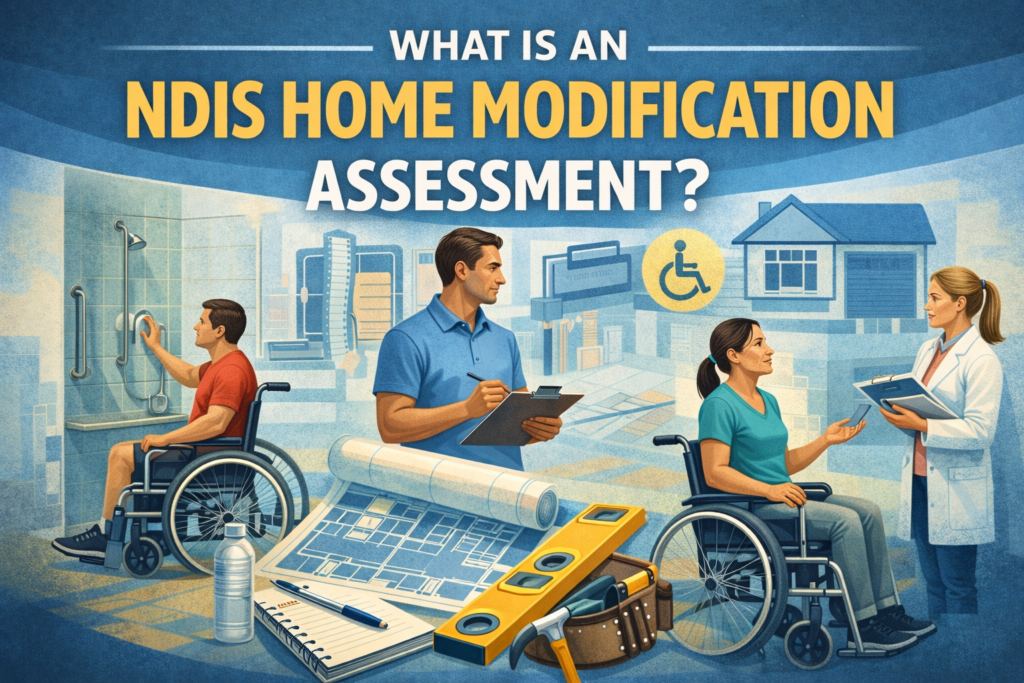
An NDIS home modification assessment is a structured on-site evaluation carried out by a qualified occupational therapist to identify physical barriers in a participant’s home environment and recommend modifications to improve safety, access, and independence.
The OT visits the participant’s home, assesses how they move through and interact with each relevant area, identifies specific barriers created by the home’s layout or features, and then produces a detailed written report. That report forms the clinical evidence the NDIA uses to fund the recommended building works under the participant’s NDIS plan.
Important: The OT does not build or organise the modifications — they assess, recommend, and report. The actual building works are carried out by an NDIS-registered builder, funded separately through your Capital Supports budget. The OT report is the gateway to that funding.
A home modification assessment is different from a Functional Capacity Assessment (FCA), which evaluates your overall daily functioning across all areas of life. A home modification assessment is specifically focused on the built environment — the physical features of your home — and how those features interact with your disability.
Who Needs a Home Modification Assessment?
You may benefit from a home modification assessment if your disability creates any of the following in your home:
- Difficulty or danger when entering or exiting the property (steps, uneven paths, heavy doors)
- Risk of falls in the bathroom or toilet area
- Inability to use a shower, bath, or toilet without assistance that could be reduced with the right equipment or structural changes
- Difficulty navigating between rooms due to narrow hallways or doorways
- Inability to access key areas such as the kitchen, laundry, or outdoor spaces
- Need for overnight support that could be reduced if the home environment were modified
- Dependence on a carer for tasks that structural modifications could make possible independently
- Use of a wheelchair, walking frame, or other mobility aid that does not fit safely through the current layout
Home modification assessments are particularly common for participants with:
Physical disabilities
Spinal cord injury, cerebral palsy, limb difference, muscular dystrophy, MS
Acquired brain injury
Stroke, traumatic brain injury, affecting mobility, balance, or cognitive safety
Neurological conditions
Parkinson’s disease, multiple sclerosis, progressive conditions affecting mobility
Intellectual & psychosocial
Where environmental modifications can improve safety and independence at home
What Does the OT Assess During a Home Modification Assessment?
The occupational therapist will assess the home systematically, moving through each relevant area and observing how the participant interacts with the built environment. They will consider the participant’s current and anticipated future needs — modifications should be appropriate not just for today, but for how the disability may progress.
Areas typically assessed
Entry and approach
The OT will assess how you approach and enter the property — including the path from the street or driveway, any steps or level changes, the front door width and weight, lighting, and whether a ramp, handrail, or intercom system is required.
Hallways and internal doors
Standard doorways (typically 820mm wide) are often too narrow for a wheelchair or walking frame to pass safely. The OT assesses internal door widths, hallway widths, turning radius requirements, and whether widening is needed to allow safe movement through the home.
Bathroom and toilet
This is the most commonly modified area in the home. The OT assesses shower access (step-over bath vs roll-in shower), toilet height and access, grab rail placement, floor surface, door swing direction, and whether a ceiling hoist or tracking system is required for transfers.
Bedroom
The OT looks at bed height, transfer space, access to wardrobes and storage, space for assistive equipment such as hoists or hospital beds, and safety considerations such as fall risk during the night.
Kitchen
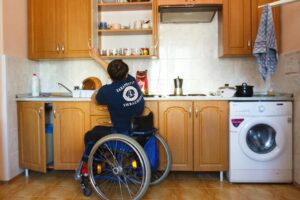
Bench height, oven and stovetop access, sink depth, cupboard accessibility, and whether a modified or adjustable kitchen is needed to support independent meal preparation.
Laundry
Access to the washing machine and dryer, reach requirements, step-overs, and whether the laundry layout supports independent use.
Outdoor access
Steps, ramps, handrails, surface texture, and access to outdoor entertaining areas, letterboxes, or clotheslines — particularly relevant for participants wanting to maintain community connection and outdoor independence.
Garage and vehicle access
Where relevant, the OT may assess parking and vehicle access — particularly for participants who use modified vehicles or need sufficient space to transfer safely between a vehicle and a wheelchair.
A note for participants in Darwin and regional NT: The majority of dwellings in the Northern Territory were built with cyclone resistance as the primary design consideration — not accessibility. This means many NT homes present significant access barriers for people with mobility impairments, making home modification assessments particularly important in this region. TEAH’s OTs have extensive experience assessing Darwin homes and understand the specific structural constraints of high-set and cyclone-rated construction.
What Home Modifications Does the NDIS Fund?
The NDIS funds home modifications that are directly related to a participant’s disability and are “reasonable and necessary” to support their independence, safety, or capacity to receive care at home. Here are the most commonly funded modifications:
| Area | Common modifications funded |
|---|---|
| Entry & access | Ramps, handrails, widened entry doors, automatic door openers, improved lighting, intercom systems, accessible pathways |
| Bathroom | Roll-in or step-free shower, grab rails, fold-down shower seat, raised toilet suite, toilet safety frame, accessible vanity, non-slip flooring, hoist tracking |
| Internal access | Widened doorways, removal of internal steps, threshold levelling, offset door hinges to increase clearance |
| Bedroom | Ceiling hoist or tracking system, hospital bed provision, modified wardrobe access |
| Kitchen | Height-adjustable benchtops, pull-out shelving, lever-style taps and handles, under-bench clearance for wheelchair access |
| Safety systems | Emergency call systems, smart home controls, sensor lighting, stair lifts |
| Outdoor access | External ramps, handrails, accessible pathways, deck access modifications |
Minor vs Major Modifications — What’s the Difference?
The NDIS categorises home modifications as either minor or major, and the approval and funding process differs significantly between the two.
Minor home modifications
Minor modifications are lower-cost, lower-complexity structural changes — typically costing under $20,000 per item and not requiring significant building work. Examples include grab rails, non-slip flooring, lever-style door handles, ramps, handrails, and threshold ramps.
Minor modifications can be approved by your support coordinator or plan manager and funded directly from your Capital Supports budget with minimal documentation. For some minor modifications, a quote from a certified installer and a letter of support from your OT may be sufficient without a full home modification report.
Major home modifications
Major modifications involve more significant structural changes — typically costing over $20,000 or involving changes to the structure, fixtures, or fittings of the building. Examples include widening doorways, converting a bath to a roll-in shower, installing a ceiling hoist, modifying a kitchen, or constructing a ramp.
Major modifications require a comprehensive OT home modification report before the NDIA will approve funding. The report must include a detailed clinical justification for each modification, relevant standards references, a functional description of how the modification addresses a specific disability-related need, and typically two builder quotes.
Minor vs major — at a glance
| Minor modifications | Major modifications | |
|---|---|---|
| Typical cost | Under $20,000 | $20,000+ |
| OT report required? | Usually a support letter | Yes — full report required |
| Builder quotes needed? | One quote typically sufficient | Usually two quotes required |
| Budget line | Capital — Home Modifications | Capital — Home Modifications |
| Approval path | Support coordinator / plan manager | NDIA approval required |
How the Process Works, Step by Step
Getting home modifications funded through the NDIS involves a clear sequence of steps. Understanding the process helps you manage expectations around timeframes and know what to prepare at each stage.
Referral to an OT
Contact TEAH by phone, email, or online referral form. Our intake team will confirm eligibility, check your Capital Supports budget, and match you with a local occupational therapist.
On-site home modification assessment
Your OT visits your home, assesses the relevant areas with you present, discusses your goals and daily routines, and identifies what modifications would most improve your safety, independence, and quality of life. This typically takes 1–2 hours.
OT report and specifications written
Your OT produces a detailed written report including clinical justification for each recommended modification, Australian Standards references, functional impact statements, and recommended specifications for the building works. You receive a draft to review — typically within 10–14 business days.
Builder quotes obtained
You or your support coordinator obtain quotes from NDIS-registered builders based on the OT’s specifications. For major modifications, the NDIA typically requires two quotes. The OT report and quotes are submitted together to the NDIA or your plan manager.
NDIA approval and funding
For major modifications, the NDIA reviews the report, specifications, and quotes and makes a funding decision. This can take several weeks. Once approved, the Capital Supports funding is available for the builder to draw against as works are completed.
Building works completed
The NDIS-registered builder carries out the approved modifications. In some cases your OT may conduct a post-modification review to confirm the works meet the clinical specifications and achieve the intended functional outcomes.
How NDIS Funding Works for Home Modifications
Home modifications are funded under the Capital Supports — Home Modifications budget in your NDIS plan. Capital Supports funding is different from your Capacity Building and Core Supports budgets — it is a separate allocation specifically for one-off capital items like modifications and assistive technology.
Does home modification funding need to be in my plan already?
For your plan to fund home modifications, you generally need to have Capital Supports funding included. If your current plan does not include this, you have two options:
- Request a plan variation — if you have a clearly identified and urgent need, your support coordinator can request the NDIA add Capital Supports funding outside of your regular review cycle.
- Wait for your next plan review — and submit the OT home modification report as supporting evidence to ensure Capital Supports funding is included in your new plan.
How much funding is available?
There is no fixed cap on home modification funding — the amount is determined by what the NDIA considers reasonable and necessary for your specific situation, based on your OT report and the builder quotes. Minor modifications might be funded at a few hundred dollars; major modifications for complex needs can reach tens of thousands of dollars or more.
The OT assessment cost: The home modification assessment itself — including the site visit and report — is funded from your Capacity Building — Improved Daily Living budget, not Capital Supports. At the NDIS rate of $193.99/hour, a home modification assessment typically costs $390–$780 (2–4 hours of OT time). This is separate from the cost of the building works themselves.
What If I Rent My Home?
Renting does not automatically exclude you from NDIS home modifications — but it does add complexity. Here is what you need to know:
Landlord consent is required
For any structural modification, you need written consent from your landlord before works can proceed. Many landlords will agree when the modifications are funded by the NDIS and carried out by a licensed builder — particularly if the modifications are reversible or add value to the property.
Some modifications are reversible
Grab rails, threshold ramps, and many minor modifications can be removed at the end of a tenancy with minimal impact on the property. Your OT report can specify whether modifications are reversible, which helps when negotiating with a landlord.
If a landlord refuses
If a landlord refuses consent for modifications that are clinically necessary, you may have grounds to pursue a resolution through the relevant state tenancy authority. In some states, anti-discrimination legislation supports a tenant’s right to make reasonable modifications related to disability.
Consider whether moving is a better solution
If your current rental property has significant structural limitations and your landlord is unlikely to consent to the modifications you need, your OT and support coordinator may recommend exploring Specialist Disability Accommodation (SDA) — housing built specifically to meet the access needs of participants with high support requirements.
NDIS Registered — WA · NT · QLD · VIC
Need a home modification assessment?
TEAH’s occupational therapists conduct on-site home modification assessments and produce detailed, NDIA-quality reports across Darwin (NT), Perth (WA), Brisbane (QLD), and Victoria.
Frequently Asked Questions
Do I need an OT report for every home modification?
Not always. Minor modifications — such as grab rails or a simple threshold ramp — may only require a supporting letter from an OT rather than a full report. Major modifications, or anything costing over $20,000 or involving significant structural work, require a comprehensive OT home modification report before the NDIA will approve funding.
Can I choose my own builder for NDIS home modifications?
If you are agency-managed, your builder must be NDIS-registered. If you are plan-managed or self-managed, you have more flexibility and may be able to use any suitably licensed builder, though they must still be capable of meeting the OT’s specifications. Your support coordinator can help you identify appropriate builders in your area.
How long does the home modification process take from assessment to completed works?
The full process — from OT assessment to completed building works — typically takes 3 to 6 months for major modifications. This includes OT report writing (2–3 weeks), obtaining builder quotes, NDIA approval (4–6 weeks for complex modifications), and the building works themselves. Simpler modifications can be completed in 4–8 weeks.
What if I plan to move home — should I still get modifications done?
If you are likely to move within the next 12 months, discuss this with your OT before proceeding. In some cases it may make more sense to factor your access requirements into your new home search, rather than modify a home you will soon leave. If you do proceed, the OT report documents the modifications for potential use in future properties.
Can the NDIS fund modifications to a family member’s home?
Yes — if a participant regularly stays at a family member’s home (for example, for weekend visits or family care arrangements), modifications to that property may be fundable if they are clinically necessary to support the participant’s safety or independence while at that address. Discuss this with your OT and support coordinator.
How do I get started with a home modification assessment through TEAH?
Simply make a referral via our online form, email referrals@topendalliedhealth.com.au, or call 1300 203 059. Our intake team will check your NDIS plan, confirm Capital Supports funding, and match you with a local OT for an in-home assessment.
Summary
An NDIS home modification assessment is the clinical foundation for getting your home environment right. It identifies the specific barriers your disability creates in your home, recommends the modifications that would best address those barriers, and produces the written evidence the NDIA needs to fund the works.
Done well, a home modification assessment can unlock funding that meaningfully reduces your reliance on support workers, improves your safety, and lets you live more independently in a home that actually works for you. At TEAH, our OTs conduct in-home assessments across Darwin (NT), Perth (WA), Brisbane (QLD), and Victoria — with a deep understanding of the specific access challenges in each region.
Book a home modification assessment
Darwin (NT) · Perth (WA) · Brisbane (QLD) · Victoria
Related articles
TEAH Allied Health Team
Top End Allied Health (TEAH) is an NDIS-registered allied health provider delivering occupational therapy, speech pathology, physiotherapy, and supported accommodation across WA, NT, QLD, and Victoria. Referrals: referrals@topendalliedhealth.com.au | 1300 203 059