
Reading time: 10 minutes | Updated: April 2026 | Written by: TEAH Allied Health Team
You have an NDIS plan. You know you need occupational therapy — or someone has told you an OT assessment would help your situation. But between checking your funding, choosing a provider, making a referral, and understanding what happens next, the process can feel opaque and overwhelming, especially if it’s your first time.
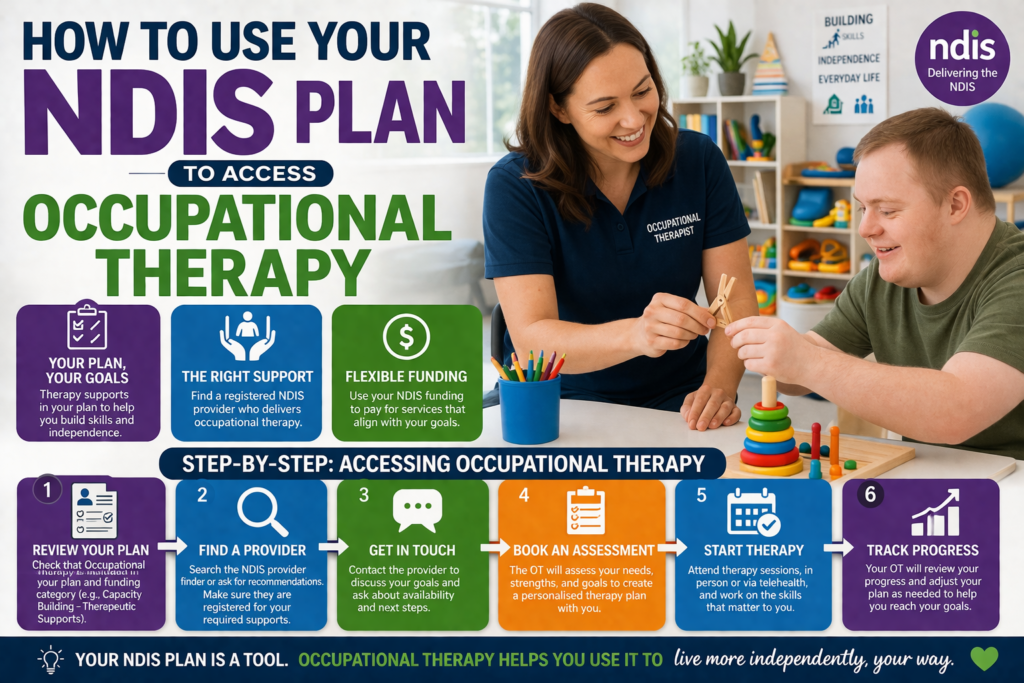
This guide cuts through that confusion. It takes you step by step from your current NDIS plan through to your first OT appointment and beyond — covering how to check you have the right funding, how to choose the right provider, what to do at referral, and how to make sure the therapy you receive actually moves your plan forward.
In this article
- Step 1 — Confirm you have the right funding in your plan
- Step 2 — Identify what you actually need from an OT
- Step 3 — Choose the right OT provider
- Step 4 — Make a referral
- Step 5 — Prepare for your first appointment
- Step 6 — Understand what the OT will deliver
- Step 7 — Track your spending and budget
- Step 8 — Use OT to build evidence for your next plan review
- What if your plan doesn’t include OT funding?
- Frequently asked questions
Step 1 — Confirm You Have the Right Funding in Your Plan
Before doing anything else, check that your NDIS plan includes the budget category that funds occupational therapy. OT is funded under Capacity Building — Improved Daily Living (sometimes shown as “CB — Improved Daily Living” or simply listed under Capacity Building Supports).
How to check your plan
If you are agency managed: Log in to the myNDIS participant portal at my.ndis.gov.au. Navigate to My Plan, open your current plan, and look under Capacity Building Supports for the Improved Daily Living subcategory. The dollar figure shown is your total allocation for the plan year.
If you are plan managed: Contact your plan manager and ask: “What is the current balance in my Capacity Building — Improved Daily Living budget?” They track your spending in real time and can tell you exactly what remains.
If you are self managed: Find your plan document and locate the Capacity Building — Improved Daily Living allocation. Subtract any invoices you have already paid from that total. You are responsible for tracking your own balance.
What to check before booking: Confirm your Improved Daily Living balance is sufficient for the OT service you need. A Functional Capacity Assessment typically costs $1,552–$2,328. A home modification assessment costs $388–$776. If you are unsure, call TEAH on 1300 203 059 — our intake team will check your plan with you before your referral is even confirmed.
What if your plan doesn’t have Improved Daily Living funding?
Jump to the section below on accessing OT without existing funding. It is a fixable situation — but it requires a different approach than simply booking an appointment.
Do you also need Capital Supports?
If the reason you are seeing an OT is to get equipment (AT) or home modifications funded, your plan also needs Capital Supports — Assistive Technology or Capital Supports — Home Modifications to actually purchase those items. The OT assessment is paid from Improved Daily Living; the equipment or building work is paid from Capital Supports. Both must be present.
Step 2 — Identify What You Actually Need from an OT
Occupational therapists deliver a wide range of services, and knowing which one you need before you make a referral helps the provider match you with the right clinician and allocate the right amount of time. Being vague — “I just need to see an OT” — leads to mismatched expectations and sometimes a second appointment to redo what should have been done in the first.
Use the following to identify which OT service fits your situation:
| Your situation | OT service you likely need | What it produces |
|---|---|---|
| Plan review coming up and current supports feel wrong | Functional Capacity Assessment | Clinical report documenting support needs — submitted as review evidence |
| Home is hard to move around safely | Home Modification Assessment | Report and specifications to unlock Capital Supports for ramps, rails, accessible bathroom |
| Need a wheelchair, hoist, or communication device | Assistive Technology Assessment | AT prescription and report to unlock Capital Supports for the equipment |
| Participant needs supported accommodation (SIL or SDA) | SIL / SDA Assessment | Eligibility report supporting SIL hours or SDA housing funding application |
| Child struggling with school tasks, fine motor, or sensory needs | Paediatric OT assessment and therapy | Assessment report and ongoing therapy program targeting developmental goals |
| Difficulty with daily tasks — cooking, dressing, managing routines | Individual OT therapy | Goal-directed therapy program to build independence in targeted tasks |
| Returning from hospital or rehab after an injury or stroke | FCA + home modification assessment + AT assessment | Combined suite of reports to fund full post-discharge support package |
Not sure which applies to you? That’s fine — describe your situation at referral and let the OT practice intake team guide you. A good intake process should identify the right service type before your first appointment is booked.
Step 3 — Choose the Right OT Provider
Once you know what you need and have confirmed your funding, choosing the right OT provider makes a significant difference to your experience and outcomes. Here is what to look for:
Check they are NDIS registered (if required)
If your plan is agency managed, your OT provider must be registered with the NDIS. Use the NDIS Provider Finder at ndis.gov.au or call the NDIA to verify registration. If you are plan managed or self managed, you can use either registered or unregistered OT providers — giving you considerably more choice.
Look for local, mobile OTs
In-home assessments — where the OT comes to you — produce far better clinical evidence than clinic-based assessments. When the OT can see you in your actual home environment, their report reflects your real challenges rather than a controlled clinical setting. Prioritise providers who offer mobile, community-based services in your area.
Check for relevant experience
Occupational therapy covers a broad scope of practice. An OT with deep experience in paediatric sensory assessment may have limited experience prescribing complex power wheelchairs, and vice versa. When you make contact with a provider, ask whether they have OTs experienced in the specific type of assessment or therapy you need.
Ask about wait times
OT wait times across Australia are significant — and getting worse in some regions. Ask the provider directly: “What is your current wait time for a Functional Capacity Assessment in [your area]?” A provider who cannot give you a clear answer, or whose wait time conflicts with your plan review timeline, may not be the right fit right now.
Ask about the referral and intake process
A provider with a clear, responsive intake process — who checks your plan funding before booking, asks about your goals and situation upfront, and provides a service agreement before the first appointment — is a green flag. A provider who books you in immediately without any intake conversation is a yellow flag.
At TEAH: Our intake team checks your plan funding before confirming your referral, matches you with an OT experienced in your specific need, and provides a clear service agreement. We offer in-home, community, and clinic-based OT across Darwin (NT), Perth (WA), Brisbane (QLD), and Victoria — with wait times consistently below the industry average. Learn about our OT services →
Step 4 — Make a Referral
Making a referral for NDIS OT is straightforward — but providing the right information upfront saves time and ensures you are matched with the most appropriate clinician from the start.
Who can make the referral?
Anyone in the participant’s support network can make a referral:
- The participant themselves
- A family member or carer
- A support coordinator
- A plan manager
- A GP or other health professional
You do not need a GP referral to access NDIS OT. You simply contact the OT provider directly.
What to include in your referral
📋 Referral information checklist
- Participant’s full name and date of birth
- NDIS participant number
- Plan management type (agency, plan managed, or self managed)
- Plan manager contact details (if plan managed)
- Current plan start and end dates
- The type of OT service you are requesting (FCA, home mod assessment, AT assessment, therapy, etc.)
- A brief description of the participant’s disability and the reason for referral
- The participant’s current address (for in-home assessments)
- Support coordinator contact details (if applicable)
- Any urgent timelines — for example, a plan review date or a discharge date from hospital
How to refer to TEAH
You can refer to TEAH in three ways:
- Online: Complete our referral form at topendalliedhealth.com.au/referral
- Email: referrals@topendalliedhealth.com.au
- Phone: 1300 203 059 (Mon–Fri, 8am–5pm)
Step 5 — Prepare for Your First Appointment
Whether your first appointment is an assessment or a therapy intake session, arriving prepared makes it significantly more productive. Here is what to do in the days before:
Gather your documents
- A copy of your current NDIS plan (or your plan goals at minimum)
- Any existing clinical reports — GP letters, specialist reports, hospital discharge summaries
- Current medication list
- Any previous NDIS assessments or therapy reports
- School reports or IEPs (for children)
Think about your goals and difficulties
Before your appointment, spend 10 minutes writing down the specific things that are difficult in your daily life because of your disability. Include tasks you need help with, tasks you have stopped doing entirely, and tasks that take much longer or are much more tiring than they should be. This list is worth more than a stack of medical letters.
For assessment appointments specifically
If your first appointment is a functional or home modification assessment, read our detailed preparation guide: How to prepare for your NDIS Functional Capacity Assessment →
The short version: describe your typical day, not your best day. The OT can only report on what they observe and what you tell them — and many participants understate their difficulties in a clinical setting.
Have a support person present if it helps
You are entitled to have a family member, carer, or support coordinator present. For participants who find self-reporting difficult — or whose functioning varies significantly day to day — having someone who knows them well can significantly improve the quality of the assessment.
Step 6 — Understand What the OT Will Deliver
What happens after your first OT appointment depends on the service type you have engaged. Here is a clear overview of what each service produces and what happens next:
After an assessment (FCA, home modification, AT, SIL/SDA)
Assessment appointment
OT visits your home or meets you in a relevant environment. Conducts structured assessment, interviews you and support network, observes you performing daily tasks.
Report writing (10–14 business days)
OT writes the clinical report. This is billed at the standard hourly rate from your Improved Daily Living budget — not a separate charge.
Draft sent for review
You (and/or your support coordinator) receive the draft. Read it carefully. Raise any inaccuracies or omissions with the OT before the report is finalised — this is your most important opportunity.
Report finalised and submitted
Final report sent to you, your plan manager or support coordinator, and (where appropriate) submitted to the NDIA. For AT and home mods, you now proceed with obtaining quotes.
After ongoing therapy sessions
If you have engaged an OT for ongoing individual therapy rather than (or in addition to) assessments, your OT will typically:
- Develop a therapy plan aligned to your NDIS goals at or after the first session
- Deliver regular sessions (weekly, fortnightly, or monthly depending on need and budget)
- Write progress notes after each session documenting goal progress
- Produce a progress or summary report when requested by you, your support coordinator, or ahead of your plan review
Ask your OT to keep goal-aligned progress notes. Every therapy session should be documented against your NDIS goals. At your next plan review, these notes are the evidence base for continued or increased IDL funding. An OT who does not keep progress notes is not just missing best practice — they are leaving you without the documentation you need to justify ongoing therapy.
Step 7 — Track Your Spending and Budget
Improved Daily Living funding is ring-fenced and does not roll over to your next plan. Running out mid-year — before a critical assessment or report is completed — is a common and avoidable problem.
How to monitor your IDL balance
- Agency managed: Check the myNDIS portal regularly. The balance updates as claims are processed — usually within a few days of the appointment.
- Plan managed: Ask your plan manager for a monthly spending statement, or request access to a real-time balance view if they offer one.
- Self managed: Maintain a simple spreadsheet of all OT invoices paid from your IDL budget and subtract from your total allocation.
Set a mid-year checkpoint
About halfway through your plan year, review your IDL balance against what you still need to do. If you have used more than 60–70% of your budget with six months remaining, talk to your OT about prioritising the most important services for the rest of the year. If you have used less than 20% with only three months left, contact your OT to schedule outstanding appointments before your plan expires.
Avoid the end-of-plan rush
One of the most common complaints in the NDIS ecosystem is participants and coordinators scrambling to book OT appointments in the final weeks of a plan year. OT providers are inundated with urgent requests in this period — and wait times blow out. The solution is simple: plan your therapy year at the start of your plan, not at the end.
Step 8 — Use OT to Build Evidence for Your Next Plan Review
Your NDIS plan review is not just an administrative event — it is the mechanism through which your funding either increases to reflect your real needs, stays the same, or (in the worst case) decreases because the NDIA does not have sufficient evidence to justify the current level.
Occupational therapy is the most powerful evidence-generating mechanism available to participants preparing for a plan review. Here is how to use it deliberately:
Commission a fresh FCA 2–3 months before your review
If your last Functional Capacity Assessment was conducted more than two years ago, or if your functional capacity has changed significantly since then, commission an updated FCA well ahead of your review date. An updated assessment gives the NDIA current, clinical evidence of your support needs — and dramatically reduces the risk of funding being reduced based on outdated information.
Ask your OT for a plan review summary letter
Even without a full new FCA, your regular OT can write a brief summary letter for your plan review documenting the therapy delivered, goal progress, ongoing therapy recommendations, and their clinical opinion on the level of OT support your plan should include. This letter, combined with your existing reports, strengthens your review submission significantly.
Use your assessment reports as evidence packages
Every OT report produced during your plan year — the FCA, the AT assessment, the home modification report — is a piece of evidence that the NDIA can draw on at your review. Ensure all reports from the current plan year are included in your review submission, even if they were primarily produced for a different purpose (such as an AT application).
Document what worked — and what still needs funding
Before your review meeting, work with your OT to articulate clearly: what therapy goals were achieved during the plan year, what goals remain unmet and why, and what OT support your next plan should include to continue your progress. This narrative — supported by the OT’s progress notes — is the most compelling case you can make for continued or increased IDL funding.
NDIS Registered — WA · NT · QLD · VIC
Ready to access OT through your NDIS plan?
TEAH’s intake team checks your plan, confirms your funding, and matches you with a local OT — with low wait times and in-home assessments across Darwin, Perth, Brisbane, and Victoria.
What If Your Plan Doesn’t Include OT Funding?
Finding that your plan has no Capacity Building — Improved Daily Living budget — or an amount too small to cover the OT services you need — is frustrating, but it is addressable.
Option 1: Request a plan variation for urgent needs
If your need for OT is urgent — for example, you need a home modification assessment following an accident, or an FCA ahead of an imminent plan review — contact the NDIA and request a plan variation. Explain the specific reason for urgency and provide any supporting evidence you have (such as a discharge letter from hospital, or a letter from your GP). Plan variations are not guaranteed, but they are granted for legitimate urgent circumstances.
Option 2: Prepare strong evidence for your next plan review
If the need is not immediately urgent, the most reliable path to getting IDL funding included is building a strong evidence case for your next scheduled plan review. This means:
- Getting a letter from your GP documenting the functional impact of your disability and recommending OT assessment
- Getting a letter from any current allied health provider supporting the need for OT
- Writing a participant statement explaining what OT would achieve for you and why it is necessary for your NDIS goals
- If you have a support coordinator, asking them to document the gap in your current plan and advocate for IDL funding at your review
Option 3: Access OT privately to generate the evidence you need
In some circumstances, paying for an initial private OT assessment (outside the NDIS) can generate the clinical report needed to secure IDL funding in your next plan. This involves upfront cost, but the resulting FCA can then be used as the supporting evidence that gets IDL funding included going forward. Discuss this option with your support coordinator before proceeding.
Frequently Asked Questions
Do I need a GP referral to see an NDIS OT?
No. You can self-refer directly to an NDIS OT provider without a GP referral. As long as your plan includes Capacity Building — Improved Daily Living funding, you simply contact the provider and make a referral. TEAH accepts referrals by phone, email, or online form.
Can I see more than one OT provider at the same time?
Yes — as long as the services are distinct and not duplicating each other, you can use multiple OT providers. For example, you might use TEAH for a Functional Capacity Assessment and a separate local provider for ongoing paediatric therapy. Your plan manager or support coordinator can help ensure claims don’t conflict.
How quickly can I get an OT appointment after making a referral?
Wait times vary significantly by provider and location. TEAH’s wait times are consistently below the industry average. For urgent situations — such as an imminent plan review or hospital discharge — flag the urgency at the time of referral and we will do everything possible to prioritise your appointment. Call us on 1300 203 059 for current availability in your area.
What is a service agreement and do I need one?
A service agreement is a written agreement between you and your OT provider that sets out the services to be provided, the costs, your rights and responsibilities, and the cancellation policy. For NDIS-funded services, a service agreement is strongly recommended and required by some plan managers. TEAH provides service agreements for all participants before services begin.
Can I change OT providers if I am not happy with my current one?
Yes. You have the right to change providers at any time. Review your service agreement for any notice period requirements, and check with your plan manager or support coordinator that the transition is managed cleanly — particularly if any reports are in progress. You do not owe a provider continued business simply because they have already conducted part of an assessment.
How long before my plan review should I book an OT assessment?
Ideally 2–3 months before your plan review date. This allows time for the assessment appointment, report writing (10–14 business days), your review of the draft, any amendments, and submission to the NDIA. Leaving it to the last month creates significant time pressure and risks the report not being ready in time for your review meeting.
What if I run out of Improved Daily Living funding before my plan renews?
If you exhaust your IDL budget before your plan year ends and still have outstanding OT needs, contact the NDIA to request a plan variation — particularly if the remaining need is urgent or was not anticipated when the plan was written. Otherwise, document the unmet need thoroughly for your next plan review to ensure adequate IDL funding is included in your new plan.
Summary
Accessing occupational therapy through your NDIS plan follows a clear sequence: confirm your Improved Daily Living funding, identify which OT service you need, choose a registered local provider with relevant experience, make a referral with the right information, prepare for your appointment, and use your OT engagement strategically to generate evidence for your next plan review.
The most common mistakes — not checking funding before booking, arriving at assessments unprepared, and leaving OT to the last months of a plan year — are all avoidable with a little planning. And the payoff is significant: well-timed OT, well-documented therapy progress, and a strong FCA submitted ahead of a plan review are among the most effective tools available to any NDIS participant.
TEAH is ready to help you through every step of that process — from checking your plan at intake through to the final report. Call us on 1300 203 059 or make a referral online.
Start your OT journey with TEAH
Darwin (NT) · Perth (WA) · Brisbane (QLD) · Victoria
Related articles
- How does the NDIS fund occupational therapy in 2025–26?
- What is Capacity Building — Improved Daily Living in the NDIS?
- What is a Functional Capacity Assessment and what does it include?
- How to prepare for your NDIS Functional Capacity Assessment
- Our Occupational Therapy Services — Darwin, Perth, Brisbane & Victoria
TEAH Allied Health Team
Top End Allied Health (TEAH) is an NDIS-registered allied health provider delivering occupational therapy, speech pathology, physiotherapy, and supported accommodation across WA, NT, QLD, and Victoria. Referrals: referrals@topendalliedhealth.com.au | 1300 203 059