Reading time: 9 minutes | Updated: April 2026 | Written by: TEAH Allied Health Team
“How much will this cost?” is one of the first questions NDIS participants and support coordinators ask when they start looking at occupational therapy. It is also one of the least clearly answered questions online — most OT provider websites either avoid it entirely or give ranges so broad they are practically useless.
This guide gives you real, specific cost figures for every common type of NDIS OT assessment in 2025–26 — based on the current NDIS Pricing Arrangements and Price Limits (PAPL). It also explains which budget the cost comes from, what drives cost variation between providers, what you should be cautious about when quotes seem unusually low or high, and how to plan your Improved Daily Living budget to make the most of what you have.
In this article
- The 2025–26 NDIS OT hourly rate
- Cost of each type of OT assessment
- Complete NDIS OT cost reference table
- What drives cost variation between assessments
- Which NDIS budget pays for what
- Red flags — when quotes seem too low or too high
- Travel costs — what you can be charged
- How to plan your IDL budget for the year
- Frequently asked questions
The 2025–26 NDIS OT Hourly Rate
The NDIA publishes a Pricing Arrangements and Price Limits (PAPL) document each financial year. This document sets the maximum rate that NDIS-registered providers can charge for all funded supports, including occupational therapy. Providers may charge at or below these limits — they cannot legally charge above them for NDIS-funded services.
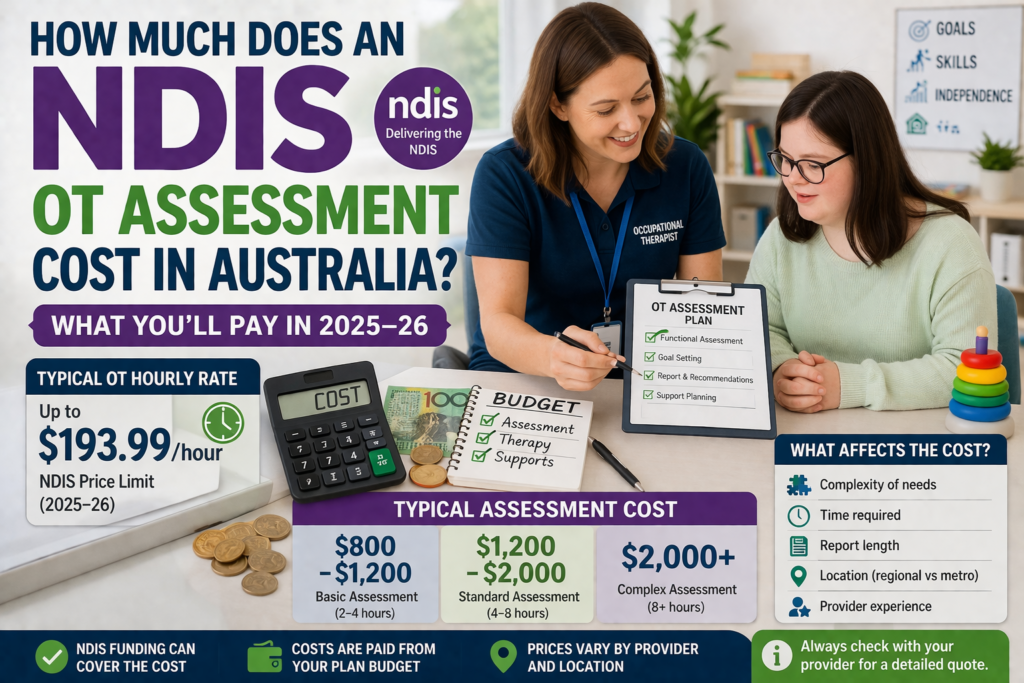
For occupational therapy in 2025–26, the PAPL maximum hourly rates are:
2025–26 NDIS OT Maximum Hourly Rates
| Day / time | Maximum hourly rate | When it applies |
|---|---|---|
| Weekday | $193.99 | Mon–Fri during standard hours |
| Saturday | $242.49 | All Saturday appointments |
| Sunday | $290.99 | All Sunday appointments |
| Public holiday | $290.99 | Gazetted public holidays |
Source: NDIS Pricing Arrangements and Price Limits 2025–26. Always verify the current PAPL at ndis.gov.au for the most up-to-date figures.
Context: The NDIS OT rate has been frozen or marginally adjusted for seven consecutive years despite consistent CPI growth and rising operational costs. The $193.99 weekday rate is the PAPL ceiling — most OT providers charge at or near this rate because below-PAPL margins are already thin. If a provider offers significantly discounted rates, understand what is being reduced to make that possible.
All cost estimates in this article use the $193.99 weekday rate unless otherwise stated. Real costs will depend on the specific provider, the complexity of the participant’s needs, and whether weekend or travel rates apply.
Cost of Each Type of OT Assessment
OT assessment costs are not a flat fee — they are calculated based on the total OT time required across all phases: the appointment itself, travel to and from the participant’s location, preparation, report writing, participant review, amendments, and any follow-up communication. Here is a breakdown by assessment type.
Functional Capacity Assessment (FCA)
Functional Capacity Assessment
Comprehensive evaluation of functional capacity across all daily living domains
$1,552 – $2,716
8–14 hours of OT time
An FCA is the most comprehensive — and therefore the most time-intensive — OT assessment. The assessment appointment alone can take 2–4 hours for complex participants, and the clinical report typically takes another 4–8 hours to write. Simpler cases (clear primary diagnosis, good existing documentation) sit toward the lower end; complex participants with multiple conditions, cognitive impairments, or disputed needs sit toward the higher end and sometimes beyond.
Home Modification Assessment
Home Modification Assessment
On-site assessment of access barriers with written specifications for NDIS-funded building works
$388 – $970
2–5 hours of OT time
A straightforward home modification assessment — such as a single grab rail or threshold ramp — may take as little as two hours in total. A whole-home accessibility assessment for a participant transitioning to a wheelchair-dependent lifestyle can take significantly longer, particularly where detailed specifications for structural works must be produced. Note that the OT assessment cost is separate from and in addition to the cost of the actual building works.
Assistive Technology (AT) Assessment
Assistive Technology Assessment
Functional assessment, equipment trial coordination, prescription, and report
$582 – $3,104
3–16 hours of OT time
AT assessment costs scale significantly with complexity. A simple daily living aid assessment takes a fraction of the time of a complex power wheelchair or AAC device assessment, which requires multiple appointments, coordinated equipment trials, detailed measurements, and a comprehensive prescription report. The equipment itself is funded from Capital Supports — the OT’s assessment time is always from Improved Daily Living.
SIL and SDA Assessment
SIL / SDA Assessment
Comprehensive functional assessment with 28-day schedule and/or SDA eligibility report
$1,940 – $3,880
10–20 hours of OT time
SIL and SDA assessments are among the most expensive OT reports in the NDIS ecosystem — and for good reason. They are also among the most consequential: a SIL assessment that justifies a 24-hour active support roster can be worth $200,000 or more per year in funded supports. The investment in a thorough, well-evidenced report is small relative to what is at stake.
Paediatric OT Assessment
Paediatric OT Assessment
Fine motor, sensory, developmental, school participation, or daily living assessment for children
$582 – $1,552
3–8 hours of OT time
Ongoing Individual OT Therapy
Individual OT Therapy Session
Goal-directed therapy session, typically 1 hour
$193.99 / hr
Per session (weekday rate)
Complete NDIS OT Cost Reference Table — 2025–26
| OT service | Total OT hours | Estimated cost range | Budget line |
|---|---|---|---|
| Functional Capacity Assessment (standard) | 8–10 hrs | $1,552–$1,940 | CB — Improved Daily Living |
| Functional Capacity Assessment (complex) | 10–14 hrs | $1,940–$2,716 | CB — Improved Daily Living |
| Home modification assessment (minor) | 2–3 hrs | $388–$582 | CB — Improved Daily Living |
| Home modification assessment (major) | 3–5 hrs | $582–$970 | CB — Improved Daily Living |
| AT assessment — simple (daily living aids) | 3–5 hrs | $582–$970 | CB — Improved Daily Living |
| AT assessment — mid-cost (manual wheelchair) | 5–8 hrs | $970–$1,552 | CB — Improved Daily Living |
| AT assessment — complex (power wheelchair / AAC) | 10–16 hrs | $1,940–$3,104 | CB — Improved Daily Living |
| SIL assessment and report | 10–16 hrs | $1,940–$3,104 | CB — Improved Daily Living |
| SDA eligibility assessment and report | 8–12 hrs | $1,552–$2,328 | CB — Improved Daily Living |
| Combined SIL + SDA assessment | 14–20 hrs | $2,716–$3,880 | CB — Improved Daily Living |
| Paediatric OT assessment (targeted) | 3–4 hrs | $582–$776 | CB — Improved Daily Living |
| Paediatric OT assessment (comprehensive) | 6–8 hrs | $1,164–$1,552 | CB — Improved Daily Living |
| AT fitting, training and handover | 2–4 hrs | $388–$776 | CB — Improved Daily Living |
| Individual OT therapy (per session, 1 hr) | 1 hr | $193.99 | CB — Improved Daily Living |
All costs calculated at $193.99/hr (2025–26 NDIS weekday rate, PAPL maximum). Actual costs depend on participant complexity, OT provider, and whether travel is billed. These are estimates — confirm with your OT provider before proceeding.
What Drives Cost Variation Between Assessments
Two participants with the same diagnosis may receive FCA quotes at very different price points. Understanding what drives that variation helps you evaluate quotes accurately rather than defaulting to the cheapest option.
Participant complexity
A participant with a single, well-documented primary diagnosis, a clear NDIS history, and a cooperative support network requires significantly less OT time than one with multiple co-occurring conditions, limited documentation, complex behaviour needs, or a contested plan history. Complex cases require more assessment time, more thorough report writing, and often multiple appointments.
Number of assessment domains
A targeted assessment covering one or two daily living domains (such as a paediatric fine motor assessment) draws far less time than a full FCA covering all eight domains of daily life. If you only need one specific question answered, a targeted assessment will cost less than a comprehensive one.
Quality and depth of the report
A 6-page narrative FCA takes less time to write than a 25-page structured report with standardised assessment scores, domain-by-domain findings, and a detailed 28-day support schedule. The latter is worth more as clinical evidence but costs proportionally more to produce. For high-stakes submissions like SIL or SDA, the more detailed report is the right choice.
In-home vs clinic-based delivery
In-home assessments are clinically superior — but they also take more OT time due to travel. Clinic-based assessments may appear cheaper per session but often produce less clinically accurate results, particularly for home modification or functional mobility assessments where the actual environment is critical.
Experience and specialisation
An OT with specialist experience in complex AT prescription, SDA assessments, or paediatric sensory processing may charge at or near the PAPL maximum and be worth every dollar. An OT with limited experience in the specific area you need may charge less — but the resulting report may not meet NDIA evidentiary standards, costing significantly more in rework and delays.
Which NDIS Budget Pays for What
A source of persistent confusion is that NDIS OT costs actually come from two different budgets — and participants sometimes arrive at their first AT or home modification appointment without realising they need both to proceed.
| What is being funded | Budget line | Examples |
|---|---|---|
| OT’s professional time | CB — Improved Daily Living | Assessment, report writing, travel, training, therapy sessions |
| Assistive technology (equipment) | Capital — Assistive Technology | Wheelchair, communication device, hoist, adjustable bed |
| Home modification building works | Capital — Home Modifications | Ramps, widened doorways, roll-in shower, grab rails (structural) |
| SIL support workers | Core Supports | The ongoing cost of support workers — not the OT who assessed the need |
Both budgets must be present: If you need an AT assessment, your plan needs Capacity Building — Improved Daily Living to pay the OT, and Capital Supports — Assistive Technology to actually purchase the equipment once it is prescribed. Having one without the other stalls the process. Check both before making a referral.
Red Flags — When Quotes Seem Too Low or Too High
The NDIS OT market is not uniformly consistent in quality, and cost alone is a poor proxy for value. Here is how to interpret quotes that fall at the extremes.
When a quote seems unusually low
If a provider quotes a very low price for a complex assessment — for example, $800 for a comprehensive FCA — ask what is being left out. Common cost-reduction strategies that compromise report quality include:
- Reducing the assessment appointment to a single, short interview rather than a multi-hour structured assessment with task observation
- Producing a templated or boilerplate report that is not meaningfully tailored to the participant’s individual circumstances
- Skipping standardised assessment tools to reduce scoring and interpretation time
- Omitting non-face-to-face time from quotes while still billing it separately later
A very cheap FCA that does not meet NDIA evidentiary standards will result in delayed approvals, requests for further information, or rejected plan review submissions — costing far more in time and re-work than a well-priced, thorough assessment would have.
When a quote seems unusually high
Quotes above the PAPL maximum rate are not permissible for registered NDIS providers charging from a participant’s agency-managed budget. If a registered provider quotes above $193.99 per hour for weekday services, ask for clarification — they may be incorrectly applying weekend or travel rates, or may be quoting for a different support type.
For plan-managed and self-managed participants, providers are not technically bound by PAPL limits — but the NDIA expects “reasonable value for money” to be demonstrated in all NDIS spending. An unusually high quote from an unregistered provider should prompt a conversation about what justifies the premium.
Travel Costs — What You Can Be Charged
In-home OT assessments involve travel, and travel has its own cost rules under the NDIS. The 2025–26 pricing changes revised provider travel rules significantly:
- Providers can claim non-labour costs (mileage) for travel to participant homes
- Provider travel time may be billed at 50% of the applicable hourly rate beyond a threshold distance — meaning $96.99/hr for weekday OT travel time
- Some providers absorb travel as a business cost and do not pass it to participants; others itemise it on invoices
Ask about travel before you book. If your home is in a regional area or some distance from the OT’s base location, travel costs can add meaningfully to your total. A good OT provider will disclose travel costs upfront in their service agreement — not as a surprise line item on your invoice. At TEAH, we discuss travel costs at intake for all regional referrals.
How to Plan Your IDL Budget for the Year
With OT costs now clearly laid out, here is how to think about planning your Improved Daily Living budget across a plan year to avoid running short.
Prioritise assessments that unlock Capital Supports first
If your plan includes Capital Supports for AT or home modifications, book those OT assessments early in the plan year. The OT cost is drawn from IDL — but the resulting Capital Supports funding it unlocks is a separate, additional budget that often dwarfs the assessment cost. Don’t leave the most leverage-generating assessments to the end of the year.
Budget planning by scenario
| Participant scenario | Recommended IDL allocation | What it covers |
|---|---|---|
| Plan review coming up, needs FCA only | $2,000–$3,000 | One standard FCA + buffer for amendments and non-face-to-face |
| Needs FCA + home modification assessment | $3,000–$4,000 | FCA + home mod assessment + report |
| Needs FCA + AT assessment (complex) | $5,000–$6,500 | FCA + complex AT assessment with trials + fitting and training |
| SIL/SDA application + ongoing therapy | $8,000–$15,000 | Combined SIL/SDA assessment + 6–12 months of fortnightly therapy |
| Child needing assessment + ongoing paediatric OT | $5,000–$10,000 | Comprehensive assessment + weekly therapy for 20–40 sessions |
NDIS Registered — WA · NT · QLD · VIC
Unsure how much OT funding you need? Let’s check together.
TEAH’s intake team will review your plan, confirm your IDL balance, and give you a clear estimate before your first appointment is booked — no surprises.
Frequently Asked Questions
Can a provider charge more than $193.99 per hour for OT?
For NDIS-registered providers billing agency-managed participants, no — $193.99 is the PAPL maximum weekday rate and cannot be exceeded for these claims. For plan-managed and self-managed participants, providers are not technically bound by PAPL limits, though the NDIA still expects reasonable value for money. Saturday rates ($242.49) and Sunday/public holiday rates ($290.99) apply on those days for all participant types.
Is the OT assessment cost the same as the cost of the equipment or home modification?
No — these are two separate costs from two separate budgets. The OT’s assessment and report are funded from Capacity Building — Improved Daily Living. The equipment (AT) or building works (home modifications) are funded from Capital Supports. You need both budgets present in your plan to complete the full process.
Why does report writing cost extra — isn’t that part of the assessment?
Yes — report writing is part of the overall OT assessment service, but it is billed as non-face-to-face time at the same hourly rate. A comprehensive FCA report can take 4–8 hours to write, score, and structure. This time is a legitimate clinical cost, and transparent providers will itemise it on their invoices. Be wary of providers who quote only for the appointment hour and then bill report writing as an additional surprise charge.
What if I need more than one type of OT assessment?
Many participants need multiple assessments in a plan year — for example, an FCA for a plan review and a home modification assessment to unlock Capital Supports. Each assessment draws separately from your Improved Daily Living budget. If you need multiple assessments, make sure your total IDL allocation is sufficient to cover all of them before committing. TEAH’s intake team can help you map your OT needs to your available budget.
Can I get a quote before committing to an assessment?
Yes — and you should. A reputable OT provider will discuss the expected scope, time, and cost of an assessment before you sign a service agreement. The quote should include the assessment appointment, report writing, non-face-to-face preparation, and any travel components. TEAH provides a clear scope and cost estimate at intake before any commitment is made.
What happens if the OT takes longer than quoted?
If a participant’s complexity means the assessment takes significantly more time than originally estimated, a reputable OT will communicate this before billing additional hours. Your service agreement should specify how scope changes are handled. If additional time is required, the OT should seek your agreement before incurring it — not present you with a larger-than-expected invoice after the fact.
Summary
NDIS OT assessment costs in 2025–26 range from approximately $388 for a straightforward home modification assessment through to $3,880 or more for a complex combined SIL and SDA report — all billed at the PAPL maximum of $193.99 per hour on weekdays and funded from your Capacity Building — Improved Daily Living budget.
The key principles for navigating OT costs wisely: know which budget pays for what, prioritise assessments that unlock Capital Supports, ask for a clear cost estimate before committing, be cautious of both unusually cheap and unnecessarily expensive quotes, and plan your full-year IDL spend at the start of your plan — not at the end.
If you are unsure how much IDL funding you have or whether it is sufficient for the OT services you need, TEAH’s intake team will check your plan and give you a clear picture before your first appointment. No commitment required.
Get a clear cost estimate from TEAH
Darwin (NT) · Perth (WA) · Brisbane (QLD) · Victoria
Related articles
- How does the NDIS fund occupational therapy in 2025–26?
- What is Capacity Building — Improved Daily Living in the NDIS?
- How to use your NDIS plan to access occupational therapy
- What is a Functional Capacity Assessment and what does it include?
- Our Occupational Therapy Services — Darwin, Perth, Brisbane & Victoria
TEAH Allied Health Team
Top End Allied Health (TEAH) is an NDIS-registered allied health provider delivering occupational therapy, speech pathology, physiotherapy, and supported accommodation across WA, NT, QLD, and Victoria. Referrals: referrals@topendalliedhealth.com.au | 1300 203 059