
Reading time: 11 minutes | Updated: April 2026 | Written by: TEAH Allied Health Team
Neurological conditions — including multiple sclerosis, Parkinson’s disease, stroke, spinal cord injury, and motor neurone disease — are among the most prevalent primary disability types in the NDIS. They share a common characteristic: they affect the nervous system in ways that ripple outward into every aspect of daily functioning, often progressively and unpredictably.
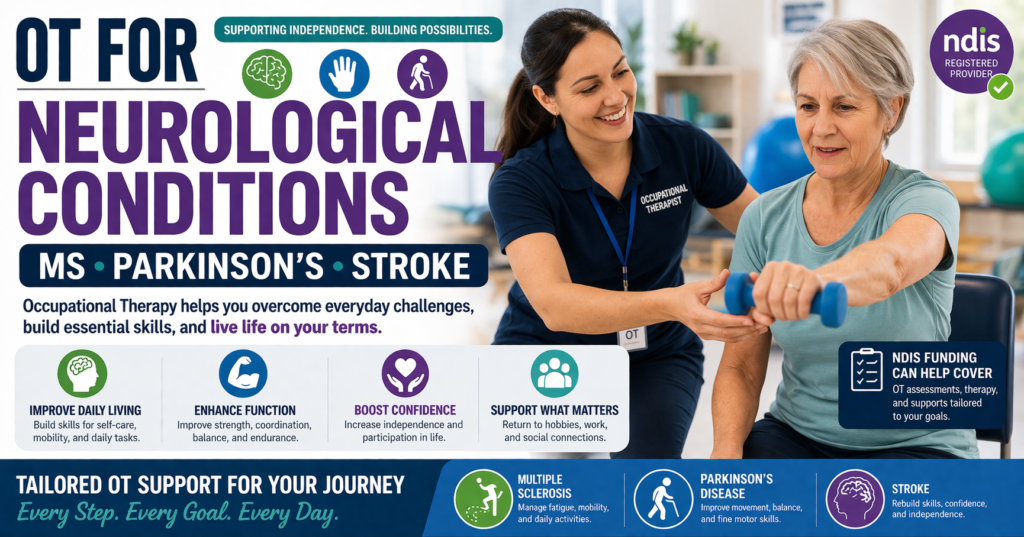
For NDIS participants living with neurological conditions, occupational therapy is one of the most consistently valuable and evidence-supported allied health disciplines available. OT addresses the real-world functional consequences of neurological impairment — how you dress, cook, move through your home, participate in your community, and manage the increasing demands of a body that doesn’t always do what you ask.
This guide explains what OT does for the most common neurological conditions in the NDIS, which assessments are most relevant, how NDIS funding applies, and how neurological OT changes as conditions progress.
In this article
- Why OT is central to neurological disability management
- OT for Multiple Sclerosis (MS)
- OT for Parkinson’s disease
- OT for stroke
- OT for other neurological conditions
- OT assessments for neurological conditions
- Fatigue and cognitive changes — OT’s hidden role
- Planning ahead — OT for progressive neurological conditions
- How the NDIS funds OT for neurological conditions
- Frequently asked questions
Why OT Is Central to Neurological Disability Management
Neurological conditions affect function across a uniquely broad spectrum — motor control, cognition, fatigue, communication, sensation, vision, and emotional regulation can all be disrupted simultaneously and in ways that interact with each other in complex ways. No single discipline can address this breadth alone.
OT’s particular contribution in this context is its focus on occupational performance — how the person actually performs the tasks of daily life, in their actual environments, with their specific combination of impairments and strengths. While a neurologist manages the underlying disease process and a physiotherapist addresses mobility and physical function, the occupational therapist addresses how all the impairments together affect what the person can do, and what they need to maintain meaningful participation in their life.
For NDIS participants, OT has an additional critical function: it produces the clinical reports — Functional Capacity Assessments, AT prescriptions, home modification reports — that justify the support funding in their plans. A well-written OT report from an experienced neurological OT can make the difference between a plan that reflects real support needs and one that doesn’t.
OT for Multiple Sclerosis (MS)
Multiple sclerosis is a chronic autoimmune condition affecting the central nervous system that causes demyelination — damage to the myelin sheath protecting nerve fibres — resulting in disrupted signal transmission between the brain and the body. MS presents very differently between individuals and across time, ranging from relapsing-remitting episodes with good recovery between relapses to progressive forms with accumulating disability.
How MS affects daily functioning
The functional consequences of MS are highly variable and may include any combination of the following:
- Fatigue — neurological fatigue is the most commonly reported and most disabling symptom of MS, affecting up to 80% of people with the condition. It is qualitatively different from ordinary tiredness and profoundly affects daily activity capacity.
- Spasticity and weakness — affecting upper and lower limb function, grip strength, fine motor skills, and mobility
- Tremor and ataxia — intention tremor and coordination difficulties affecting handwriting, eating, dressing, and precision tasks
- Cognitive changes — particularly in information processing speed, working memory, and attention
- Heat sensitivity (Uhthoff’s phenomenon) — temporary worsening of symptoms with heat, affecting activity tolerance in warm climates
- Bladder and bowel dysfunction — affecting continence management and daily routines
- Pain — neuropathic pain affecting activity tolerance and sleep
- Visual disturbances — optic neuritis, diplopia, and nystagmus affecting reading, driving, and navigation
What OT does for MS
OT intervention for MS is tailored to the individual’s current presentation — which can change significantly between relapses and remissions. Core OT contributions include:
- Fatigue management programs — pacing strategies, energy conservation techniques, activity analysis, and planning tools that allow the person to prioritise and sequence activities within their energy envelope
- Upper limb function — strengthening, compensation strategies, and adaptive equipment for tremor, weakness, or spasticity affecting fine motor tasks
- Home modification assessment — particularly relevant as MS progresses, to address changing mobility needs, bathroom access, and fall risk
- Assistive technology prescription — mobility aids, adapted kitchen equipment, electronic aids for daily living, and powered mobility for participants with significant physical impairment
- Heat management strategies — structuring activity around cooler parts of the day, identifying cooling equipment and AT, and modifying the home environment for thermoregulation
- Cognitive compensatory strategies — memory aids, routine structuring, environmental simplification, and digital tools for participants with MS-related cognitive changes
- Planning for progression — proactive assessment and planning for likely future needs, particularly regarding housing, AT, and support levels
MS variability in NDIS reports: MS presentations change — sometimes dramatically — between relapses and remissions. An OT assessment conducted during a relapse will capture a very different picture from one conducted during a period of good remission. For NDIS plan review purposes, the OT report must document both the participant’s functioning during their baseline and during relapses, and must address how MS affects the participant’s typical day across the full range of their presentation.
OT for Parkinson’s Disease
Parkinson’s disease is a progressive neurodegenerative condition primarily affecting dopaminergic neurons in the basal ganglia. It produces a characteristic cluster of motor symptoms — resting tremor, rigidity, bradykinesia (slowness of movement), and postural instability — alongside a range of non-motor symptoms that significantly affect daily functioning and are often underappreciated in clinical settings.
How Parkinson’s affects daily functioning
- Bradykinesia — slowing of all movements, making every physical task take longer and require more effort; getting dressed, eating, and writing all become more demanding
- Tremor — resting tremor (typically hand and arm) affecting fine motor tasks, eating, writing, and daily living activities
- Freezing of gait — sudden episodes where movement stalls completely, creating significant fall risk and difficulty navigating the home
- Postural instability — increased fall risk, difficulty with transfers and getting up from chairs
- Hypomimia and hypophonia — reduced facial expression and quiet voice affecting communication and social participation
- Autonomic dysfunction — affecting blood pressure regulation (orthostatic hypotension), bowel function, and thermoregulation
- Cognitive changes — in later stages, Parkinson’s-associated dementia affects memory, executive function, and safety awareness
- Fatigue — significant and often overlooked, affecting activity capacity throughout the day
- Medication fluctuations (“on/off” periods) — function can vary dramatically across the day in line with medication cycles
What OT does for Parkinson’s disease
- Falls prevention and home safety — assessment of fall risk, home hazard identification, and environmental modification to reduce fall frequency and severity
- Adaptive equipment for daily living — weighted cutlery for tremor, button hooks, velcro fastenings, non-slip mats, adapted kitchen tools, and electric toothbrushes and shavers
- Managing “on/off” medication fluctuations — structuring daily activities around the times of day when the person is “on” (medication at peak effectiveness) for highest-demand tasks
- Freezing strategies — rhythmic auditory cueing (counting, music), visual floor markers, attentional focus techniques, and environmental modifications that reduce freezing triggers
- Handwriting and fine motor — intervention for micrographia (abnormally small handwriting), fine motor adaptation strategies, and digital alternatives for written communication
- Home modification assessment — bathroom modifications, bed rail and hospital bed assessment, ramps, and widened access as the condition progresses
- Powered mobility assessment — for participants with significant motor impairment or frequent freezing, powered wheelchair assessment may be appropriate
- Cognitive and safety assessment — for participants in later stages, kitchen and home safety assessment, and assessment of capacity to manage medication and finances independently
Timing matters for Parkinson’s OT assessments. Parkinson’s patients can function dramatically differently during “on” periods (when medication is effective) versus “off” periods (when medication is wearing off or has not yet taken effect). An OT who conducts the entire assessment during an “on” period will document significantly better function than the person typically experiences. Good Parkinson’s OT assessment is conducted across multiple visits and explicitly documents the “on/off” cycle and its functional impact.
OT for Stroke
Stroke — sudden interruption of blood supply to part of the brain — is one of the leading causes of acquired disability in Australia. Because stroke causes focal brain damage (damage to a specific region), its functional consequences depend entirely on which area of the brain was affected and to what degree. No two stroke presentations are identical, though certain patterns are common.
Stroke is covered in detail in our companion article on OT for Acquired Brain Injury. Here we focus on the aspects of stroke that are most distinctive when compared with other neurological conditions in the NDIS.
How stroke affects daily functioning
- Hemiplegia or hemiparesis — weakness or paralysis affecting one side of the body, impacting upper and lower limb function, transfer ability, and all activities requiring bilateral coordination
- Spasticity — increased muscle tone in the affected limb, limiting range of motion and making movement effortful and uncomfortable
- Aphasia — language impairment affecting expression, comprehension, reading, or writing, depending on which hemisphere was affected
- Neglect — failure to attend to one side of the body or environment; a person with left neglect may not dress or shave the left side, bump into objects on the left, or eat food from the left side of the plate
- Dysphagia — swallowing difficulties, managed primarily by speech pathology but relevant to OT where meal preparation and eating independence is a goal
- Perceptual difficulties — difficulty interpreting visual, spatial, or sensory information, affecting dressing, navigation, and safety
- Cognitive changes — memory, attention, executive function, and processing speed may all be affected, particularly after large or bilateral strokes
- Emotional lability — involuntary laughing or crying, depression, and anxiety are common post-stroke and affect participation and quality of life
What OT does for stroke
- Upper limb rehabilitation — evidence-based approaches including constraint-induced movement therapy, task-specific practice, electrical stimulation, and mirror therapy to support motor recovery and compensation
- Personal care retraining — graduated, task-specific programs for showering, dressing, grooming, and eating, adapted for hemiplegia and using appropriate adaptive equipment
- Neglect rehabilitation — scanning training, environmental cueing, and compensatory strategies for participants with hemispatial neglect
- Home assessment and modification — particularly important at the time of hospital discharge, to ensure the home environment is safe and accessible for the person’s current level of function
- Splinting and positioning — for participants with spasticity, the OT may prescribe and fit hand or wrist splints to maintain range of motion and prevent contracture
- Return to community activities — graduated program building confidence and capacity for community participation, driving reassessment, and return to meaningful roles
OT for Other Neurological Conditions
The NDIS supports participants with a wide range of neurological conditions beyond MS, Parkinson’s, and stroke. Here is a brief overview of OT’s role in other common neurological presentations:
| Condition | Key OT focus areas |
|---|---|
| Spinal cord injury (SCI) | Upper limb function and independence, power wheelchair prescription and training, pressure care, home modification (often extensive), AT prescription, driving assessment, return to work |
| Motor neurone disease (MND/ALS) | Anticipatory AT prescription as function declines (AAC, powered mobility, adapted equipment), energy conservation, home modification, carer training, and advance care planning support |
| Huntington’s disease | Falls prevention, home safety, adapted equipment for chorea-affected movement, cognitive compensatory strategies, AT for communication as speech deteriorates, SIL assessment as disease progresses |
| Cerebral palsy (adults) | Upper limb function, AT prescription, home modification, community participation, employment support, fatigue management, SIL assessment for those with high support needs |
| Epilepsy with significant functional impact | Home and community safety assessment, AT for seizure detection and alert systems, activity modification to reduce seizure-related injury risk, independent living assessment |
| Traumatic brain injury (TBI) | Cognitive rehabilitation, fatigue management, daily living retraining, home safety assessment, return to work/community, AT prescription — see our detailed ABI OT guide |
OT Assessments for Neurological Conditions
Neurological OT assessment combines condition-specific tools with comprehensive functional capacity measurement. For NDIS purposes, the goal is always to produce clinical documentation that objectively demonstrates the impact of the neurological condition on the participant’s daily functioning — not just to diagnose or classify impairments.
| Assessment tool | What it measures | Relevant conditions |
|---|---|---|
| Barthel Index of ADL | Independence across 10 personal care and mobility tasks (0–100) | Stroke, MS, Parkinson’s, SCI, MND |
| Functional Independence Measure (FIM) | Self-care, transfers, locomotion, communication, and cognition across 18 items | Stroke, SCI, MS, ABI |
| WHODAS 2.0 | Disability across 6 life domains — directly maps to NDIS functional capacity | All neurological conditions |
| Fatigue Severity Scale (FSS) | Severity and functional impact of fatigue on daily activities | MS, Parkinson’s, stroke, MND |
| MS Functional Composite (MSFC) | Arm function (9-hole peg test), leg function (timed walk), and cognition (PASAT) | MS |
| Unified Parkinson’s Disease Rating Scale — ADL section (UPDRS Part II) | Self-reported impact of Parkinson’s on speech, swallowing, writing, dressing, hygiene, freezing, falls | Parkinson’s disease |
| Action Research Arm Test (ARAT) | Upper limb function — grasp, grip, pinch, gross arm movements | Stroke, MS, SCI |
| Assessment of Motor and Process Skills (AMPS) | Motor and process skills observed during self-selected daily tasks in the person’s own environment | All neurological conditions |
| Spinal Cord Independence Measure (SCIM) | Self-care, respiration, sphincter management, and mobility for SCI | Spinal cord injury |
For NDIS plan review, the most important output is a comprehensive Functional Capacity Assessment that combines several of these standardised tools with direct observation in the participant’s home and detailed documentation of how the neurological condition affects daily functioning across all relevant domains.
Fatigue and Cognitive Changes — OT’s Hidden Role
Fatigue and cognitive changes are among the most disabling and most underestimated consequences of neurological conditions — and they are where OT’s contribution is often least visible to outside observers but most important to the participant’s daily life.
Neurological fatigue across conditions
Fatigue is a significant feature of MS, Parkinson’s disease, stroke, TBI, MND, and many other neurological conditions. Unlike ordinary tiredness, neurological fatigue is caused by the increased metabolic demand placed on damaged neural pathways and does not reliably resolve with rest. It is characterised by:
- Disproportionate exhaustion relative to the activity performed
- Worsening with heat (particularly in MS)
- Cognitive fatigue — the mental effort of problem-solving, concentrating, or managing complex tasks is as draining as physical activity
- Significant day-to-day and within-day variability
- Invisibility to others — the person may appear fine while being profoundly fatigued
An OT addresses neurological fatigue through structured fatigue management programs: activity analysis, energy conservation techniques, pacing strategies, planned rest periods, environmental modifications to reduce unnecessary cognitive and physical load, and AT that reduces the energy cost of essential daily tasks.
Cognitive changes in neurological conditions
Cognitive impairment affects many people with neurological conditions — including slowed processing speed in MS, executive dysfunction in Parkinson’s, memory difficulties after stroke, and progressive cognitive decline in MND, Huntington’s, and advanced Parkinson’s. OT addresses cognitive changes through:
- Compensatory memory and organisational aids — physical and digital
- Simplified daily routines and visual supports
- Environmental modifications that reduce cognitive load — organised kitchen, simplified medication management, labelled storage
- Safety assessment — identifying where cognitive changes create risks at home or in the community
- Capacity assessment — for participants where cognitive decline raises questions about the ability to make independent decisions about daily activities
Planning Ahead — OT for Progressive Neurological Conditions
For participants with progressive neurological conditions — MS, Parkinson’s, MND, Huntington’s — one of the most valuable things an OT can do is help plan ahead. Waiting until function deteriorates to a crisis point before addressing home modifications, AT, and support levels is reactive, inefficient, and often results in avoidable harm (such as a fall in a bathroom that could have been modified) and funding delays at exactly the wrong time.
Anticipatory AT prescription
An experienced neurological OT will assess not only current AT needs but anticipated future needs. For someone with MND, this might mean prescribing a power wheelchair before they can no longer transfer safely, rather than waiting until ambulation has failed completely. For someone with MS approaching a relapse, it might mean having home modifications approved before they are urgently needed. Anticipatory prescription requires the OT to understand disease trajectory and to work with the participant and their neurologist to anticipate functional milestones.
Staged home modification planning
Home modifications for progressive conditions should ideally be planned in stages — addressing the most urgent current needs while anticipating future modifications that will become necessary as the condition advances. An OT who understands the natural history of MS or Parkinson’s can help the participant and their support coordinator plan a multi-stage modification program that is funded efficiently across successive NDIS plan years rather than through crisis-driven funding requests.
Building a plan review evidence base over time
For progressive conditions, regular OT review — and consistent, well-documented progress notes — builds the longitudinal evidence base that makes plan reviews more effective. An OT who has tracked a participant’s functional decline over multiple years can provide the NDIA with compelling clinical narrative about trajectory and future support needs that a one-off assessment alone cannot replicate.
Don’t wait for a crisis. The most common and most avoidable mistake in neurological OT is waiting until function deteriorates before addressing AT and home modification needs. The NDIS funding and approval process takes time — and submitting a Capital Supports application six months before the need becomes critical is dramatically more effective than submitting it while the participant is in hospital following a preventable fall.
How the NDIS Funds OT for Neurological Conditions
Capacity Building — Improved Daily Living
All OT professional time — assessments, therapy sessions, report writing, carer training, AT fitting and training — is funded from Capacity Building — Improved Daily Living at the 2025–26 NDIS rate of $193.99 per hour (weekday). For participants with progressive conditions requiring regular OT review and multiple assessment types, IDL allocation needs to be planned carefully across the year.
Capital Supports — AT and home modifications
Assistive technology and home modifications recommended by the OT are funded from Capital Supports — Assistive Technology and Capital Supports — Home Modifications respectively. For neurological participants, these Capital allocations can be substantial — power wheelchairs alone can exceed $20,000, and whole-home modifications for participants with significant physical impairment can reach $50,000 or more.
Typical IDL funding by condition severity
| Neurological participant profile | Typical IDL range (annual) | What it covers |
|---|---|---|
| Mild impairment — fatigue management and AT review | $3,000–$6,000 | FCA + monthly OT (fatigue, ADL, AT review) |
| Moderate — multiple domains, ongoing therapy | $6,000–$15,000 | FCA + fortnightly OT + AT assessment + home mod assessment |
| Severe / progressive — complex AT, SIL application, multidisciplinary | $15,000–$40,000+ | FCA + SIL assessment + complex AT + home mods + ongoing weekly OT |
The importance of regular FCA updates for progressive conditions
For participants with progressive neurological conditions, the NDIA expects that plan reviews are supported by current clinical evidence. An FCA that is two or three years old for a participant with progressive MS or Parkinson’s will not accurately reflect current functional capacity — and may result in funding that no longer matches support needs. Most neurological OTs recommend updating the FCA at least every 12–18 months for progressive conditions, and immediately following any significant relapse, deterioration, or functional change.
NDIS Registered — WA · NT · QLD · VIC
OT for neurological conditions across Darwin, Perth, Brisbane and Victoria
TEAH’s occupational therapists deliver comprehensive in-home assessments, NDIA-quality reports, and evidence-based neurological OT programs — with experience across MS, Parkinson’s, stroke, SCI, and other neurological conditions.
Frequently Asked Questions
Can OT help if my neurological condition is stable or in remission?
Yes — OT is valuable across all stages of neurological conditions, including periods of relative stability. During stable periods, OT can focus on optimising daily functioning, preventing secondary complications (such as falls or contractures), building capacity for future progression, and completing assessments and reports that anticipate future needs. For progressive conditions, acting during stable periods is often more effective than waiting for a crisis.
How often should someone with a progressive neurological condition see an OT?
This depends on the rate of disease progression and the specific goals being addressed. During periods of rapid change — following a relapse, post-surgery, or after a significant functional decline — more frequent contact (weekly or fortnightly) is appropriate. During stable periods, monthly review may be sufficient. For plan review purposes, an updated FCA is recommended every 12–18 months, or immediately following any significant functional change.
What is the difference between OT and physiotherapy for neurological conditions?
Physiotherapy primarily addresses physical function — mobility, balance, strength, gait, and pain management. OT addresses how neurological impairment affects participation in daily activities — dressing, cooking, community access, employment, and everything in between. Both are important for most neurological conditions, and the two disciplines work best when they coordinate their intervention. OT also produces the NDIS clinical reports that physiotherapy generally does not.
Can OT help with driving after a stroke or neurological diagnosis?
Driving assessment after a neurological diagnosis requires a specialist OT driver assessor — an occupational therapist with specific postgraduate training in on-road and off-road driver assessment. If driving is a goal, ask your OT whether they hold driver assessor qualifications or can refer to a colleague who does. An NDIS plan may fund a driver assessment and any AT modifications to a vehicle that are subsequently recommended.
How is fatigue documented in an NDIS FCA for a neurological condition?
A thorough neurological FCA will document fatigue using a standardised tool such as the Fatigue Severity Scale, combined with a diary-based or interview-based account of how fatigue affects daily activity across a typical week. The OT should document the specific activities most affected by fatigue, the time of day when fatigue is most significant, and the relationship between activity and the subsequent fatigue impact — to justify support hours throughout the day, not just during peak-function periods.
How do I refer someone with a neurological condition to TEAH?
Submit a referral online at topendalliedhealth.com.au/referral, email referrals@topendalliedhealth.com.au, or call 1300 203 059. Include the participant’s diagnosis, current functional challenges, and the purpose of the referral. Our intake team will check NDIS funding and match the participant with an OT experienced in neurological conditions across Darwin, Perth, Brisbane, or Victoria.
Summary
Occupational therapy for neurological conditions addresses the real-world functional consequences of MS, Parkinson’s disease, stroke, spinal cord injury, MND, and other conditions — through fatigue management, daily living skill adaptation, AT prescription, home modification, and clinical reporting that underpins NDIS plan funding. For progressive conditions, the most valuable OT is proactive: anticipating future needs, planning modifications before they become urgent, and building a longitudinal evidence base that makes plan reviews more effective over time.
The quality of the OT assessment and report — including how thoroughly it documents fatigue, cognitive changes, on/off fluctuations, and the variability of the participant’s functioning across time and contexts — is the most important factor in whether an NDIS plan adequately reflects the real support needs of a neurological participant.
TEAH’s occupational therapists work with neurological NDIS participants across Darwin (NT), Perth (WA), Brisbane (QLD), and Victoria — with in-home assessments, NDIA-quality reports, and evidence-based neurological rehabilitation and support programs.
Refer for neurological OT with TEAH
Darwin (NT) · Perth (WA) · Brisbane (QLD) · Victoria
Related articles
- OT for Acquired Brain Injury — what NDIS participants need to know
- What is a Functional Capacity Assessment and what does it include?
- What is an NDIS home modification assessment?
- Assistive technology assessments under the NDIS
- NDIS plan review — why an OT report matters
- Our Occupational Therapy Services — Darwin, Perth, Brisbane & Victoria
TEAH Allied Health Team
Top End Allied Health (TEAH) is an NDIS-registered allied health provider delivering occupational therapy, speech pathology, physiotherapy, and supported accommodation across WA, NT, QLD, and Victoria. Referrals: referrals@topendalliedhealth.com.au | 1300 203 059