
Reading time: 10 minutes | Audience: Support Coordinators & Specialist Support Coordinators | Updated: April 2026
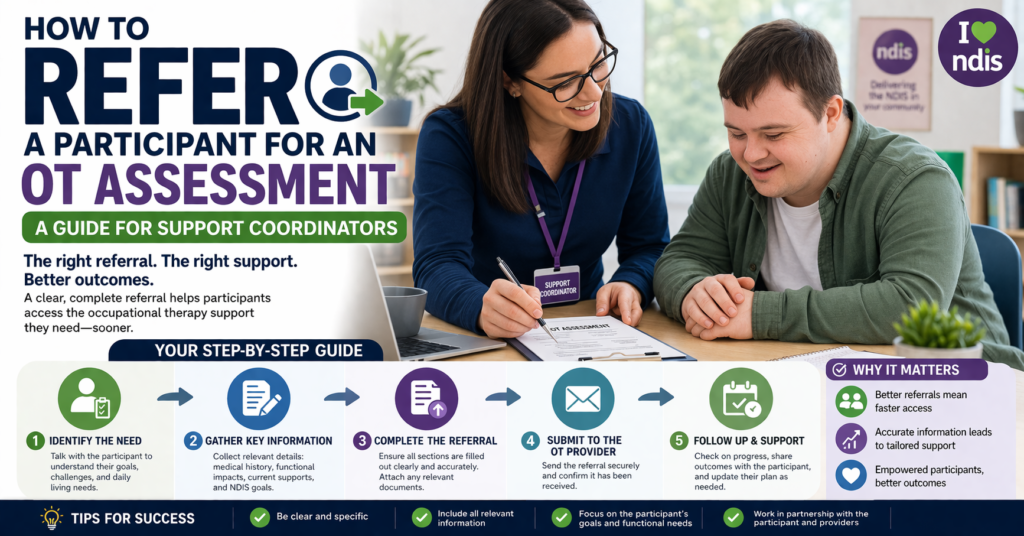
Making an OT referral seems straightforward – pick up the phone or fill in a form. But the quality of a referral has a significant effect on the quality of the outcome. A referral that contains the right information, clearly identifies the purpose, and arrives at the right time gives the OT everything they need to match the participant with the most appropriate clinician, plan the right scope of work, and deliver a report that actually moves the participant’s plan forward.
A referral that is vague, poorly timed, or missing key information produces a longer intake process, incorrect scope, mismatched clinicians, and – at worst – an OT report that fails to address what the NDIA actually needs to see.
This guide is written specifically for support coordinators. It covers how to decide when to refer, what to include in a referral, how to brief the OT effectively, how to manage the process through to report delivery, and how to use the completed report in the participant’s best interests.
In this article
- When to refer – recognising OT triggers
- Which type of OT service does your participant need?
- Checking funding before you refer
- What to include in a referral
- How to brief the OT effectively
- Timing your referral – critical deadlines
- Managing the process from referral to report
- Reviewing the OT report – what to check
- Using the report – plan review, AT, home mods, SIL
- Frequently asked questions
When to Refer – Recognising OT Triggers
The most common mistake support coordinators make with OT referrals is leaving them too late – often because the trigger is not recognised until a crisis has already developed. Learning to spot the early indicators that an OT assessment is needed gives you time to commission the assessment, receive the report, and use it strategically rather than reactively.
Plan review approaching
This is the most consistently time-sensitive trigger. An OT report submitted as part of a plan review submission is one of the most powerful pieces of evidence available. But it takes time to produce – assessment, report writing, draft review, amendments. If your participant’s plan review is less than eight weeks away and you have not yet started the OT process, you are already behind. Refer at least three to four months before the review date.
Participant’s current plan feels wrong
If Core Supports hours are consistently insufficient, if a participant is presenting at risk in their home or community, or if family members and support workers are reporting needs that the current plan does not cover – these are all signals that the clinical evidence base for the plan needs updating. An OT assessment is the most effective way to capture and document those unmet needs.
Significant change in function or circumstances
A deterioration in a progressive condition, a significant health event (hospitalisation, surgery, fall, relapse), a change in living situation, or the loss of a primary informal carer – all of these create changed support needs that the current NDIS plan may not reflect. A change-of-circumstances OT assessment and updated FCA is the appropriate response.
Participant moving toward independence or SIL
When a participant is transitioning from family home to supported living, from a group home to more independent arrangements, or when a SIL provider needs a roster to be updated, an OT assessment is required. Read our detailed SIL and SDA OT assessment guide →
Home access or safety concerns
If a participant is at risk of falls, having difficulty accessing key areas of their home, or needs building modifications to remain living independently, a home modification assessment is needed before Capital Supports funding can be accessed for building works.
Equipment needs
When a participant needs a new or replacement piece of assistive technology – particularly mid- to high-cost AT such as a wheelchair, communication device, or ceiling hoist – an AT assessment and prescription is required before Capital Supports funding is approved.
Child needing school or developmental support
Where a child is struggling at school, has received a new diagnosis, or where the family reports developmental concerns that the current plan is not addressing, a paediatric OT assessment should be commissioned. School-based and developmental OT is funded from the child’s Capacity Building – Improved Daily Living budget.
Which Type of OT Service Does Your Participant Need?
One of the most useful things you can do before making a referral is identify the specific type of OT service required. This allows the OT provider to match the participant with the right clinician and scope the engagement correctly from the outset.
| Participant situation | OT service needed | What it produces |
|---|---|---|
| Plan review with changed or inadequate supports | Functional Capacity Assessment (FCA) | Comprehensive functional report for plan review submission |
| Home access barriers or fall risk | Home modification assessment | Report and specifications for Capital Supports home modification funding |
| Wheelchair, hoist, communication device, or other AT needed | AT assessment and prescription | AT prescription report for Capital Supports AT funding |
| Participant applying for or reviewing SIL funding | SIL assessment and 28-day schedule | FCA with support hours and roster to underpin SIL application |
| Participant applying for SDA housing | SDA eligibility assessment | SDA eligibility report specifying design category with clinical justification |
| Child with developmental concerns or new diagnosis | Paediatric OT assessment | Developmental assessment and therapy plan; school report where relevant |
| Participant needs ongoing therapy program | Individual OT therapy sessions | Structured goal-directed therapy; progress notes; progress summary for plan review |
Not sure which applies? Describe the situation in your referral and let the OT’s intake team help determine the correct scope. A good provider will ask the right questions rather than making assumptions about what is needed.
Checking Funding Before You Refer
Before making any referral, confirm that the participant’s NDIS plan includes the correct budget to fund the OT service. This prevents the frustration of a referral being accepted, an appointment being booked, and then discovering partway through that the funding isn’t there.
What to check
Pre-referral funding checklist
- Capacity Building – Improved Daily Living – must be present and have sufficient balance to cover the OT’s professional time (assessment, report, non-face-to-face)
- Capital Supports – Assistive Technology – required if the referral involves an AT assessment and the AT will need to be purchased
- Capital Supports – Home Modifications – required if a home modification assessment is being commissioned and building works will follow
- Plan management type – confirm whether agency-managed (registered OTs only), plan-managed, or self-managed, as this determines which providers can be used
- Plan expiry date – ensure there is sufficient time left in the plan year to complete the assessment and report before expiry
- Remaining IDL balance – verify the current IDL balance with the plan manager or through the myNDIS portal before committing
The most common funding trap: A participant has Capital Supports – Assistive Technology in their plan but insufficient Capacity Building – Improved Daily Living to fund the OT assessment. The equipment cannot be purchased without the OT report – and the OT report cannot be funded without IDL. Both must be present. Check both budgets before referring.
What to Include in a Referral
A complete, well-structured referral reduces intake time, prevents mismatches, and gets your participant booked with the right OT sooner. Here is everything a good OT referral should contain:
📋 Complete OT referral – information checklist
Participant basics
- Full name and date of birth
- NDIS participant number
- Current address (for in-home assessment)
- Primary contact – participant, carer, or family member, and preferred contact method
NDIS plan details
- Plan management type (agency, plan-managed, or self-managed)
- Plan manager name and contact details (if plan-managed)
- Plan start and end dates
- Confirmed IDL balance and any other relevant budget balances
Disability and clinical information
- Primary diagnosis and any co-occurring conditions
- Brief description of current functional challenges relevant to the referral
- List of existing supports and services (support workers, other allied health, day programs)
- Relevant existing reports (can be sent separately)
Purpose of referral
- Specific OT service requested (FCA, home modification, AT assessment, SIL assessment, therapy, etc.)
- The purpose of the assessment – plan review, SIL application, AT funding, home modification funding, discharge planning, etc.
- Any specific questions you need the OT to address in the report
Timelines and urgency
- Plan review date (if applicable)
- Any urgent timelines – hospital discharge, SIL start date, AT urgency
- Any dates when the participant is unavailable (school holidays, medical appointments, travel)
How to Brief the OT Effectively
The referral form gets the participant through the door. The briefing shapes what happens once they are there. A well-briefed OT produces a more targeted, more useful report – and is far less likely to miss something that matters for the NDIA submission.
Share existing reports before the assessment
Before the OT conducts the assessment, send them any relevant clinical documentation: the participant’s most recent NDIS plan, existing FCA or allied health reports, specialist medical letters, school reports (for children), and any behaviour support plan. A well-prepared OT reads these before the appointment and uses them to focus the assessment on what has changed and what matters most – rather than duplicating work already done.
Describe the NDIA’s specific concern
If you know why the participant’s previous plan was inadequate – for example, “the NDIA rejected SIL because informal support wasn’t adequately addressed” or “Core Supports were reduced because the OT report didn’t quantify hours by task” – tell the OT directly. Experienced OTs will know how to address these gaps, but only if they know what the gaps are.
Clarify what the report needs to achieve
Be explicit about the purpose: “This FCA needs to support a plan review in June – I need it to justify increased Core Supports for personal care and community access, and to recommend inclusion of fortnightly OT therapy in the next plan.” This level of specificity allows the OT to structure the report around what the NDIA needs to see – not just what they observed on the day.
Introduce any complicating factors
Alert the OT to anything that might complicate the assessment process: English is not the participant’s first language; they have significant anxiety about unfamiliar people; a previous negative OT experience has made them resistant; their condition means they function very differently at different times of day. These are not obstacles – they are important clinical context that allows the OT to conduct a better assessment.
Confirm who should be present
Advise the OT whether a family member, carer, or interpreter will be present. For participants with intellectual disability, acquired brain injury, or psychosocial disability – where self-report may be limited or unreliable – a support person who knows the participant well is essential for the accuracy of the assessment. Arrange this in advance, not as an afterthought on the day.
Timing Your Referral – Critical Deadlines
Timing is one of the most consequential decisions in OT referral management. Every delay compresses the available window for assessment, report writing, review, and submission – and when that window runs out, the participant carries the cost.
Ideal referral point for plan review FCA
Allows time for intake, assessment, report writing, participant review of draft, amendments, and submission to NDIA well ahead of the review meeting.
Minimum lead time for a standard FCA
Tight but achievable with a provider who has low wait times. Any less than this and the report may not arrive before the review meeting, or may arrive without sufficient time for the participant to review it properly.
For SIL applications
SIL assessments are more complex and the NDIA review process longer. Refer well ahead of the intended SIL start date — not in response to a pending housing vacancy with a two-week deadline.
For major AT and home modification assessments
AT trials take time. Home modification reports need builder quotes before NDIA submission. Factor in these downstream steps when calculating when to refer.
Hospital discharge or crisis situations
For post-acute discharge, escalating fall risk, or urgent safety concerns – flag urgency explicitly at referral. Providers with capacity for urgent referrals will prioritise; others will advise their wait time so you can make an informed decision about whether to wait or refer elsewhere.
Managing the Process from Referral to Report
Submitting a referral is not the end of your involvement – it is the beginning of a process you need to actively manage. Here is what effective support coordination looks like through the OT engagement:
Confirm receipt and intake
Chase a confirmation of receipt within 48 hours if you have not received one. Confirm the intake details, expected appointment timeframe, and the OT who will be assigned. If there is a wait time that conflicts with your critical deadline, know this immediately – not three weeks later – so you can explore alternatives if needed.
Prepare the participant and their network
Before the assessment appointment, prepare the participant and their carer or family member. Explain what the OT will do, why it is happening, and what the participant will be asked. Review our guide to preparing for an NDIS FCA with the participant or their family — particularly the guidance on describing typical functioning rather than best-day functioning.
Ensure the right people are at the assessment
Confirm that any essential support people – carers, interpreters, family members – know about the appointment and will be present. For complex participants, the OT’s ability to gather multi-source information during the assessment is crucial to the quality of the report. Don’t leave this to chance on the day.
Send any outstanding documentation
Before the assessment appointment, send the OT any reports or documents you said you would provide. An OT who arrives for the assessment having reviewed existing documentation produces a better assessment than one who is encountering the participant’s history for the first time on the day.
Check in during the report writing period
If you have not heard anything after 15 business days, follow up with the OT provider. This is particularly important as plan review deadlines approach – a delayed report has consequences you need to know about in time to manage them.
Reviewing the OT Report – What to Check
As a support coordinator, you should review the draft OT report before it is finalised – not as an afterthought, and not just to confirm it arrived. Your review is a critical quality checkpoint.
Factual accuracy
Check that the participant’s diagnosis, living situation, current supports, and plan goals are described correctly. Errors in these foundational details undermine the credibility of everything that follows. Flag corrections to the OT before the report is finalised.
Does the report describe typical functioning or best functioning?
This is the most important clinical question to ask as you read. Does the report describe how the participant functions on a representative day – including their worst days? Or does it describe what was observed during a single clinical appointment that may have been unrepresentative? If the participant’s actual daily functioning is more impaired than what the report describes, raise this with the OT and ask them to address variability and typical performance explicitly.
Are support needs quantified by task?
For plan review purposes – particularly where Core Supports or SIL hours are at stake – the report should specify support needs by task, level, and frequency, not just in general terms. “Requires supervision for meal preparation” is less useful than “requires verbal prompting at each of eight steps of meal preparation, three times daily, estimated 45 minutes of support per day.” If the quantification is insufficient, ask the OT to strengthen this section.
Are all necessary domains covered?
Check that the OT has addressed all the domains relevant to the purpose of the referral. For a plan review FCA, this should include personal care, domestic tasks, mobility and transfers, medication management, community access, overnight needs, and cognitive/behavioural factors. If a domain is absent, ask why – and whether it should be addressed.
Is the report consistent with what you are requesting?
Check that the OT’s recommendations align with the support levels being requested. If you are proposing a SIL roster with 24 active support hours and the OT report documents moderate support needs, you have a problem – the NDIA will notice the discrepancy. Identify and resolve these inconsistencies before submission, not after rejection.
Are the recommendations actionable and specific?
Recommendations should be specific enough to act on: “install grab rails to Australian Standards AS 1428.1 in the shower and beside the toilet” is more useful than “the participant would benefit from bathroom modifications.” Specific recommendations give builders what they need to quote, and give the NDIA clear justification for Capital Supports funding.
You have every right to request revisions. Requesting amendments to a draft report before it is finalised is not only appropriate – it is part of the process. A good OT expects and welcomes feedback on draft reports. The goal is accuracy, not deference. If something is wrong, incomplete, or insufficiently detailed to serve the participant’s NDIS needs, say so clearly and give the OT the opportunity to fix it.
Using the Report – Plan Review, AT, Home Mods, SIL
Once you have a finalised, high-quality OT report, use it fully. Many OT reports are underused – they are submitted to the NDIA for one purpose and their broader usefulness is not exploited.
Plan review submission
The FCA should be the anchor document of your plan review evidence package. Read our guide on why an OT report matters for NDIS plan reviews for a full breakdown of how to build an effective submission package. Key point: submit the report at least two weeks before the review meeting – not on the day.
AT funding application
Submit the AT assessment report alongside supplier quotes directly to the NDIA (for agency-managed participants) or to the plan manager (for plan-managed participants). Ensure the quotes match the specifications in the OT report exactly. Discrepancies between the OT’s prescription and the supplier’s quote – different model, different configuration – will result in delays or rejection.
Home modification application
Submit the home modification report with two builder quotes (for major modifications) to the NDIA. Ensure the builder quotes reference the OT’s specifications directly. For minor modifications, the OT report and a single quote may be sufficient – confirm with the NDIA or plan manager before proceeding.
SIL application
The SIL OT assessment should be submitted alongside the participant’s statement, the proposed roster of care, and any other supporting documentation as a complete SIL application package. Ensure the roster of care is fully consistent with the OT’s clinical findings before submission. Any inconsistency between the two documents is a significant red flag for the NDIA.
Secondary uses of the OT report
OT reports have value beyond their primary NDIS purpose. A comprehensive FCA can be shared (with the participant’s consent) with SIL providers who need to understand the participant’s support needs, with new support workers being inducted, with school teams developing individual education plans, and with other allied health professionals joining the participant’s team. A good OT report is a genuinely useful clinical document – not just an NDIS administrative artifact.
NDIS Registered — WA · NT · QLD · VIC
Make a referral to TEAH for your participant
Our intake team responds quickly, checks the participant’s funding, and provides a clear scope and timeframe before any commitment is made. Refer online, by phone, or by email – we make the process easy for support coordinators.
Frequently Asked Questions
Can I make a referral on behalf of a participant without their consent?
No. Participant consent – or that of their legal guardian or nominee – is required before a referral can proceed. In practice, most participants and their families are actively seeking OT support and consent is straightforward. Where a participant has reduced decision-making capacity, ensure the appropriate decision-maker (nominee, legal guardian, or plan nominee) has provided consent before making the referral.
What if the participant’s IDL budget is nearly exhausted?
If the IDL balance is insufficient for the OT assessment needed, you have options: request a plan variation from the NDIA if there is an urgent clinical need; explore whether the assessment cost can be partially offset from another budget line (discuss with the OT and plan manager); or defer the assessment to the beginning of the next plan year and request adequate IDL at plan review. Do not proceed with an assessment that will exhaust the budget before the report is complete – this creates a funding dispute mid-assessment.
My participant has had a bad experience with OT before – how do I handle this?
Disclose this in the referral and discuss it with the intake team. A previous negative experience – particularly one involving a mismatch in approach, communication style, or clinical focus – can often be addressed by matching the participant with a different type of OT than they saw previously. Be specific about what went wrong (was it the clinical approach? The communication style? A report that felt inaccurate?) so the intake team can find a more appropriate match.
The OT report arrived but the NDIA is asking for more information. What do I do?
Contact the OT provider and request that the OT address the specific questions the NDIA has raised. A reputable provider will provide clarifying information or addendum documentation in response to NDIA requests for further information. This is part of the OT’s professional responsibility to their client – not an unusual or unreasonable request. Clarify upfront in your service agreement how such requests will be handled and whether they attract additional fees.
Can TEAH accommodate urgent referrals?
Yes – flag urgency explicitly at referral (hospital discharge, imminent plan review, urgent safety concern) and our intake team will confirm what is possible given current capacity in your area. TEAH’s wait times are consistently below industry average, but we cannot guarantee specific timeframes for urgent referrals without knowing current availability. Call us directly on 1300 203 059 for the fastest response to urgent situations.
How do I refer multiple participants to TEAH at once?
For support coordinators who refer multiple participants, we recommend calling our intake team directly rather than submitting multiple online forms – this allows us to process your referrals efficiently and discuss any with particularly complex circumstances or urgent timelines. We value our support coordinator relationships and aim to make the referral process as straightforward as possible for coordinators managing large caseloads.
Summary
A well-timed, well-structured OT referral is one of the most important contributions a support coordinator makes to their participant’s NDIS outcomes. The difference between a vague, late referral and a detailed, well-briefed, strategically timed one is often the difference between a plan that works and one that doesn’t.
Know when the triggers are present. Check funding before you refer. Include complete information and a clear purpose statement. Brief the OT on what the report needs to achieve. Manage the process actively. Review the draft critically. And use the final report fully – not just for its primary purpose, but for the broader value it brings to the participant’s support plan.
TEAH’s OT team works with support coordinators across Darwin (NT), Perth (WA), Brisbane (QLD), and Victoria – with a responsive intake team, below-average wait times, and experienced OTs who understand what you need from a report and how to produce it.
Refer a participant to TEAH today
Darwin (NT) · Perth (WA) · Brisbane (QLD) · Victoria
Related articles for support coordinators
TEAH Allied Health Team
Top End Allied Health (TEAH) is an NDIS-registered allied health provider delivering occupational therapy, speech pathology, physiotherapy, and supported accommodation across WA, NT, QLD, and Victoria. Referrals: referrals@topendalliedhealth.com.au | 1300 203 059