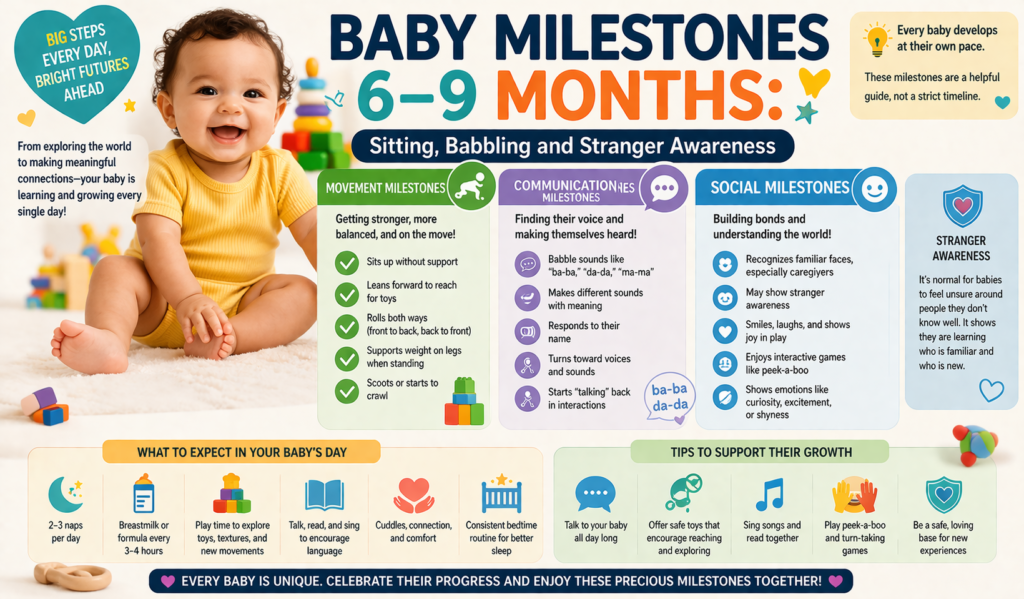
Six to nine months is one of the most action-packed stages of early development. Babies at this age are becoming genuinely mobile, their communication is taking on a conversational quality, and their personalities are emerging in full force. Understanding 6–9 month baby milestones helps you know what to expect, what to watch for, and when a conversation with an allied health professional might be worthwhile.
As with all milestones, these are ranges — not rigid deadlines. Some babies will reach each skill earlier or later than average and still be developing completely typically. What matters is the overall pattern: continued progress across all areas, and a baby who is engaged, curious, and connecting with the people around them.
Gross motor milestones at 6–9 months
Movement expands dramatically during this window. Most babies go from needing full support to sit, to sitting independently, to beginning to pull themselves around — all within the space of three months. It’s a stage of rapid physical confidence.
At this age, most babies may:
- Sit independently without support, usually achieved between 6–8 months
- Move in and out of sitting with increasing control toward 8–9 months
- Begin to move across the floor — crawling on hands and knees, commando crawling on their tummy, bottom-shuffling, or rolling to get around (all are normal variations)
- Pull to a standing position holding onto furniture or a caregiver’s hands
- Bounce enthusiastically when held in standing
- Pivot on their tummy to reach toys in different directions
- Bear more weight through their legs and begin to step when supported
Crawling is not a compulsory milestone some babies skip it entirely and go straight to cruising along furniture and then walking. What matters is that your baby is finding some way to move independently and exploring their environment with confidence.
Continuing tummy time during this stage, even now that your baby can sit, supports the strength and coordination needed for crawling, transitions between positions, and eventually walking.
Fine motor milestones at 6 – 9 months
Hands become increasingly skilled and purposeful during this period. The shift from a raking, whole-hand grasp toward a more refined pincer grasp is one of the most significant fine motor developments of infancy and it happens largely within this window.
At this age, most babies may:
- Pick up objects using a raking motion, drawing them into the palm
- Begin developing a pincer grasp, using the thumb and index finger to pick up small objects (this typically emerges toward 8–9 months)
- Pass objects back and forth between hands with ease
- Bang objects together and against surfaces to explore sound and cause-and-effect
- Poke at objects with their index finger
- Deliberately drop and throw objects, repeatedly, and with great satisfaction
- Begin using both hands together in coordinated ways, such as holding one object in each hand simultaneously
Offering safe small objects to pick up soft puffs, small pieces of banana, or textured toys encourages the developing pincer grasp. Always supervise closely when small objects are present.
Speech and language milestones at 6–9 months
Babbling enters a new, richer phase during this window. Babies move from simple repeated syllables to more varied, expressive vocalisations that begin to sound genuinely conversational complete with rising and falling intonation, pauses, and apparent intent.
At this age, most babies may:
- Babble with a wider variety of consonant-vowel combinations – “ba”, “da”, “ga”, “ma”
- String sounds together in longer sequences: “bababababa”, “mamama”
- Use different intonation patterns, sounds that rise like a question, fall like a statement
- Respond to their own name by turning, pausing, or looking up
- Begin to understand a small number of frequently used words – “no”, “bye-bye”, their own name
- Use gestures deliberately – reaching to be picked up, pushing away something unwanted
- Vocalise to get attention and to express emotion
- Look toward a caregiver and babble as if telling them something
Responding to your baby’s babble as though it’s a real contribution to a conversation – pausing, replying, waiting for their next “turn” – is one of the most powerful things you can do for language development at this age. These serve-and-return interactions build the neural pathways for communication.
Wondering if your baby’s development is on track?
Our paediatric allied health team works with babies and families across Australia. If you have a concern or just want a developmental check-in, we’re here to help you work it out.
Social and emotional milestones at 6 – 9 months
The social and emotional changes in this period are some of the most striking of early childhood. Two developments stand out: the deepening of attachment to primary caregivers, and the emergence of stranger awareness – a sign that your baby’s brain is now distinguishing clearly between familiar and unfamiliar people.
At this age, most babies may:
- Show strong, clear preferences for primary caregivers – lighting up when they appear, settling more easily in their arms
- Display stranger anxiety – becoming wary, clingy, or distressed when approached by unfamiliar people, even friendly ones
- Show separation anxiety when a caregiver leaves the room
- Use social referencing – looking to a caregiver’s face to gauge how to respond to something new or uncertain
- Mirror facial expressions and emotional tone
- Show a growing range of clear emotions: joy, frustration, surprise, fear, curiosity
- Enjoy extended social games like peek-a-boo and “so big”
Stranger anxiety and separation distress at this age are healthy signs – they reflect secure attachment and normal developmental progress. Responding warmly and consistently to your baby’s distress (rather than encouraging them to “not be silly”) supports the secure attachment that underpins long-term emotional wellbeing.
Play, thinking and learning at 6 – 9 months
Babies at this age are natural experimenters. They are testing cause and effect, beginning to understand that objects continue to exist when they’re out of sight, and showing clear preferences for certain toys, games, and people.
At this age, most babies may:
- Look for a dropped or hidden object – demonstrating growing object permanence
- Show strong interest in cause-and-effect toys – anything that responds to their actions with sound, movement, or light
- Drop objects repeatedly to observe what happens (and to observe the caregiver retrieving them)
- Begin to imitate simple actions they observe – clapping, waving, banging
- Show clear preferences for certain toys and become frustrated when a preferred object is taken away
- Enjoy looking at themselves in a mirror and interacting with their reflection
- Explore objects in multiple ways – mouthing, shaking, banging, turning, dropping
Simple containers and objects to put in and take out, stacking cups, soft books with different textures, and cause-and-effect toys are all well-suited to this stage. The best play at this age involves a caregiver – your engagement and responses are more interesting to your baby than any toy.
Red flags to watch for at 6 – 9 months
The following signs don’t mean something is definitely wrong but they suggest your baby may benefit from a professional assessment. Raising concerns early gives the best chance of timely, effective support.
Consider speaking with your GP or child health nurse if your baby:
- Isn’t sitting independently (even with some wobbling) by 9 months
- Shows no interest in or attempt to move toward objects or across the floor
- Isn’t babbling with varied consonant sounds by 9 months
- Doesn’t respond to their own name
- Doesn’t reach for nearby objects
- Shows no stranger awareness or no preference for familiar caregivers
- Doesn’t make eye contact or engage in back-and-forth interaction
- Moves one side of the body noticeably more than the other
- Has lost any skills they previously had
That last point deserves emphasis. Any loss of previously acquired skills in communication, movement, or social engagement at any age is always worth raising with a health professional promptly.
How allied health can support your baby at 6–9 months
Paediatric physiotherapy is well-suited to gross motor concerns at this stage — including delayed or absent sitting, limited movement exploration, asymmetrical movement, low muscle tone, or not beginning to pull to stand. A physiotherapist can assess your baby’s movement patterns, provide targeted support, and give you specific activities to build into daily routines at home.
Occupational therapy can support babies who show signs of sensory sensitivity, difficulty with feeding as solids are introduced, limited hand exploration, or challenges with the fine motor skills developing at this age. OTs also work with families on safe, enriching play environments and daily routines. Learn more about how occupational therapy supports babies and young children.
Speech pathology at this age is relevant if your baby is not babbling with varied sounds, not responding to their name, not using gestures, or showing limited interest in communication. As solids begin at around 6 months, speech pathologists also support families navigating feeding difficulties — gagging, refusal, or difficulty managing different textures.
For a full picture of what to expect across every stage from birth to school age, visit our complete guide to child development milestones.
Supporting your 6–9 month old at home
The best support you can give your baby’s development during this stage is an environment that is safe, stimulating, and full of warm, responsive interaction. Some specific ideas for this age:
- Create floor time opportunities — a safe space on the floor with interesting objects within reach encourages movement, exploration, and developing independence.
- Offer objects at different distances — placing a toy just slightly out of reach motivates your baby to move toward it, building the motivation and muscle patterns needed for crawling.
- Introduce solids with patience — first foods are as much about texture exploration and learning to manage different consistencies as they are about nutrition. Expect mess, refusal, and experimentation. An occupational therapist or speech pathologist can help if feeding is proving difficult.
- Keep up the conversation — respond to babble, name objects and people, read simple books with your baby on your lap. The more rich, responsive language your baby hears and participates in, the stronger their language foundation.
- Play peek-a-boo and hiding games — these aren’t just fun. They directly support the development of object permanence, anticipation, and early emotional regulation.
- Respect stranger anxiety — allow your baby time to warm up to unfamiliar people in their own time rather than being passed around. This models respect for their emotional experience and supports secure attachment.
Not sure if your baby needs support?
Our paediatric speech pathologists, occupational therapists, and physiotherapists work with babies and families across Darwin and the NT. Whether you have a specific concern or just want peace of mind, we’re here to help — without the wait-and-see.