
Reading time: 8 minutes | Updated: April 2026 | Written by: TEAH Allied Health Team
When your NDIS plan is set up, one of the decisions made — often without a lot of explanation — is how your funding will be managed. Agency-managed, plan-managed, or self-managed: these three options determine who holds your money, who pays your invoices, and — critically — which occupational therapists you can actually access with your NDIS funding.
Most participants and families are not told clearly at the time how these management choices affect their provider options. They find out later, when they try to book an OT and are told their funding type does not allow them to use that particular provider. This guide explains the practical differences between the three management types, how each affects your OT choices, and what to consider if you are thinking about changing how your plan is managed.
In this article
- The three plan management types explained
- Agency-managed — how it works and what it limits
- Plan-managed — the most flexible funded option
- Self-managed — maximum choice, maximum responsibility
- How each management type affects your OT choices — side by side
- Why most participants benefit from plan management for OT
- Can you change how your plan is managed?
- Mixed management — a lesser-known option
- Frequently asked questions
The Three Plan Management Types Explained
Before examining how each type affects OT access, here is a concise overview of what each management type actually means:
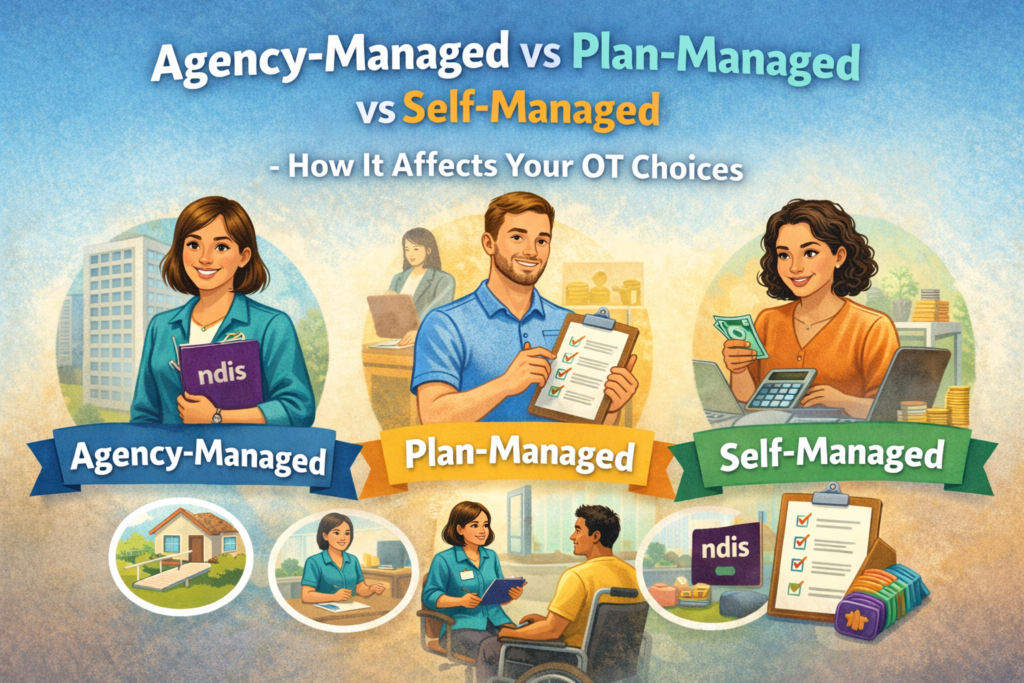
Agency-managed
NDIA holds the funds
The NDIA directly holds your funding and pays registered NDIS providers on your behalf after they submit claims through the NDIS portal. You do not handle money or invoices. Only NDIS-registered providers can be used.
Plan-managed
Plan manager holds and pays
A registered plan management provider receives your funding allocation and pays invoices on your behalf. You can use both registered and unregistered NDIS providers. The NDIS funds an additional amount for plan management — it does not come from your support budget.
Self-managed
You hold and pay directly
You receive your NDIS funding directly into a dedicated bank account, pay providers yourself, and claim reimbursement through the myNDIS portal. You can use any provider — registered or not — and even use the funds for supports you organise yourself, within the NDIA’s rules.
Agency-Managed — How It Works and What It Limits
Agency management is the default arrangement for participants who have not expressed a preference or who the NDIA has determined require additional oversight. It is simple to administer because the participant never handles funds — but that simplicity comes at a cost.
How it works for OT
When you use an agency-managed plan to access OT, the process is:
- You engage an NDIS-registered OT provider
- After each appointment, the OT submits a claim directly to the NDIA through the NDIS portal
- The NDIA pays the provider within a few days
- You never handle an invoice or make a payment
The critical limitation — registered providers only
The significant constraint of agency management is that you can only use providers who are registered with the NDIS Quality and Safeguards Commission. NDIS registration involves significant compliance obligations, annual audits, and ongoing reporting — requirements that some excellent OTs and OT practices have chosen not to pursue because the administrative burden outweighs the benefit for their particular business model.
In practice, this means a proportion of highly qualified, experienced OTs — particularly those operating as sole practitioners or in small specialised practices — are not available to agency-managed participants. The OT who is highly regarded within your local disability community, or the specialist sensory OT recommended by your child’s school, may simply not be NDIS-registered, making them inaccessible to you under agency management.
The PAPL rate ceiling
Under agency management, registered providers are bound by the NDIS Pricing Arrangements and Price Limits (PAPL) — the maximum rate at which they can claim. For OT in 2025–26, this is $193.99 per hour on weekdays. This ceiling applies to all registered provider claims against agency-managed budgets without exception.
Agency management is not wrong — it is simply more constrained. For participants who are comfortable with their existing registered OT provider, who do not wish to manage any administrative aspects of their plan, or who have limited capacity to oversee plan spending, agency management may be entirely appropriate. The constraint matters most when a participant wants to access a specific OT who is not registered, or when they want to exercise more choice in how and with whom they use their IDL budget.
Plan-Managed — The Most Flexible Funded Option
Plan management is the arrangement that most participants and families who have researched their options choose — and with good reason. It provides substantially more flexibility than agency management while delegating the financial administration to a professional plan manager.
How it works for OT
When you use a plan-managed arrangement for OT:
- You choose any OT provider — registered or unregistered
- The OT sends their invoice to your plan manager (not to you)
- Your plan manager pays the invoice from your IDL budget and keeps records for the NDIA
- You receive monthly statements showing how your budget is being used
- You never handle invoices or reimbursement — the plan manager manages this
What plan management enables for OT
The most significant advantage of plan management is access to the full OT market — registered and unregistered providers. This means:
- You can use any qualified, AHPRA-registered occupational therapist, regardless of their NDIS registration status
- You have access to specialist OTs who may not have pursued NDIS registration but who have significant expertise in a specific area relevant to your needs
- You can compare providers more broadly and choose based on clinical quality and fit, not just registration status
- Unregistered providers are not bound by PAPL rates — meaning highly specialised OTs may charge above $193.99 per hour, but this is only appropriate if their expertise justifies the premium
The cost of plan management
Plan management is funded by the NDIA as a separate budget allocation — it does not come from your Improved Daily Living or any other support budget. The cost of plan management (currently around $104.45 per month for standard management at the PAPL rate) is an addition to your plan, not a deduction from it. This is an important point many participants do not know: asking for plan management does not reduce your support funding.
Self-Managed — Maximum Choice, Maximum Responsibility
Self-management gives you the greatest flexibility and control over how your NDIS funding is used — but it also requires the most active administration and carries the greatest responsibility.
How it works for OT
Under self-management for OT:
- You receive NDIS funding directly into a dedicated bank account
- You choose any OT provider — any qualified person, not just AHPRA-registered OTs in principle, though professional qualifications are required for allied health services
- You pay the OT’s invoice yourself directly from your NDIS account
- You submit claims through the myNDIS portal to draw down the relevant budget
- You keep records of all spending and are responsible for demonstrating that all supports purchased were in line with your plan goals
The full breadth of choice
Self-management provides the broadest provider choice of any management type. Beyond unregistered providers (which are also accessible under plan management), self-managed participants can in principle use international providers, pay workers directly, and structure supports in highly individualised ways that are difficult to achieve through the standard provider market.
The administrative commitment
Self-management requires significant ongoing administrative effort — claiming through the portal, maintaining records, tracking spending against budgets, and managing provider relationships. For participants who have the capacity and interest to actively manage this, it can be very rewarding. For participants who do not — or whose disability limits their capacity to manage administrative complexity — self-management can become burdensome and create compliance risks.
Self-management is not a blank cheque. The NDIA conducts audits of self-managed plans and can request evidence that spending was aligned with plan goals and the reasonable and necessary criteria. Self-managed participants should keep thorough records of all OT invoices, the goals each service supported, and any progress documentation provided by the OT.
How Each Management Type Affects Your OT Choices — Side by Side
| OT access consideration | Agency-managed | Plan-managed | Self-managed |
|---|---|---|---|
| Can use NDIS-registered OT providers | ✅ Yes | ✅ Yes | ✅ Yes |
| Can use unregistered OT providers | ❌ No | ✅ Yes | ✅ Yes |
| Provider bound by PAPL rate? | Yes — max $193.99/hr | Registered: yes Unregistered: no (but value-for-money applies) |
No formal ceiling (value-for-money applies) |
| Who pays OT invoices | NDIA (direct claim by provider) | Plan manager | You (then you claim) |
| Who monitors IDL balance | NDIA portal (participant checks) | Plan manager (provides statements) | You (NDIS portal + records) |
| Administrative effort required | Minimal | Low — plan manager handles it | High — you manage everything |
| Cost to participant | None | None (funded separately by NDIA) | None (but significant time cost) |
| Can TEAH be used? | ✅ Yes (TEAH is registered) | ✅ Yes | ✅ Yes |
Why Most Participants Benefit from Plan Management for OT
For the majority of NDIS participants accessing OT, plan management provides the optimal balance of flexibility and administrative simplicity. Here is why:
Access to the full OT market without administrative burden
Plan management opens up unregistered OT providers — expanding your choice to the full pool of qualified occupational therapists in your area — while still having a plan manager handle all invoicing, payment, and record-keeping. You get the provider freedom of self-management without the administrative complexity.
Plan management does not cost you anything
This is the fact that changes most minds. The NDIA funds plan management as a separate line item in the plan — not from your Capacity Building or Core Supports budget. Asking for plan management does not reduce your IDL allocation by a single dollar. It is an additional funded support on top of your existing plan.
It is reversible
If you have tried plan management and find it is not right for you, you can request a change back to agency management or a move to self-management at your next plan review. Plan management is not a permanent commitment.
Plan managers provide useful oversight
A good plan manager provides regular budget statements, alerts you when budgets are running low, and can help you track spending across multiple providers — including your OT, speech pathologist, and physiotherapist. This oversight is valuable for participants managing multiple allied health providers simultaneously.
Can You Change How Your Plan Is Managed?
Yes — and more easily than most participants realise. Here is how:
Changing from agency-managed to plan-managed
You can request this change at any time — you do not need to wait for your scheduled plan review. Contact the NDIA (by phone or through the myNDIS portal) and request that plan management be added to your plan. You will need to nominate a registered plan manager. The change typically takes effect within a few weeks. This is one of the fastest and most impactful changes a participant can make to expand their OT provider options.
Changing from plan-managed to self-managed
This requires more consideration and is typically discussed at a plan review rather than as a mid-plan change. The NDIA will consider whether the participant has the capacity to manage their own funds, and may ask for supporting information. For participants who are confident in managing finances and record-keeping, self-management is a reasonable transition from plan management.
Changing from self-managed back to plan-managed or agency-managed
If self-management is proving too administratively demanding, you can request a change to plan management at any time. Moving back to agency management is also possible but more restrictive — you lose access to unregistered providers, so ensure any OTs you are currently using are registered before making this change.
Talk to your support coordinator before changing management type. Your support coordinator can advise whether the change is appropriate for your situation, help you identify and engage a suitable plan manager, and ensure the transition is managed without disruption to your existing OT and other provider arrangements. A poorly managed transition can temporarily disrupt payment to providers mid-engagement.
Mixed Management — A Lesser-Known Option
Few participants know that it is possible to have different parts of the same NDIS plan managed in different ways — what is sometimes called “mixed management” or “combination management.”
For example, a participant might have:
- Core Supports — agency-managed (simplest for regular support worker payments)
- Capacity Building — Improved Daily Living — plan-managed (for flexibility in OT and allied health provider choice)
- Capital Supports — agency-managed (for AT and home modification purchases)
This approach allows you to apply the management type that best suits each budget category — maximising provider flexibility where it matters most (for IDL and allied health) while keeping simpler management for categories where choice is less important.
Mixed management requires a bit more planning to set up, but your support coordinator or plan manager can guide you through it. The NDIS supports this approach and it is increasingly common among more engaged participants.
NDIS Registered — WA · NT · QLD · VIC
TEAH accepts all plan management types
Whether you are agency-managed, plan-managed, or self-managed, TEAH can work with you. As a registered NDIS provider, we are accessible under all three management types — across Darwin (NT), Perth (WA), Brisbane (QLD), and Victoria.
Frequently Asked Questions
Does plan management cost me anything from my support budget?
No. Plan management is funded by the NDIA as a separate budget line in your plan — it does not reduce your Core Supports, Capacity Building, or Capital Supports allocations by a single dollar. The NDIA pays the plan manager’s fees separately from your support funding. This is one of the most important facts to understand when considering whether to move to plan management.
Can I change to plan management without waiting for my plan review?
Yes — you can request plan management at any time during a plan year, not just at your scheduled review. Contact the NDIA and request the change. Nominate a registered plan manager, and the change will typically take effect within a few weeks. You do not need to justify the request — it is a participant right.
If I am agency-managed, can I still use TEAH for OT?
Yes. TEAH is a registered NDIS provider, which means agency-managed participants can use our services. The OT will claim directly through the NDIS portal after each appointment, and you will not need to handle any invoices or payments. Plan-managed and self-managed participants can also use TEAH — we accept all three management types.
I am currently agency-managed and the OT I want to use is not NDIS registered. What can I do?
The fastest solution is to request a change to plan management. This change can be made mid-plan without waiting for your review. Once you are plan-managed, you can use the unregistered OT. Your support coordinator can help you initiate the change and identify a plan manager in your area. Alternatively, you could seek a registered OT provider who offers comparable expertise — TEAH, for example, is registered and works across all management types.
What is the difference between a support coordinator and a plan manager?
These are two distinct roles that are often confused. A plan manager handles the financial administration of your NDIS plan — receiving invoices from providers, paying them from your budget, and providing you with spending statements. A support coordinator helps you identify, engage, and coordinate your NDIS supports and providers. They may work together on your plan, but they are separate services funded from different budget categories (plan management from Improved Life Choices; support coordination from Support Coordination).
Is self-management better than plan management for accessing OT?
In terms of provider access, self-management and plan management provide essentially the same OT choices — both allow you to use registered and unregistered providers. The difference is who administers the payments. Unless you have a specific reason to want to pay providers directly and manage your own claims — or unless you want to access highly non-traditional support arrangements — plan management provides equivalent provider flexibility with significantly less administrative burden.
Summary
Your plan management type is one of the most practically important but least understood variables in how you access NDIS OT. Agency management restricts you to registered providers only. Plan management opens access to the full OT market — registered and unregistered — while still having a plan manager handle all payment administration. Self-management provides maximum flexibility at the cost of significant administrative responsibility.
For most participants, plan management is the optimal balance — it does not cost anything from your support budget, it significantly expands your provider options, and it keeps financial administration off your plate. If you are currently agency-managed and finding that the OT you want to use is not registered, moving to plan management is the fastest and most effective solution.
TEAH is a registered NDIS provider — meaning we are accessible to participants under all three management types. Whether you are agency-managed, plan-managed, or self-managed, we can work with your plan as it is today.
Refer to TEAH — we work with all management types
Darwin (NT) · Perth (WA) · Brisbane (QLD) · Victoria
Related articles
- How to use your NDIS plan to access occupational therapy
- What is Capacity Building — Improved Daily Living in the NDIS?
- How to choose an NDIS occupational therapist — 8 questions to ask
- How much does an NDIS OT assessment cost in Australia?
- Our Occupational Therapy Services — Darwin, Perth, Brisbane & Victoria
TEAH Allied Health Team
Top End Allied Health (TEAH) is an NDIS-registered allied health provider delivering occupational therapy, speech pathology, physiotherapy, and supported accommodation across WA, NT, QLD, and Victoria. Referrals: referrals@topendalliedhealth.com.au | 1300 203 059