
Reading time: 10 minutes | Updated: April 2026 | Written by: TEAH Allied Health Team
Applying for the NDIS for the first time can feel overwhelming. The scheme is large, the language is technical, and the process involves evidence gathering, formal requests, and meetings with people you have never met – all while managing a disability or supporting someone who does.
But the NDIS is one of the most significant social investments in Australian history, and for the people it is designed to support, access can be genuinely life-changing. The right plan, with the right supports, can fund occupational therapy, assistive technology, home modifications, support workers, and a range of allied health services that restore independence and participation.
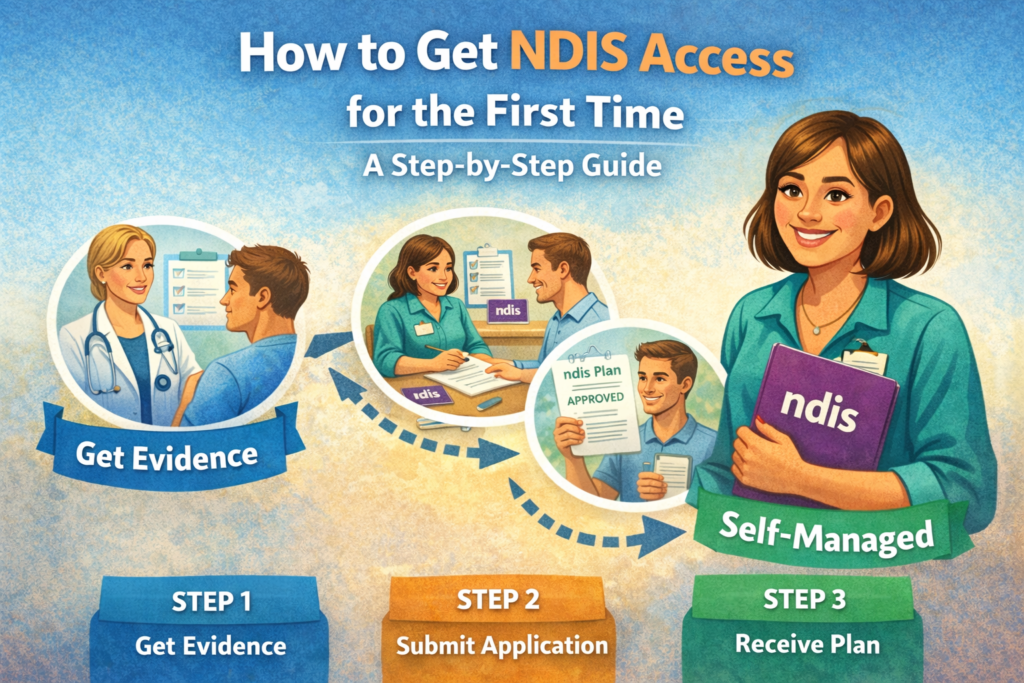
This guide cuts through the complexity. It takes you step by step through how to apply for the NDIS for the first time – from checking whether you are eligible, to gathering evidence, to your first planning meeting, and what comes next. It is written for participants, families, and support coordinators who are navigating the process for the first time.
In this article
- Who can apply for the NDIS?
- Step 1 – Check the eligibility criteria
- Step 2 – Gather your supporting evidence
- Step 3 – Submit your access request
- Step 4 – The NDIA’s decision
- Step 5 – Your first planning meeting
- Step 6 – Using your plan — including OT
- Children under 9 — the Early Childhood Approach
- How an OT helps with NDIS access
- Frequently asked questions
Who Can Apply for the NDIS?
The NDIS is available to Australians with a permanent disability that significantly affects their daily functioning. Eligibility is not based on diagnosis alone – it is based on the functional impact of the disability on the person’s daily life. Two people with the same diagnosis may have very different levels of functional impairment, and it is the impairment, not the label, that the NDIA assesses.
To apply, you must meet all four of the following criteria at the time you apply:
| Criterion | What it means in practice |
|---|---|
| Age | Under 65 at the time of first access. People who are 65 or older at the time they apply are directed to the aged care system instead. |
| Residency | An Australian citizen, permanent resident, or holder of a Protected Special Category visa living in Australia. |
| Disability requirement | A disability caused by a permanent impairment that significantly reduces functional capacity in at least one of: communication, social interaction, learning, mobility, self-care, or self-management. |
| Early intervention requirement | Even if a disability is not yet permanent, early intervention supports would reduce the future impact of the condition. This applies particularly to children with developmental delays. |
Important: “Permanent” does not mean the condition cannot fluctuate or improve. It means the underlying impairment is not expected to resolve entirely. Many conditions — including multiple sclerosis, autism, intellectual disability, and psychosocial disability – meet the permanence requirement even though functioning varies significantly day to day and between episodes.
Step 1 – Check the Eligibility Criteria
Before submitting a formal access request, do a preliminary self-check. The NDIS website includes an eligibility checker at ndis.gov.au — this is not a formal decision but it gives you an early indication of whether an application is worth pursuing.
At this stage, ask yourself – or the person you are supporting – the following:
- Does the disability significantly affect daily activities — getting dressed, preparing food, communicating, managing a routine, moving around safely?
- Is the disability caused by a permanent impairment (physical, intellectual, cognitive, neurological, sensory, or psychiatric)?
- Are existing mainstream supports (healthcare, education, family) insufficient to meet the person’s needs?
- Would NDIS-funded supports meaningfully improve daily functioning, independence, or community participation?
If the answers are mostly yes, an access request is worth pursuing. If you are uncertain, speaking with a Local Area Coordinator (LAC) or an Early Childhood Partner (for children under 9) is a useful next step – these are NDIS-funded partners in the community who can guide you through the process without cost.
Step 2 – Gather Your Supporting Evidence
The quality of your supporting evidence is the single biggest determinant of whether an NDIS access request is successful. The NDIA makes its eligibility decision based entirely on the documentation you provide – it cannot see what it is not told.
What evidence you need
Your access request should include evidence across three areas:
Evidence checklist for your NDIS access request
1. Diagnosis and medical evidence
- Diagnostic reports from specialists (psychiatrist, paediatrician, neurologist, geneticist)
- GP clinical letter confirming the diagnosis, permanence, and functional impact
- Hospital discharge summaries or specialist clinic letters
- Imaging or test results where relevant (MRI, genetic testing, audiological assessment)
2. Functional impact evidence
- Allied health reports documenting how the disability affects daily functioning – particularly from an occupational therapist
- Standardised assessment scores (WHODAS 2.0, Barthel Index, Vineland-3, ABAS-3)
- Speech pathology, physiotherapy, or psychology reports
- School reports or IEPs documenting functional impact in the school environment (for children)
3. Your own account
- A participant statement or carer statement describing how the disability affects daily life in plain language
- Specific examples of tasks the person cannot do independently, does with difficulty, or has stopped doing entirely
Why the OT report is the most important document
Of all the evidence you can submit with an NDIS access request, a functional assessment report from an occupational therapist carries the most weight. This is because it directly documents functional capacity – how the disability affects the person’s actual daily activities – using standardised, objective measurement tools that the NDIA’s processes are designed to respond to.
A diagnostic report from a specialist confirms what the condition is. An OT functional assessment report demonstrates what the condition does – which is exactly what the NDIA needs to make an eligibility determination and, later, to set the right level of funding.
Do not submit an access request without functional evidence. Many first-time applications fail not because the person doesn’t meet the eligibility criteria, but because the supporting evidence focuses on diagnosis rather than functional impact. The NDIA funds functional limitation – not diagnoses. An OT assessment that documents specific daily living deficits using standardised tools dramatically improves your chances of a successful first application.
Step 3 – Submit Your Access Request
Once you have gathered your supporting evidence, you can submit your access request in three ways:
Phone – 1800 800 110
Call the NDIA directly and a staff member will guide you through the access request verbally. You can submit supporting evidence by post or via myplace portal afterward.
Online – myplace portal (my.ndis.gov.au)
Create a myGov account, link it to myplace, and submit an access request with supporting documents online. This is the fastest pathway and allows direct upload of all evidence.
In person – NDIS office or Local Area Coordinator
Visit an NDIS office or meet with a Local Area Coordinator in your community. LACs are particularly helpful if you are unsure what evidence to submit or need help completing paperwork.
With your access request you will need to submit or provide:
- Your personal details and proof of identity
- Proof of residency (Australian citizenship, permanent residency, or eligible visa)
- All supporting evidence gathered in Step 2
- Consent to the NDIA contacting your treating professionals if further information is needed
Step 4 – The NDIA’s Decision
After receiving your access request, the NDIA has 21 days to make an eligibility decision (though in practice this can take longer, particularly if they request further information). The NDIA will contact you by letter or phone with the outcome.
If your access request is approved
You will receive written confirmation that you are now an NDIS participant. The next step is your first planning meeting, where your NDIS plan – including your funding allocations – is developed.
If your access request is not approved
The NDIA will provide reasons in writing. If you believe the decision is incorrect, you have the right to request a review. The most effective response to a rejected access request is to commission a more detailed OT functional assessment that addresses the specific gaps the NDIA identified in its decision notice. Common reasons for rejection include insufficient evidence of functional impact, evidence that only addresses diagnosis rather than daily function, or information suggesting the disability may not be permanent.
A rejected access request is not necessarily the end. You have 3 months from receiving the decision to request an internal review. An updated or more comprehensive OT functional assessment – one that addresses the NDIA’s stated reasons for rejection – is the most powerful evidence you can submit for a review. Contact TEAH if you have received a rejection and need a targeted assessment to support an appeal.
Step 5 – Your First Planning Meeting
Once approved as a participant, you will be invited to a planning meeting – either with an NDIA planner or a Local Area Coordinator. This meeting determines what funding is included in your first plan.
What to bring
- All your supporting evidence (including the OT report, specialist letters, and any other allied health reports)
- A written statement about your goals – what you want to achieve, what matters most to you, and what a successful plan would look like
- A list of your current supports – formal and informal – and how they are currently meeting (or failing to meet) your needs
- A support person, advocate, or support coordinator if you would like one present
What will be discussed
The planning meeting covers your diagnosis and disability, your current functional capacity, your goals for the plan period (typically 12 months), what supports you currently receive and from whom, and what new supports you are requesting. The NDIA uses this information alongside your submitted evidence to determine the funding categories and amounts in your plan.
Prepare, do not improvise
Your first plan is the foundation for everything that follows. A participant who arrives at their planning meeting with a clearly articulated set of goals, strong supporting clinical evidence, and an understanding of what NDIS supports are available is far more likely to receive a plan that reflects their real needs than one who arrives without preparation.
Step 6 – Using Your Plan, Including OT
Once your plan is issued, you can begin accessing funded supports. If your plan includes Capacity Building – Improved Daily Living, this budget funds occupational therapy services – including assessments, therapy sessions, and reports.
At the 2025–26 PAPL rate of $193.99 per hour (weekday), a typical NDIS OT Functional Capacity Assessment costs $1,552–$2,716 depending on complexity. Home modification assessments cost $388–$970. Assistive technology assessments for complex equipment (wheelchairs, communication devices) can range from $582–$3,104.
Your plan will also specify the plan management type – agency-managed, plan-managed, or self-managed – which determines which OT providers you can access and who handles payment of invoices. If your first plan is agency-managed but you want access to a wider range of OT providers, you can request a change to plan management at any time, without waiting for your next plan review.
NDIS Registered — WA · NT · QLD · VIC
Need an OT assessment to support your NDIS access request?
TEAH’s OTs conduct in-home functional capacity assessments across Darwin (NT), Perth (WA), Brisbane (QLD), and Victoria – producing the clinical evidence the NDIA needs to approve access and fund the right supports.
Children Under 9 – The Early Childhood Approach
Children under 9 with developmental delays or disabilities have a different pathway into the NDIS: the Early Childhood Approach (ECA). The ECA is designed to connect very young children with early intervention supports as quickly as possible – often before a formal diagnosis has been confirmed.
How the ECA works
Rather than submitting a full NDIS access request, families with children under 9 can contact an Early Childhood partner in their area (findable at ndis.gov.au). The EC partner conducts an initial meeting, assesses whether NDIS early intervention supports are likely to be beneficial, and connects the child and family with appropriate services – including OT – funded through the NDIS.
Key advantages of the ECA
- Does not require a formal diagnosis – developmental concerns are sufficient to trigger ECA support
- Faster access to early intervention than the standard NDIS access request pathway
- Supports are focused on the child’s natural environments (home, childcare, school)
- OT is one of the most commonly funded early intervention supports through the ECA
If your child is under 9 and you are concerned about their development – particularly if they have sensory processing differences, motor delays, communication difficulties, or challenges with daily routines – contacting an Early Childhood partner is the fastest route to OT and other early intervention support.
How an OT Helps with NDIS Access
An occupational therapist can contribute to your NDIS access journey at multiple points – not just after you have a plan. Here is how:
Before you apply – building the evidence case
An OT can conduct a functional assessment that documents how your disability affects daily life using standardised tools (WHODAS 2.0, Barthel Index, Vineland-3, and others). This assessment report is often the most influential document in an NDIS access request because it translates clinical diagnosis into functional impact – exactly what the NDIA needs to see.
After access is approved – in your first plan
Once you have an NDIS plan with Capacity Building – Improved Daily Living funding, an OT can conduct a comprehensive Functional Capacity Assessment for your first plan review, assess your need for assistive technology or home modifications, deliver ongoing therapy targeted at your plan goals, and produce clinical reports that underpin future plan decisions.
If your access request was rejected
An updated OT assessment that addresses the specific reasons the NDIA gave for rejection is the most effective response. TEAH can commission a targeted assessment designed to address identified evidence gaps – maximising the likelihood of a successful review or reapplication.
Frequently Asked Questions
How long does the NDIS access process take?
The NDIA has 21 days to make an eligibility decision after receiving a complete access request with all supporting evidence. In practice, the process from first contact to an approved plan can take 3–6 months depending on how quickly evidence is gathered, whether further information is requested, and wait times for planning meetings. Starting the evidence gathering process – including commissioning an OT assessment – well in advance is strongly recommended.
Do I need a doctor’s referral to apply for the NDIS?
No – you do not need a GP referral to submit an NDIS access request. You do need supporting evidence from qualified health professionals, including a GP letter or specialist diagnostic report confirming the disability. You also do not need a referral to commission an OT assessment to support your application – you can contact TEAH directly.
My child doesn’t have a formal diagnosis yet. Can they still access the NDIS?
Yes – through the Early Childhood Approach (ECA). Children under 9 do not need a confirmed diagnosis to access ECA-funded early intervention supports, including OT. Contact an Early Childhood partner in your area to begin the process. Acting early – while the brain’s neuroplasticity is highest – produces significantly better outcomes than waiting for a formal diagnosis before seeking intervention.
Will getting NDIS access affect my Medicare, Centrelink, or private health insurance?
NDIS access does not affect your Medicare entitlements or Centrelink payments (including DSP, Carer Payment, or Family Tax Benefit). You continue to access Medicare and Centrelink as normal. NDIS funding is separate and complementary. Some private health insurance extras (such as physiotherapy or OT extras) may overlap with NDIS-funded services – you cannot be funded by both for the same service, but your insurer and support coordinator can help you understand what applies in your situation.
What if I am over 65? Can I still access disability supports?
If you are 65 or over when you first apply, you are not eligible to access the NDIS. Instead, you are directed to the aged care system – Home Care Packages and Residential Aged Care. However, if you were an NDIS participant before turning 65, you can choose to remain on the NDIS. People with younger-onset dementia (under 65) may be eligible for the NDIS – speak with your GP and contact the NDIA to discuss your situation.
How much does an OT assessment cost to support an NDIS access request?
If you do not yet have an NDIS plan, an OT assessment to support your access request must generally be funded privately (out of pocket) or through a GP-referred Medicare plan. A targeted functional assessment – designed specifically to document functional impact for an NDIS access request – typically costs $1,200–$2,000 depending on complexity. Once your NDIS plan is approved and includes Capacity Building – Improved Daily Living, future OT assessments are funded from that budget at the 2025–26 rate of $193.99 per hour.
How do I get TEAH to help with my NDIS access application?
Contact TEAH directly to discuss your situation. We can advise on whether an OT functional assessment would strengthen your access request, what it would involve, and what it would cost. Submit a referral online at topendalliedhealth.com.au/referral, email referrals@topendalliedhealth.com.au, or call 1300 203 059. We operate across Darwin (NT), Perth (WA), Brisbane (QLD), and Victoria.
Summary
Getting NDIS access for the first time is a process — but it is a navigable one. The key steps are: confirm you meet the eligibility criteria, gather strong functional evidence (particularly from an OT), submit your access request, and prepare carefully for your planning meeting. For children under 9, the Early Childhood Approach offers a faster, diagnosis-free pathway to early intervention.
The most impactful single action you can take to strengthen an NDIS access request is commissioning an occupational therapy functional assessment that documents how the disability affects daily life using standardised tools. This is the evidence the NDIA is most equipped to act on — and TEAH can provide it across Darwin, Perth, Brisbane, and Victoria.
Need an OT assessment for NDIS access?
Darwin (NT) · Perth (WA) · Brisbane (QLD) · Victoria
Related articles
- What is a Functional Capacity Assessment and what does it include?
- What is Capacity Building — Improved Daily Living in the NDIS?
- How to use your NDIS plan to access occupational therapy
- Paediatric OT under the NDIS — a guide for families
- Our Occupational Therapy Services — Darwin, Perth, Brisbane & Victoria
TEAH Allied Health Team
Top End Allied Health (TEAH) is an NDIS-registered allied health provider delivering occupational therapy, speech pathology, physiotherapy, and supported accommodation across WA, NT, QLD, and Victoria. Referrals: referrals@topendalliedhealth.com.au | 0484 705 911