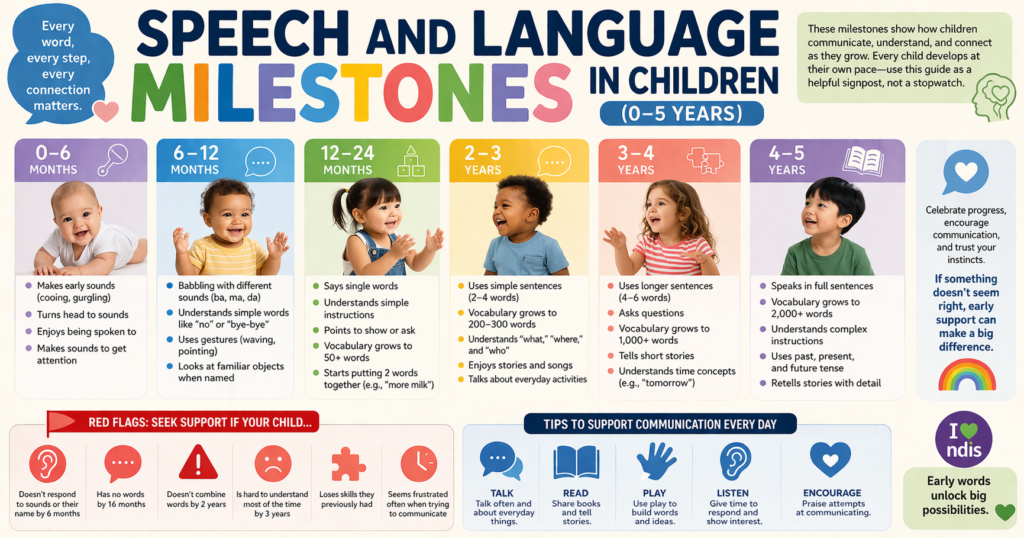
Understanding speech milestones in children is one of the most common reasons parents turn to Dr Google at 2am. If you’ve ever wondered whether your child is talking enough, clearly enough, or at the right time — you’re not alone. Speech and language development varies widely between children, and knowing what to look for at each age can help you feel more confident and act early if support is needed.
This guide walks through what most children can do with communication from birth to five years, the signs that may suggest a child would benefit from extra support, and how a speech pathologist can help.
What are speech milestones in children?
Speech milestones are general markers of how communication develops over time. They cover two connected areas:
- Receptive language — what a child understands (following instructions, recognising words)
- Expressive language — what a child can say or communicate (words, sentences, gestures)
Milestones are ranges, not deadlines. Some children reach them earlier, some later. What matters most is the overall pattern of progress — and whether your child is continuing to develop, even if at their own pace.
Speech and language milestones by age
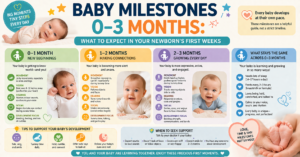
0–3 months
From the very first weeks, babies are already communicating. Most newborns will:
- Startle or turn toward sounds and voices
- Recognise a caregiver’s voice and calm when they hear it
- Make small throaty sounds and begin cooing
- Cry differently for different needs (hunger, discomfort, tiredness)
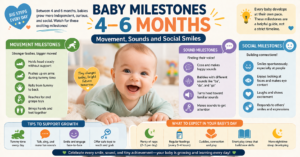
4–6 months
Babies become much more vocal and expressive during this stage. Most will:
- Babble with repeated sounds like “ba-ba” or “ma-ma” (without meaning yet)
- Laugh and squeal with delight
- Respond differently to warm and stern tones of voice
- Look toward where sounds are coming from
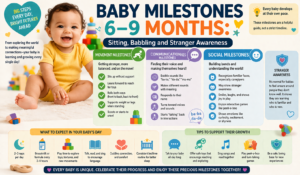
6–9 months
Babbling becomes more varied and conversational. At this age, most babies:
- String together longer babble sequences
- Use gestures like reaching and pointing to communicate
- Respond to their own name
- Begin to understand simple words like “no” and “bye-bye”
9–12 months
The lead-up to first words is an exciting time. Most children around this age:
- Use one or two words with meaning (often “mama”, “dada”, or a word for a familiar object)
- Understand simple instructions like “give me” or “come here” with a gesture
- Wave bye-bye and shake their head for “no”
- Imitate sounds and simple words they hear often
12–18 months
Vocabulary grows steadily during this period. Most toddlers:
- Use between 5 and 20 words meaningfully by 18 months
- Point to pictures in books when named
- Follow two-step instructions (“Get your shoes and bring them here”)
- Use words more often than gestures to communicate wants
Wondering if your child’s speech is on track?
Our paediatric speech pathologists can assess your child’s communication development and give you clear, practical guidance — no referral needed to get started.
18–24 months
This is often called the “language explosion” stage. Most children:
- Have a vocabulary of 50 or more words by age 2
- Begin combining two words (“more milk”, “daddy go”, “big dog”)
- Are understood by familiar caregivers most of the time
- Ask simple questions like “What’s that?”
- Name familiar people, body parts, and everyday objects
2–3 years
Language becomes much richer and more complex. Most children aged 2–3:
- Use three- to four-word sentences regularly
- Strangers can understand them about 50–75% of the time
- Ask “why” and “who” questions frequently
- Follow instructions with two or three steps
- Begin using pronouns (I, me, you) though mix-ups are common
- Enjoy simple stories and rhymes
3–4 years
Speech becomes clearer and sentences longer. Most children aged 3–4:
- Speak in sentences of four to six words
- Are understood by most people outside the family
- Use past tense, though errors like “runned” or “goed” are normal
- Answer simple questions about stories (“What happened next?”)
- Talk about things that happened earlier in the day
- Use language during pretend play
4–5 years
By school age, most children are confident communicators. Most children aged 4–5:
- Speak clearly enough to be understood by everyone, nearly all of the time
- Use sentences of five or more words with correct grammar most of the time
- Tell simple stories with a beginning, middle, and end
- Understand and follow classroom-style instructions
- Ask and answer “when”, “where”, “why”, and “how” questions
- Recognise rhymes and show early awareness of sounds in words
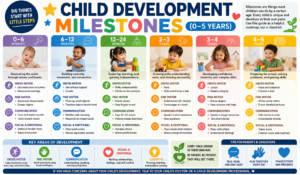
Speech milestones in children: a quick reference table
| Age | Key speech and language markers |
|---|---|
| 0–3 months | Coos, reacts to voices, cries differently for different needs |
| 4–6 months | Babbles, laughs, responds to tone |
| 6–9 months | Longer babble, points, responds to own name |
| 9–12 months | First words with meaning, gestures, imitates sounds |
| 12–18 months | 5–20 words, follows simple instructions |
| 18–24 months | 50+ words, two-word phrases, asks “What’s that?” |
| 2–3 years | 3–4 word sentences, asks “why”, understood by caregivers |
| 3–4 years | 4–6 word sentences, understood by most people |
| 4–5 years | Clear speech, tells stories, school-ready communication |
Common concerns parents have about speech milestones in children
“My child isn’t talking yet — should I be worried?”
Late talking is one of the most common concerns parents bring to a speech pathologist. Some children do catch up on their own, while others benefit from early support. The key question isn’t just how many words a child has, but whether they’re communicating in other ways — pointing, gesturing, making eye contact, and showing interest in others.
“My child was talking, then stopped”
A loss of words or skills that a child previously had — called regression — is worth discussing with a professional promptly. This can happen for many reasons, and a speech pathologist or GP can help work out the right next step.
“My child stutters — is that normal?”
Many children go through a period of normal disfluency between ages 2 and 5, when language is developing faster than their ability to get it out. This often resolves on its own. If stuttering is frequent, causing distress, or persisting past age 5, a speech pathologist can assess and support your child.
“I can’t understand what my child is saying”
Speech clarity develops gradually. By age 3, strangers should understand about 75% of what a child says. By age 4–5, speech should be clear to everyone. If your child’s speech is significantly harder to understand than their peers, a speech pathology assessment is a good idea.
Signs that a child may benefit from speech pathology support
The following signs don’t mean something is “wrong” — they simply suggest your child may benefit from a professional assessment. Early support consistently leads to better outcomes.
Consider speaking with a speech pathologist if your child:
- Isn’t babbling or making sounds by 9 months
- Hasn’t said their first word by 12–15 months
- Has fewer than 20 words by 18 months
- Isn’t combining two words by 24 months
- Is difficult to understand by familiar caregivers at age 2, or by strangers at age 3–4
- Loses words or communication skills they previously had
- Struggles to follow simple instructions for their age
- Rarely initiates communication or seems uninterested in interacting
- Has a stutter that is causing distress or not improving
Trust your instincts. If something feels off, it’s always worth asking — even if it turns out everything is on track, the reassurance is valuable.
How a speech pathologist supports children’s communication development
Speech pathologists are university-trained allied health professionals who specialise in communication. For children, they work across a wide range of areas including:
- Late talking — helping children build vocabulary and sentences
- Speech sound difficulties — supporting clear articulation and pronunciation
- Language delays — building understanding and expression of language
- Stuttering — assessment and evidence-based fluency support
- Social communication — helping children with the back-and-forth of conversation
- School readiness — pre-literacy and phonological awareness skills
Therapy sessions are play-based and child-friendly. A good speech pathologist will also coach parents and caregivers on strategies to use at home — because the most powerful learning happens in everyday moments, not just in the clinic.
For children who may have broader developmental needs, speech pathology often works alongside occupational therapy and physiotherapy as part of an early childhood intervention team.
Accessing speech pathology support in Australia
Families can access speech pathology through several pathways:
- Private referral — you can self-refer to a private speech pathologist without a GP referral in most cases
- GP referral — your GP can refer your child and may be able to access Medicare funding through a Chronic Disease Management plan
- NDIS — children with a confirmed developmental condition or disability may access speech pathology funding through the National Disability Insurance Scheme
- Early Childhood Early Intervention (ECEI) — for children under 9 showing developmental concerns, ECEI provides support and connects families with the right services
If you’re unsure which pathway is right for your family, speaking directly with a speech pathology clinic is often the quickest way to get clear answers.
Not sure if your child needs support?
Our paediatric speech pathologists in Darwin work with children from birth through to school age. Whether you have a specific concern or just want peace of mind, we’re here to help you work it out — without the wait-and-see.