Reading time: 9 minutes | Audience: Support Coordinators & Specialist Support Coordinators | Updated: April 2026
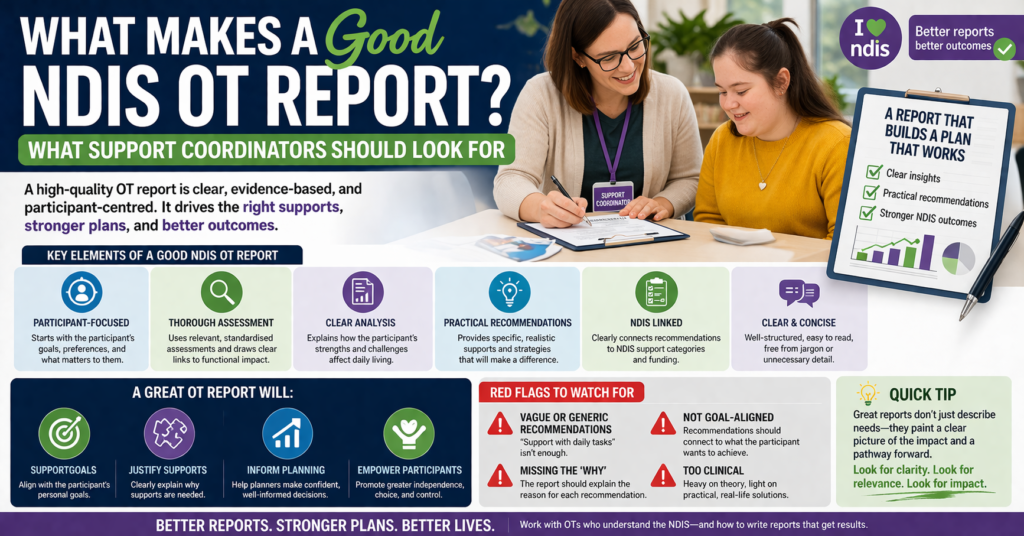
Most support coordinators can spot a bad OT report after a plan review rejection. Fewer can spot one before it is submitted — and even fewer have a clear framework for what “good” actually looks like.
This matters enormously. The quality of an OT report is one of the strongest predictors of NDIS plan outcomes. A report that is clinically thin, vague about support needs, missing standardised assessment data, or inconsistent with the funding being requested will not survive NDIA scrutiny — and the participant carries the cost of that in reduced or denied funding.
This guide gives support coordinators a practical, specific framework for evaluating OT report quality before a report is submitted. It covers what every strong report must contain, what distinguishes genuinely useful clinical evidence from filler, and the specific red flags that should prompt you to request revisions before the document goes anywhere near the NDIA.
In this article
- What the NDIA actually needs from an OT report
- Essential elements every strong OT report must contain
- Standardised assessment tools — why they matter and what to look for
- Specificity and quantification — the test every section must pass
- What to look for by report type — FCA, AT, home mods, SIL
- Red flags — signs a report needs revision before submission
- Green flags — signs you have a strong report
- How to request revisions professionally and effectively
- Frequently asked questions
What the NDIA Actually Needs from an OT Report
Before evaluating any specific report, it helps to understand the lens through which the NDIA reads it. The NDIA is not looking for a clinical narrative of the participant’s life and history — it is looking for answers to a specific set of questions that determine whether each requested support meets the “reasonable and necessary” threshold:
- Does this person have a permanent and significant disability that is related to the supports being requested?
- Does the disability demonstrably affect their capacity to perform the specific activities the requested supports would assist with?
- Is the level of support requested proportionate to the observed functional limitation?
- Can informal supports adequately meet any of this need — and if not, why not?
- Is the recommended support the most appropriate and cost-effective solution?
- Does the support connect directly to the participant’s NDIS goals?
A strong OT report answers every one of these questions with clinical evidence — not advocacy, not assertion, and not narrative. The NDIA’s planners have become increasingly sophisticated at distinguishing between reports that demonstrate clinical rigour and those that simply make a case without substantiating it.
Evidence, not advocacy. The NDIA does not fund support because a participant deserves it or because their situation is difficult. It funds support because clinical evidence demonstrates that the support is necessary. An OT report that reads as advocacy — “this participant clearly needs more support and it is urgent” — without the objective clinical foundation to back it will not produce the outcome the participant needs.
Essential Elements Every Strong OT Report Must Contain
Regardless of report type — FCA, AT assessment, home modification, or SIL — every credible NDIS OT report should contain the following foundational elements:
1. Clear identification of the assessing OT and their qualifications
The report should identify the occupational therapist by name and include their AHPRA registration number, professional qualifications, and any relevant specialist training or experience. For agency-managed participants, the report should also confirm the provider’s NDIS registration. A report from an unidentified or inadequately credentialled OT is vulnerable to challenge — and rightfully so.
2. Date and setting of the assessment
The report must state when and where the assessment was conducted. For most NDIS purposes, in-home assessment is expected — a report based solely on a clinic-based interview will be regarded with more scepticism than one conducted in the participant’s actual environment. If any part of the assessment was conducted via telehealth, this should be disclosed and the clinical rationale for that approach explained.
3. Who was present and their relationship to the participant
The report should identify every person present at the assessment — the participant, any family members or carers, support workers, interpreters — and their relationship to the participant. This matters because it affects how the NDIA weighs the information: a carer’s account of daily functioning carries different evidentiary weight than direct OT observation.
4. Background and relevant history
A concise but complete section on the participant’s diagnosis, relevant medical history, current medications, existing supports, and previous OT or allied health input. This contextualises the assessment findings and demonstrates that the OT has engaged with the participant’s history rather than conducting an assessment in isolation.
5. Assessment methodology — tools used and approach
The report should explicitly name every standardised assessment tool used, the conditions under which it was administered, and how the results were interpreted. This section is often underwritten — OTs sometimes list assessments in an appendix without integrating the findings meaningfully into the report body. The methodology section should make it clear that the OT’s conclusions rest on objective, reproducible measurement, not just clinical impression.
6. Findings presented by domain
A structured presentation of findings across all relevant daily living domains — personal care, domestic tasks, mobility, communication, cognition, community participation, sleep, and behaviour. Each domain should describe the participant’s current capacity, the level of support required, and the relationship between the disability and the observed limitation.
7. Explicit discussion of informal support
The NDIA always considers informal support. A strong OT report addresses this directly — who provides informal support, what they provide, how frequently, and whether this support is sustainable long term. Where informal support is declining (ageing carer, carer with their own health issues, family living interstate), this should be stated plainly and its impact on formal support needs documented.
8. Goal-aligned recommendations
Every recommendation in the report should be connected to at least one of the participant’s NDIS goals. This is not window dressing — the NDIA assesses whether each recommended support is “necessary to achieve or maintain the goals” in the participant’s plan. A recommendation without goal alignment is harder to justify under the reasonable and necessary criteria.
9. OT’s clinical signature and date
The report must be signed by the assessing OT, including the date of finalisation. An unsigned or undated report is not a completed clinical document.
Standardised Assessment Tools — Why They Matter and What to Look For
Standardised assessment tools are the backbone of clinical credibility in NDIS OT reports. They matter because they provide objective, reproducible, norm-referenced data that allows the NDIA to compare the participant’s functional capacity against established benchmarks — not just against the OT’s clinical impression.
A report without standardised assessment data is clinically credible only to the degree that the OT’s observational and clinical judgment is trusted. The NDIA’s response to reports without objective data is typically to request further information — delaying the funding decision and frustrating participants, families, and coordinators.
What standardised tool use looks like in a strong report
| What a strong report includes | What a weak report does instead |
|---|---|
| Names specific tools: “Vineland-3, WHODAS 2.0, Barthel Index” | Vague reference: “standardised assessments were administered” |
| Reports actual scores: “Barthel Index 35/100; WHODAS disability score 68%” | No scores provided — just narrative summary |
| Interprets scores in context: “35/100 on the Barthel Index indicates severe dependence in activities of daily living, placing the participant in the highest quintile of support need” | Lists scores without interpretation or clinical significance |
| Uses condition-appropriate tools: MPAI-4 for ABI, Vineland-3 for intellectual disability, FSS for MS or Parkinson’s | Uses the same generic tool regardless of the participant’s condition |
| Acknowledges where assessments were partially completed and why | No acknowledgement of limitations in the assessment process |
Common tools you should expect to see cited (by context)
- For most disability types: WHODAS 2.0, Barthel Index, Functional Independence Measure (FIM)
- For intellectual disability: Vineland-3, ABAS-3
- For ABI/neurological conditions: FIM, Barthel, MPAI-4, Dysexecutive Questionnaire, Fatigue Severity Scale
- For ASD (paediatric): SPM-2, Sensory Profile 2, Vineland-3, BOT-2
- For psychosocial disability: WHODAS 2.0, LSP-16, MOHOST, COPM
- For SIL/SDA: FIM, Barthel, Vineland-3 or ABAS-3 (for ID), WHODAS 2.0 across all types
Specificity and Quantification — The Test Every Section Must Pass
The single most reliable way to evaluate an OT report’s quality is to apply the specificity test to every section that describes a support need. Ask: does this statement give the NDIA enough information to validate the proposed support level, or does it require the NDIA to make an inference?
The specificity test works like this: take any sentence from the report and ask whether a stranger who has never met the participant could use it to accurately determine how much support is needed, for which tasks, and how often. If the answer is no, the sentence needs to be more specific.
| Vague (fails the specificity test) | Specific (passes) |
|---|---|
| “Requires assistance with showering.” | “Requires physical assistance to transfer over the shower threshold and verbal prompting at each step of the showering sequence due to cognitive sequencing difficulties. Showering requires approximately 35 minutes with one-to-one support, twice daily.” |
| “Struggles with meal preparation and needs help with cooking.” | “Cannot safely use the stove or oven unattended due to cognitive impairment affecting judgment and hazard recognition. Requires continuous supervision and verbal prompting for all 14 steps of meal preparation. Cannot self-initiate meal preparation without being prompted by a support worker.” |
| “Has significant difficulty with community access.” | “Cannot use public transport independently due to inability to manage multi-step sequences, difficulty with money handling, and anxiety in unfamiliar environments that triggers shutdown. Currently accesses community only with one-to-one support worker, twice per week.” |
| “Requires 24-hour support.” | “Requires active support during all waking hours for personal care, meals, medication management, and community access (16 hours daily), and passive overnight supervision (8 hours) due to documented nocturnal seizures occurring 2–3 times per week requiring immediate response.” |
What to Look for by Report Type
Functional Capacity Assessment (FCA)
The FCA is the most comprehensive and most scrutinised of all NDIS OT reports. In addition to the universal elements above, a strong FCA must:
- Address all eight daily living domains — personal care, domestic tasks, mobility and transfers, medication management, sleep and overnight needs, community participation, social interaction, and behaviour/emotional regulation
- Document variability — how the participant’s functioning differs between their best and worst days, and what drives that variability (fatigue, condition fluctuations, medication cycles)
- Distinguish what the participant can do independently from what they can do with prompting, supervision, or hands-on assistance
- Include time estimates per task — not just that support is needed, but approximately how long each task takes with support
- Address informal support sustainability — who provides it, what they provide, and whether it can continue
Home Modification Assessment
A strong home modification report must:
- Confirm that the OT visited the home — not a clinic or a generic environment
- Include specific measurements — door widths, corridor widths, step heights, turn radii — not just general descriptions of barriers
- Reference relevant Australian Standards (AS 1428.1 for access and mobility) in specifications
- State a clinical justification for each recommended modification, connected to a specific observed functional limitation
- Distinguish between modifications addressing current needs and those anticipating likely future needs in progressive conditions
Assistive Technology Assessment
A strong AT report must:
- Document that a trial was conducted in a real environment — not a showroom or clinic — and report the outcome of that trial
- Include a comparative analysis — why this product over the alternatives considered
- Provide exact product specifications — model, configuration, dimensions, accessories — sufficient for a supplier to quote without ambiguity
- Address training and setup requirements for the participant and support workers
- State the expected lifespan of the equipment and any maintenance requirements
SIL Assessment
A strong SIL report must:
- Quantify support needs by task, level, and time — sufficient to validate a proposed 28-day roster
- Distinguish between active and passive overnight support needs — the NDIA and the DSS treat these very differently and the distinction must be clinically justified
- Address behaviour and safety risks that affect staffing ratios, and justify any 2:1 support recommendations
- Document relapse or episode-related support needs for participants with episodic conditions — not just stable-period functioning
- Be internally consistent with the proposed roster — if the roster proposes 16 active support hours, the FCA must document needs that justify 16 active hours, not 10
Red Flags — Signs a Report Needs Revision Before Submission
These are the specific characteristics that should prompt you to return the report to the OT for revision before it goes anywhere near the NDIA:
❌ No standardised assessment scores cited
A report that describes functional findings without any objective measurement data is built on clinical impression alone. The NDIA can dismiss clinical impression; it struggles to dismiss a Barthel Index score of 25/100.
❌ Support needs described in general terms, not quantified
“Requires significant support with personal care” tells the NDIA nothing about how many hours of support are justified. Every support need must be translated into observable, time-quantified, task-specific terms.
❌ Informal support not addressed
If the report does not address who currently provides informal support, what they provide, and whether it is sustainable — the NDIA will raise this question itself, and not having an answer on file creates an evidence gap that typically results in reduced funding.
❌ Report describes best-day functioning
A single visit during a period of wellness produces a report that does not reflect the participant’s real support needs across their full range of functioning. If there is no mention of variability, fluctuation, or worst-day capacity — the report is incomplete for NDIS purposes.
❌ Recommendations not linked to NDIS goals
Every recommendation should be explicitly linked to a goal in the participant’s NDIS plan. A recommendation floating without goal alignment is harder to approve under the reasonable and necessary framework.
❌ SIL report inconsistent with proposed roster hours
If the OT’s clinical findings justify 14 hours of daily active support but the submitted roster proposes 20, the NDIA will identify the discrepancy and reduce the roster to match the evidence — or reject the application and request more information.
❌ Assessment conducted only via telehealth with no in-home visit
For home modification, SIL, and most FCA purposes, a telehealth-only assessment is clinically insufficient. The OT needs to see the environment and observe the participant in context. A telehealth-only report will be questioned — particularly for home modifications where the OT must document actual measurements.
❌ Template language that does not reflect the individual
Paragraphs that read identically across different participants — because they have been copy-pasted from a template — are a serious quality indicator. NDIA planners recognise template language, and it reduces confidence in the report’s accuracy. Every section of a strong OT report reflects the specific individual being assessed.
Green Flags — Signs You Have a Strong Report
A genuinely strong OT report exhibits the following characteristics — each of which signals that the OT has conducted a thorough, clinically rigorous assessment and produced documentation that gives the NDIA what it needs:
✅ Standardised scores cited and interpreted
Specific tool names, actual scores, and clinical interpretation of what those scores mean for this participant.
✅ Task-level quantification throughout
Every support need is translated into observable, time-referenced, task-specific terms — not general statements.
✅ Variability explicitly documented
Typical functioning AND worst-day functioning are described, with the factors that drive fluctuation clearly identified.
✅ Informal support addressed directly
Who provides informal support, what they provide, frequency, and whether it is sustainable — stated plainly, not left for the NDIA to infer.
✅ All recommendations linked to NDIS goals
Each recommended support explicitly references the participant’s plan goal it supports — no floating recommendations.
✅ Clearly individualised — not templated
The report reads as a document about this specific person in this specific environment, not a modified version of a generic template.
✅ Assessment conducted in the participant’s home
The report notes that the assessment was conducted in the participant’s actual living environment — not a clinic or an unfamiliar setting.
✅ Multi-source information used
Findings draw on the participant’s self-report, carer input, direct observation, and existing documentation — not any single source alone.
NDIS Registered — WA · NT · QLD · VIC
TEAH produces NDIA-quality OT reports
Our OTs use standardised assessment tools, conduct in-home assessments, and produce reports with the specificity and clinical rigour that NDIA planners need — across Darwin, Perth, Brisbane, and Victoria.
How to Request Revisions Professionally and Effectively
When you identify a gap in a draft OT report, the way you raise it matters. A poorly framed request for revision can damage the working relationship with the OT and produce defensive responses rather than genuine improvements. A well-framed request produces exactly what you need.
Be specific about what is missing, not just that something is wrong
“The report needs to be better” is not actionable. “The report describes support needs in general terms but does not quantify the time required for each task — can you add time estimates for showering, dressing, and meal preparation?” is both accurate and actionable. The more precisely you can identify the gap, the more efficiently it can be addressed.
Refer to the NDIS evidentiary framework, not personal preference
“I think the report should have more detail” positions the request as your preference. “For the NDIA to approve the proposed Core Supports hours, the report needs to include task-level time estimates — without these, the planner cannot validate the proposed roster” positions the request as a clinical necessity. The latter gets a faster and less defensive response.
Ask for an addendum if the report is otherwise strong
If a report is fundamentally sound but missing one or two specific elements — for example, it does not address informal support sustainability, or it omits overnight needs — an addendum letter addressing those specific points is often faster than requesting a full revision. Many OTs can produce a targeted addendum within a few days, whereas a full report revision may take longer.
Document your revision requests in writing
Send your revision requests by email rather than phone. This creates a clear record of what you asked for, when, and what was provided in response — which is valuable if the matter is ever reviewed. It also gives the OT a clear reference document when making revisions rather than working from verbal recollection.
Frequently Asked Questions
Can I share a rejected NDIA decision notice with the OT to help them revise the report?
Yes — and you should. NDIA decision notices typically include the specific reasons why a funding request was not approved. Sharing this document with the OT allows them to address each stated deficiency directly in a revised report or addendum. This is one of the most efficient paths to a stronger second submission.
How long should an NDIS OT report be?
Length is not the primary indicator of quality — specificity is. A 10-page report with precise, task-level quantification and relevant standardised scores is more valuable than a 25-page report full of general narrative. That said, a comprehensive FCA for a participant with complex needs across multiple domains typically runs to 15–25 pages. Home modification and AT reports are generally shorter (5–12 pages). A SIL report including a 28-day schedule may be longer. If a report seems very short for the complexity of the participant’s presentation, ask why.
The NDIA has asked for “further information” after receiving an OT report. What does this mean?
A request for further information (RFI) is not a rejection — it is the NDIA asking for additional evidence to support a funding decision they cannot yet make on the basis of the current documentation. Common RFI triggers include: missing standardised scores, vague support quantification, insufficient justification for specific hours, or absence of information about informal support. Share the specific RFI questions with the OT and request targeted addendum documentation that addresses each point.
Is it appropriate to ask the OT to write certain things into the report?
It is appropriate to ask the OT to address specific areas — “please ensure the report covers overnight support needs in detail” or “please include task-specific time estimates for personal care tasks.” It is not appropriate to ask the OT to state conclusions that are not supported by their clinical assessment, to inflate or misrepresent findings, or to include information the OT did not independently assess. The OT has professional and ethical obligations that cannot be overridden by coordinator requests — and a report that does not reflect the OT’s genuine clinical judgment is professionally compromised.
The participant disagrees with the OT’s findings. What should I do?
First, take the disagreement seriously — participants often have accurate insight into their own functioning that may not have been fully captured in the assessment. Ask the participant to articulate specifically what they believe is inaccurate or missing. Share this with the OT and ask them to consider whether the concern warrants revision. If the OT has conducted a rigorous assessment and stands by their findings, the participant has the option of seeking a second assessment from a different OT.
How do TEAH’s OT reports compare to what I’ve described here?
TEAH’s OTs use standardised assessment tools appropriate to the participant’s disability and context, conduct assessments in the participant’s home wherever possible, include task-level support quantification and time estimates, address informal support sustainability, and connect all recommendations to NDIS plan goals. Draft reports are provided for coordinator and participant review before finalisation. If you have questions about our reporting approach for a specific participant’s situation, call our intake team on 1300 203 059 before you refer.
Summary
A good NDIS OT report is not defined by length, by the reputation of the OT who wrote it, or by the confidence with which it is presented. It is defined by whether it gives the NDIA the specific, objective, quantified clinical evidence it needs to approve the supports being requested — and whether it anticipates and addresses every question the NDIA is likely to ask.
Support coordinators who can evaluate OT report quality against the framework in this guide — standardised assessment data, task-level specificity, documented variability, addressed informal support, goal-aligned recommendations — are far better positioned to advocate effectively for their participants. And providers like TEAH who understand what that framework requires build it into every report they produce.
Refer a participant to TEAH for a quality OT report
Darwin (NT) · Perth (WA) · Brisbane (QLD) · Victoria
Related articles for support coordinators
- How to refer a participant for an OT assessment — a support coordinator’s guide
- When should I refer my NDIS participant to an occupational therapist?
- SIL and SDA OT assessments — what support coordinators need to know
- NDIS plan review — why an OT report matters
- Our Occupational Therapy Services — Darwin, Perth, Brisbane & Victoria
TEAH Allied Health Team
Top End Allied Health (TEAH) is an NDIS-registered allied health provider delivering occupational therapy, speech pathology, physiotherapy, and supported accommodation across WA, NT, QLD, and Victoria. Referrals: referrals@topendalliedhealth.com.au | 1300 203 059