Reading time: 8 minutes | Updated: April 2026 | Written by: TEAH Allied Health Team
When you are looking for an NDIS occupational therapist, one of the first questions you will encounter is whether the OT comes to you or whether you travel to a clinic. It might seem like a logistical preference, which is more convenient? But the choice between in-home and clinic-based OT has real clinical consequences, particularly for assessments.
Where you are assessed matters, where therapy is delivered matters, and for many NDIS participants, the difference between an in-home OT and a clinic-based one is the difference between a report that accurately captures real daily life and one that does not.
This guide explains the practical and clinical differences between in-home and clinic-based OT, when each is appropriate, and how to use this knowledge to make the right choice for your specific needs and circumstances.
In this article
- What in-home and clinic-based OT actually look like
- Why assessment setting matters clinically
- When in-home OT is clearly the right choice
- When clinic-based OT is appropriate
- In-home vs clinic for ongoing therapy
- NDIS plan implications — cost, credibility, and reporting
- Regional and remote participants — particular considerations
- What about telehealth OT?
- Frequently asked questions
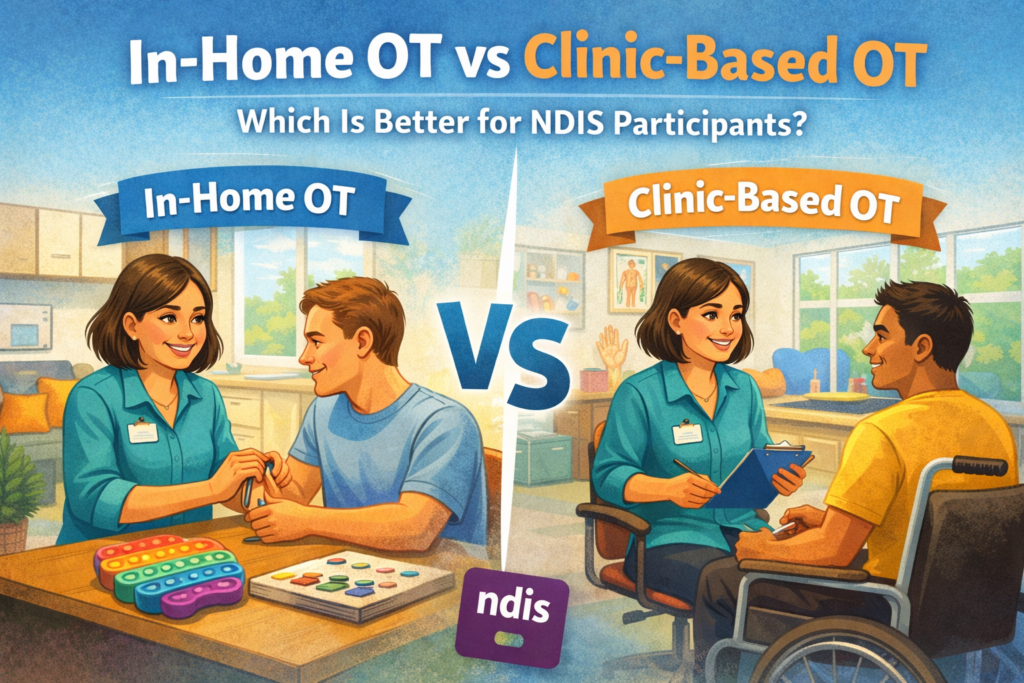
What In-Home and Clinic-Based OT Actually Look Like
Before comparing the two, it helps to understand what each involves in practice.
🏠 In-Home OT
The occupational therapist travels to the participant’s home — and sometimes to their school, workplace, or community setting — to conduct the assessment or deliver therapy.
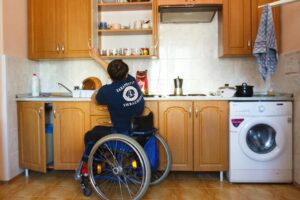
The OT sees: Your actual environment, your actual furniture, your actual kitchen, your actual bathroom — and how you actually navigate and function in those spaces.
🏥 Clinic-Based OT
The participant travels to the OT’s clinic — typically a purpose-built therapy space with standardised equipment, assessment resources, and a controlled environment.
The OT sees: How you perform in a clinical environment that is nothing like your actual home. They observe you in a room they have set up, not the space where your daily challenges occur.
Why Assessment Setting Matters Clinically
For OT therapy sessions, the setting is often a matter of practical preference and therapeutic design. But for OT assessments — the appointments that produce reports for NDIS plans — the setting is a clinical issue, not a logistical one. Here is why.
Clinics are controlled environments; homes are not
An OT clinic is designed for clinical work. The lighting is consistent, the floor is level, the bathroom is accessible, the kitchen surfaces are clear, and the furniture is chosen for easy observation of movement. None of this bears any resemblance to the participant’s actual home — which may have narrow doorways, cluttered hallways, a particular bathroom layout, specific kitchen hazards, or sensory features (noise, lighting, smell) that profoundly affect daily functioning.
When the NDIA reads a Functional Capacity Assessment and funds supports based on it, they are funding support for life at home — not performance in a clinic. An assessment conducted in a clinic cannot tell the NDIA how the participant manages their actual bathroom, negotiates their actual staircase, or deals with the specific sensory demands of their actual kitchen at 7am on a bad day.
Performance in a clinic differs from performance at home
Research consistently shows that people perform differently in familiar versus unfamiliar environments. For NDIS participants, this effect has specific and consequential implications:
- People with cognitive impairment often perform better in a structured, distraction-free clinical environment than they do in the busy, unpredictable context of their actual home
- People with anxiety perform better in a lower-stimulation environment than in the sensory complexity of their daily life
- People with physical disabilities may find clinic equipment easier to use than their own home equipment — adjusted seating heights, grab rails in the right positions, non-slip flooring
- Children with ASD or sensory processing differences may be significantly more dysregulated in an unfamiliar clinical environment — or alternatively, perform better in the calm of a clinic than the demands of their typical school day
The net effect is that clinic-based assessment often produces either an overly optimistic picture (the participant performs better in the controlled environment than they do at home) or an artificially pessimistic one (the participant is more anxious or dysregulated than usual due to the unfamiliar setting). Neither gives the NDIA an accurate picture of real-world functioning.
The fundamental problem with clinic-based assessment: The NDIA funds supports for daily life at home and in the community. An assessment conducted in a clinic cannot provide direct evidence of what that daily life actually looks like. At best, it extrapolates. At worst, it produces a misleadingly optimistic picture that leads to inadequate funding — and a plan that does not reflect real support needs.
When In-Home OT Is Clearly the Right Choice
For many NDIS OT services — particularly assessment-based ones — in-home delivery is not just preferable. It is clinically necessary. Here are the situations where in-home is the only appropriate option:
Functional Capacity Assessment (FCA)
A comprehensive FCA conducted entirely in a clinic is clinically inadequate for NDIS plan review purposes. The FCA must document how the participant functions in their actual daily environment. This requires the OT to visit the home, observe the participant in context, and assess how disability-related impairments manifest in the real-world setting where funded supports will be delivered. An FCA produced solely from a clinic appointment and a questionnaire is missing its most important clinical data.
Home modification assessment
There is no such thing as a valid home modification assessment without a home visit. The OT must physically visit the property, measure doorways and corridors, assess bathroom access, identify step heights, evaluate turning radii for mobility aids, and document specific access barriers. This assessment cannot be conducted remotely or in a clinic under any circumstances.
SIL assessment
A SIL assessment documents the participant’s support needs across all daily living tasks in their actual home environment. An OT who has not visited the home cannot produce a credible 28-day support schedule because they have no direct knowledge of the specific tasks the participant needs to perform, the specific environment in which they perform them, and the specific barriers that arise in that environment. The NDIA is aware of this and may question SIL assessments not supported by a home visit.
Assistive technology assessment involving mobility
When an OT prescribes a wheelchair, walker, or other mobility aid, the equipment must be appropriate not just clinically but practically — for the actual doorway widths in the participant’s home, the floor surfaces they navigate, the turning space in their kitchen and bathroom, and the gradients they must manage in their daily routine. A trial conducted in a clinic showroom may identify appropriate clinical specifications but cannot confirm that the equipment actually works in the participant’s home. A home trial is essential for complex mobility aid prescription.
Paediatric assessment for school or home participation
For children, assessment in the natural environment — home, childcare, or school — produces far more ecologically valid data than clinic assessment. A child’s actual daily functioning occurs in these settings, and the barriers to participation arise in these environments. OT delivered in the child’s natural environment also allows the OT to observe the actual demands the child faces and to work directly with parents and teachers in the settings where strategies need to be implemented.
When Clinic-Based OT Is Appropriate
Clinic-based OT is not without merit — there are specific circumstances where a clinic setting provides genuine clinical advantages. The key is knowing which those are.
Standardised assessment requiring specialist equipment
Some standardised assessment tools require specific materials, equipment, or standardised conditions that are difficult to replicate in a home setting. Fine motor assessments using precise timing tools, perceptual assessments requiring standardised visual stimuli, and certain cognitive assessments involving specific materials are more reliably administered in a clinic where conditions are controlled. For these specific components, clinic administration is appropriate — ideally as part of an assessment that also includes a home visit.
Specialist sensory integration therapy
Sensory Integration Therapy (as developed by Dr Jean Ayres and requiring specific postgraduate certification) is typically delivered in a purpose-built sensory gym with suspended equipment, climbing structures, and a range of sensory materials that cannot be replicated in a home setting. For participants whose OT program includes formal Sensory Integration Therapy, clinic delivery is clinically appropriate and necessary.
Hydrotherapy
OT-delivered hydrotherapy requires a therapeutic pool — clearly a clinic-based service by nature. For participants with conditions where aquatic therapy is indicated, this is an appropriate exception to the general preference for in-home or community-based OT.
Hand therapy and upper limb rehabilitation
Post-surgical hand therapy and upper limb rehabilitation often involve specialist equipment — paraffin baths, traction devices, specific resistance equipment — that is more efficiently delivered in a clinic setting. While some elements of upper limb therapy can be delivered at home, the more specialised technical components are appropriately clinic-based.
Group therapy programs
OT-delivered group programs — social skills groups, life skills groups, fine motor groups — are by definition clinic or community centre-based, as they bring multiple participants together. Group therapy is a legitimate and cost-effective use of IDL budget and is appropriately delivered in a shared venue.
In-Home vs Clinic for Ongoing Therapy
For ongoing individual OT therapy — rather than assessments — the setting question is more nuanced. Both in-home and clinic-based delivery can be clinically appropriate for ongoing therapy, and the best choice depends on the participant’s goals, their condition, and what the therapy is working toward.
| Therapy goal | Better setting | Why |
|---|---|---|
| Daily living skill building (cooking, self-care, cleaning) | In-home | Skills must be practised in the environment where they will be applied; generalisation from clinic to home is not automatic |
| Fatigue management for neurological conditions | In-home | Fatigue must be managed in the actual daily context — activity scheduling, rest placement, energy budgeting across real tasks |
| Home safety and fall prevention | In-home | Safety strategies and environmental modifications are home-specific; cannot be meaningfully addressed in a clinic |
| Sensory integration therapy (formal Ayres-based) | Clinic (sensory gym) | Requires specialist suspended equipment that cannot be installed in a home |
| Fine motor skill-building (paediatric) | Either, with home follow-through | Clinic has specialist equipment; home practice consolidates gains. Best results combine clinic sessions with structured home activities |
| Community access skills (transport, shopping) | Community (in-vivo) | Must be practised in real community environments — OT accompanies participant in the community to build real-world capacity |
| Upper limb rehabilitation (post-stroke or neurological) | Either, depending on phase | Early phases benefit from specialist clinic equipment; functional application phases benefit from in-home delivery to embed gains into daily tasks |
For many participants, the most effective therapy program combines both — clinic-based sessions for components requiring specialist equipment, and in-home delivery for components that need to be embedded in daily life. Ask your OT whether a combined approach is available and appropriate for your goals.
NDIS Plan Implications — Cost, Credibility, and Reporting
Does in-home OT cost more?
In-home OT may include a travel component that clinic-based OT does not — the OT’s travel time to and from your location is billable at up to 50% of the hourly rate, plus mileage costs. For participants living close to the OT’s base, this may add $50–$150 to the cost of an assessment. For participants in regional areas, travel costs can be more significant.
That said, the additional cost of in-home assessment should be weighed against its clinical value. An in-home FCA that produces a credible, specific report is far more likely to secure adequate NDIS funding than a clinic-based assessment that produces a vague or optimistic report. The travel cost of an in-home assessment is typically a small fraction of the additional annual support funding that a well-evidenced plan review can secure.
Does the NDIA care whether the assessment was conducted at home?
Yes — and increasingly so. NDIA planners are aware of the limitations of clinic-based assessments, and a well-written in-home assessment report carries more credibility because it contains direct observational evidence from the environment where supports will be delivered. An OT report that notes “the assessment was conducted in the participant’s home and included direct observation of [specific tasks]” provides more clinically specific evidence than one conducted in a clinic with no reference to the real environment.
Can a clinic-based assessment be supplemented with a home visit?
Yes — and for some providers, this is the standard approach. The initial assessment interview and standardised tool administration occurs in the clinic; the home visit occurs separately to observe the participant in their actual environment and complete the environmental components of the assessment. This combined approach is more thorough than either alone, though it does increase the total OT time billed from IDL.
Regional and Remote Participants — Particular Considerations
For NDIS participants in regional and remote areas — including across the Northern Territory, regional Western Australia, Queensland, and rural Victoria — the in-home vs clinic question is framed differently. In many locations, there is no local OT clinic to attend, and the choice is between an in-home or community-based local OT (if one exists) versus travelling significant distances for clinic-based services.
Fly-in fly-out (FIFO) OT services
In areas where local OT provision is limited or absent, some providers offer FIFO assessment services — an OT travels to the participant’s community to conduct the assessment. This is often the only way to access an in-home assessment for participants in remote communities, and it is fundable from IDL with travel costs billed appropriately. When comparing FIFO OT with telehealth, FIFO is clinically superior for assessment purposes — particularly for home modification, SIL, and FCA purposes — because the OT can observe the participant in context.
Telehealth as a supplement, not a replacement
Telehealth OT (delivered via video call) has expanded significantly and is fundable from IDL at the same rate as in-person delivery. For regional and remote participants who cannot access in-home services, telehealth can be a valuable option for some assessment components (interview, standardised self-report tools, carer-completed questionnaires) and for ongoing therapy that does not require physical presence. However, it cannot substitute for an in-home visit where the assessment purpose requires direct environmental observation. See the telehealth section below for more detail.
What About Telehealth OT?
Telehealth occupational therapy — delivered via video call platforms — became substantially more prevalent after 2020 and is now a permanent feature of NDIS OT service delivery. It is funded from Capacity Building — Improved Daily Living at the same hourly rate as in-person services.
What telehealth OT can do well
- Initial intake and background interviews
- Administering self-report and carer-completed standardised questionnaires
- Providing coaching and strategy sessions to participants and carers who are comfortable with video technology
- Follow-up sessions where the OT checks in on progress and adjusts home programs
- Consultation with teachers or support workers about implementing OT strategies
- Providing services between in-person visits, reducing the frequency of home visits needed
What telehealth OT cannot adequately replace
- Home modification assessment — the OT must physically see and measure the home
- In-person observation of the participant performing daily tasks in their actual environment
- Hands-on assessment of mobility, balance, or physical function
- Complex AT trial and prescription — particularly for powered mobility and seating systems
- Direct, hands-on therapy techniques — splinting, manual handling training, physical guiding
Hybrid delivery is often the most effective and efficient model. A combination of in-home visits for the components that require direct environmental observation, and telehealth or clinic sessions for the components that do not, gives you the clinical quality of in-home assessment alongside the efficiency and lower travel cost of remote or clinic-based contact where appropriate. Ask your OT whether a hybrid delivery model is available.
NDIS Registered — WA · NT · QLD · VIC
TEAH delivers in-home OT across Darwin, Perth, Brisbane and Victoria
Our OTs come to you — conducting assessments and therapy in your home, school, or community setting. In-home FCA, home modification assessment, AT assessment, and SIL assessment, all delivered where it matters.
Frequently Asked Questions
Will an in-home OT assessment cost more than a clinic assessment?
Potentially — in-home assessments typically include travel costs (mileage and potentially travel time billed at up to 50% of the OT hourly rate). For participants close to the OT’s base, this may add $50–$150. For regional participants, more. These costs are drawn from your Improved Daily Living budget. They should be disclosed upfront in the service agreement — not as a surprise on the invoice. The additional cost is almost always justified by the superior clinical evidence an in-home assessment produces.
Can the NDIA reject an OT assessment report because it was clinic-based?
Not automatically — but for specific assessment types (particularly home modification assessments and SIL assessments), a report without documented home visit evidence is likely to attract scrutiny or a request for further information. The NDIA may also give less weight to a functional capacity assessment that was conducted entirely in a clinic, particularly for participants whose disability affects their functioning in the home environment specifically.
My child gets very anxious in clinics. Is in-home OT better for them?
For a child with significant anxiety in unfamiliar settings, in-home or school-based OT is almost always clinically superior. The child is more regulated, more accessible to the OT’s interventions, and more accurately assessed in a familiar environment. A clinic assessment of a child who is acutely anxious may significantly underestimate their functional capacity by capturing distress-related performance rather than disability-related limitations. Alert the intake team to your child’s anxiety so they can plan appropriately.
I live in a remote area and there are no local OTs. What are my options?
Several options are available. FIFO OT services — where an OT travels to your community — are available from some providers and are fully fundable from IDL with appropriate travel costs. Telehealth OT can be used for assessment components that do not require physical presence, supplemented by a FIFO home visit for the components that do. Contact TEAH to discuss what is available in your specific location — we operate across regional NT, WA, QLD, and Victoria.
Can ongoing OT therapy be delivered at home even if my assessment was done in a clinic?
Yes — the setting of the initial assessment does not determine the setting of subsequent therapy. You can request in-home delivery of ongoing therapy regardless of where the assessment was conducted. In fact, if your initial assessment was clinic-based and your ongoing therapy goals involve daily living skills at home, requesting in-home therapy delivery is often the best way to ensure the clinical value of the therapy is maximised.
Does TEAH offer in-home OT assessments?
Yes — in-home assessment is TEAH’s standard approach for FCA, home modification assessment, SIL assessment, and AT assessment involving mobility. Our OTs travel to participants’ homes across Darwin (NT), Perth (WA), Brisbane (QLD), and Victoria. Where a home visit is not feasible for a specific component, we discuss a hybrid approach that preserves in-home delivery for the elements that require it. Contact us on 1300 203 059 to discuss your situation.
Summary
For OT assessments — particularly FCAs, home modification assessments, SIL assessments, and complex AT assessments — in-home delivery is clinically superior and, for most of these assessment types, clinically necessary. A report produced without a home visit cannot accurately capture how a participant functions in the actual environment where funded supports will be delivered.
For ongoing therapy, the right setting depends on what the therapy is working toward. Daily living skills, fatigue management, home safety, and community access all benefit from in-home or community-based delivery. Specialist equipment-dependent therapy (sensory integration, some fine motor work) and group programs may be appropriately delivered in a clinic. A hybrid approach — combining in-home and clinic or telehealth components — is often the most effective and efficient model.
TEAH’s standard approach is in-home — our OTs come to you across Darwin, Perth, Brisbane, and Victoria — because that is where the best clinical evidence is produced and where the most meaningful therapy is delivered.
In-home OT with TEAH — we come to you
Darwin (NT) · Perth (WA) · Brisbane (QLD) · Victoria
Related articles
TEAH Allied Health Team
Top End Allied Health (TEAH) is an NDIS-registered allied health provider delivering occupational therapy, speech pathology, physiotherapy, and supported accommodation across WA, NT, QLD, and Victoria. Referrals: referrals@topendalliedhealth.com.au | 1300 203 059